
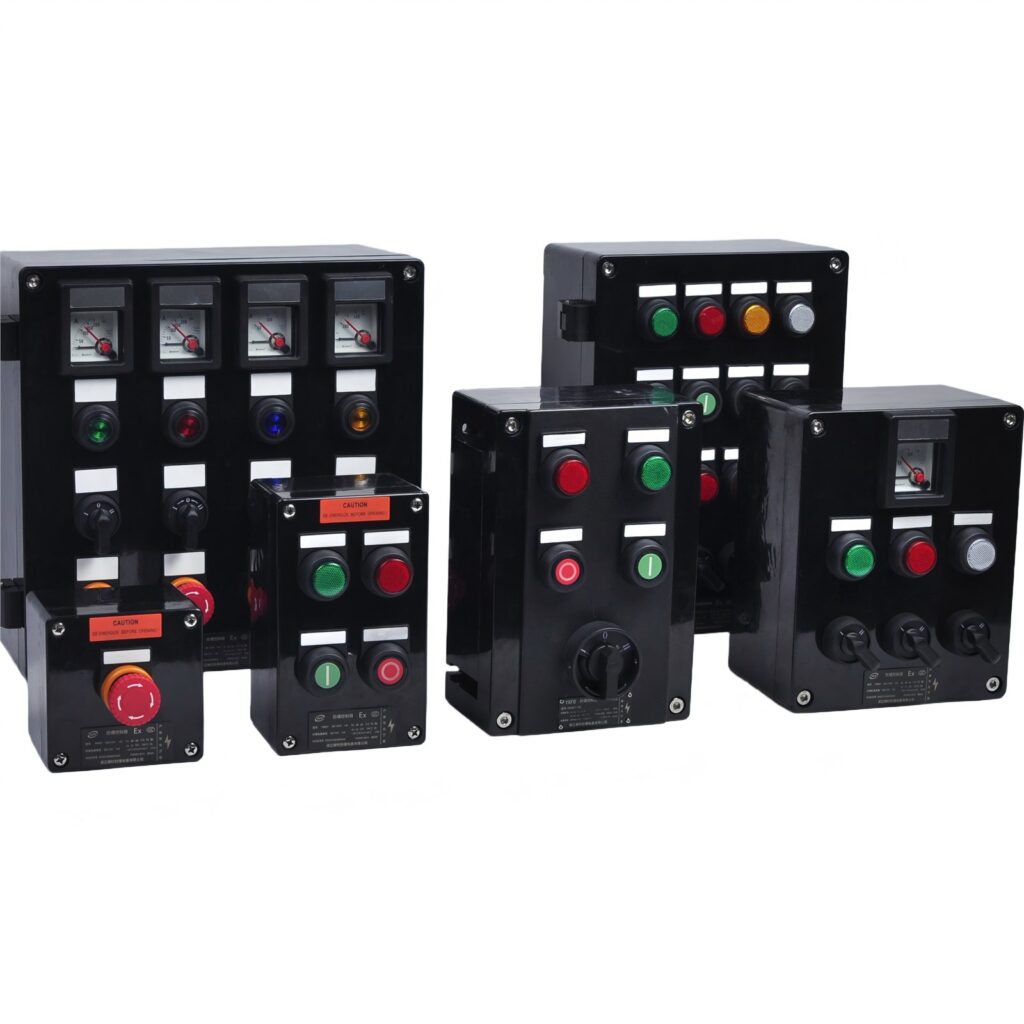
These answers are written for procurement teams, distributors, engineers and project personnel preparing an initial enquiry. They are not a substitute for a hazardous-area assessment or competent engineering approval.
1. What does “explosion-proof electrical equipment” mean?
It does not mean equipment that can never be involved in an explosion.In international purchasing, “explosion-proof” is often used as a broad commercial term for equipment designed with a recognised type of protection for explosive atmospheres.
The exact technical meaning depends on the marking and protection concept—for example, flameproof enclosure “d,” increased safety “e” or intrinsic safety “i.” Always evaluate the full marking and documentation, not the phrase “explosion-proof” alone.
2. What is a hazardous area?
A hazardous area is a location where an explosive atmosphere may occur in a quantity that requires special precautions. The atmosphere may involve flammable gas, vapour, mist or combustible dust mixed with air.
The area classification is based on the nature, frequency and duration of the hazard. It should be produced by competent persons using process and substance information. Equipment suppliers should not guess a site’s zone from a short application description.
3. What is the difference between Zones 0, 1 and 2?
For gas, vapour or mist hazards:
- Zone 0:an explosive atmosphere is present continuously, for long periods or frequently.
- Zone 1:an explosive atmosphere is likely to occur occasionally in normal operation.
- Zone 2:it is not likely in normal operation and, if it occurs, persists only briefly.
Combustible-dust areas use Zones 20, 21 and 22. The official EU framework appears inDirective 1999/92/EC.
4. Does a Zone 1 classification tell me exactly which product to buy?
No.Zone is only one part of equipment selection. Buyers also need the required EPL or category, gas group, temperature class, ambient range, type of protection, electrical ratings, environmental conditions, cable arrangement and applicable market approval.
A product described as “Zone 1 suitable” can still be unsuitable for the gas group, temperature, cable system or destination-country rules.
5. What is the difference between ATEX and IECEx?
ATEX is the European Union framework covering equipment and protective systems intended for potentially explosive atmospheres. IECEx is an international certification system based on IEC standards.
They address related hazards but have different legal and certification structures. One does not automatically replace the other. See theIECEx official guidanceandEuropean Commission ATEX overview.
6. Is an IP rating the same as explosion protection?
No.An IP rating classifies the enclosure’s protection against access, solid objects and water under IEC 60529. Explosion protection addresses ignition hazards in explosive atmospheres.
A high IP code does not make an ordinary enclosure suitable for a hazardous area. Conversely, Ex equipment still needs an IP rating and environmental suitability appropriate to its installation.
7. What is the difference between Ex d and Ex e?
Ex dis the flameproof-enclosure protection concept. The enclosure is designed to withstand an internal explosion and control flame transmission through specified joints.
Ex eis increased safety. It uses measures intended to provide increased security against excessive temperatures and the occurrence of arcs or sparks in service covered by the protection concept.
Their construction and installation rules differ. Neither should be selected solely because it appears stronger or less expensive.
8. Why do gas group, temperature class and ambient range matter?
The gas group relates to characteristics of the explosive gas or vapour and the level of equipment design required. Temperature class limits the equipment’s maximum surface temperature under specified conditions.
Ambient range matters because certification and temperature performance apply only within stated limits. Direct sun, process heat, cold weather and internal heat loads can put an installation outside the documented range.
9. Are non-metallic enclosures suitable for hazardous areas?
They can be, when the complete product is designed, assessed, marked and documented for the intended use. GRP and polycarbonate can offer advantages such as corrosion resistance and lower weight.
Selection must still consider UV exposure, chemical compatibility, impact, temperature, electrostatic precautions, cable entries and bonding of metallic parts. “Non-metallic” or “corrosion resistant” is not an Ex approval by itself.
10. Why are cable glands and stopping plugs critical?
Cable entries form part of the equipment’s protection system. The gland must match the cable construction and diameter, enclosure thread, type of protection, environmental requirement and applicable certificate.
Unused entries need suitable stopping elements. Unapproved glands, mismatched threads, excessive adapters or field-drilled holes can compromise protection even when the main enclosure was correctly assessed.
11. What documents should I request before ordering?
Request documents for the exact model and configuration, including:
- Datasheet and dimensional drawing
- Complete Ex marking
- Applicable certificate or declaration
- Certificate schedule and conditions of use
- Installation and maintenance instructions
- Terminal and cable-entry schedule
- Configured bill of materials where relevant
- Current revision and traceability information
Verify certificate numbers through the issuing scheme’s official system. Do not accept a certificate for a similar-looking model as evidence for the ordered product.
12. Are MMAIATEX products already ATEX, IECEx or CCC certified?
Do not assume so.The current MMAIATEX About page describes ATEX, IECEx and CCC certification asin progress. A category page, product photograph or general company statement is not proof of certification.
Ask MMAIATEX for the present status and product-level documents for the exact model, configuration and destination market. Selection, installation and inspection should then be approved by competent hazardous-area professionals under local requirements.
Send a complete technical enquiry
Send your destination country, zone, hazard, gas or dust group, temperature, ambient range, cable schedule and required documents through theMMAIATEX contact page. A detailed request allows a more accurate model-level response.
Safety notice:This FAQ provides general information only. It does not classify a hazardous area, approve a product, interpret a certificate for a specific project or replace manufacturer instructions. Use qualified personnel and the current applicable regulations and standards for all safety decisions.