
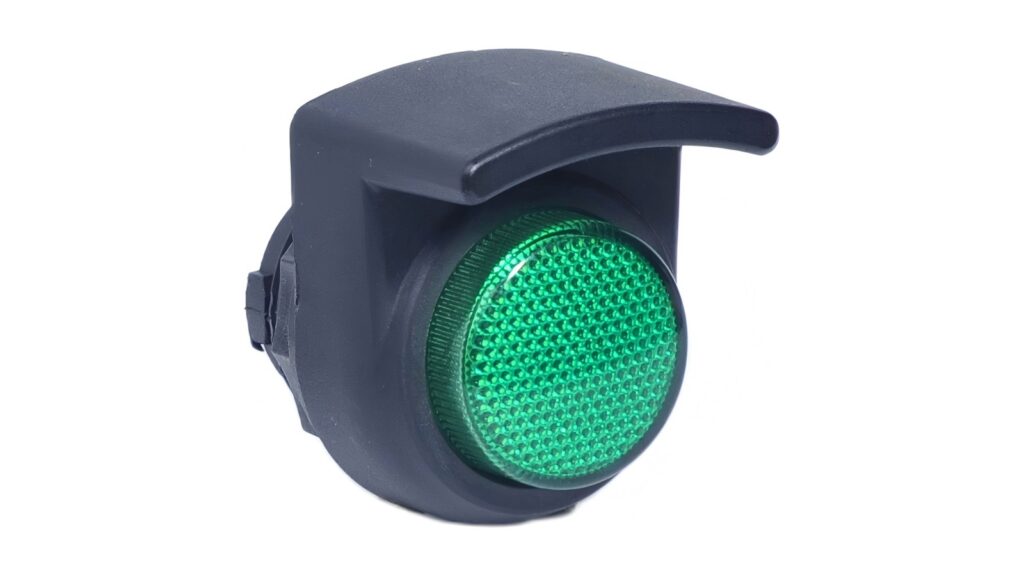
Image note: The representative photograph shows a green covered indicator component, not a material specimen or measurement. Its housing appearance establishes no material grade, insulation rating, CTI or PTI. Verify exact model marking, certificate scope and current documentation.
CTI vs PTI: identify the claim being offered
Before comparing numbers, ask which question the submitted record answers. A material-selection comparison and a statement about meeting an identified acceptance criterion are not interchangeable purchasing decisions. Keep the original index label visible instead of shortening both to "tracking rating."
This editorial comparison helps route the evidence. It is not a test specification or a standard-mandated acceptance form.
| Statement received | Question it can help address | Unresolved purchasing point |
|---|---|---|
| CTI entry | Material characterization or comparison | Which identified material does the entry describe? |
| PTI entry | Acceptance or quality-control criterion | What criterion and subject does the record identify? |
| Material-grade document | Information about the named grade | How is that grade connected to the offered part? |
| Finished-component statement | Information about the named component | What supporting record and limitations apply? |
A useful clarification can therefore begin before any numerical ranking: "These two attachments describe different claims. Which one addresses the enquiry?" That is a narrower conclusion than declaring either product acceptable or unacceptable.
What the current public IEC source actually establishes
The IEC 60112:2025 catalogue record identifies Edition 6.0, published June 23, 2025, with the February 2026 corrigendum incorporated. Its public scope concerns testing solid insulating materials, including material plaques and pieces taken from equipment parts. It notes that composition and surface condition influence results and that the results do not directly determine safe creepage distances.
These are limited statements from the public scope. This guide does not reproduce the test procedure, set a passing index, assign a material group or prescribe a required distance. The edition shown today also does not establish which edition appears on an existing supplier record. Record that document's actual reference rather than silently updating its heading.
Follow the material reference into the offered part
Start with the subject named on the submitted record. Is it a named material grade, a specimen identifier, a fabricated part or an assembled component? Preserve that wording. If the attachment does not identify its subject, ask the issuer to clarify it before attaching the result to a quotation line.
Next, locate the proposed part in the offer. A housing, insert and operating-head assembly can appear together in one commercial description. The purchaser should ask which particular part the material statement concerns, rather than assigning it to every insulating piece in the assembly.
Then ask how the supplier connects the two identities. A reference in controlled product documentation can be reviewed; a shared colour or similar photograph cannot establish the relationship. The buyer need not invent a new material specification. The immediate task is to make any missing connection explicit for the responsible technical reviewer.
The listed control modules and operating heads provide product-family context for an enquiry. Their listings do not identify a verified tracking index for every visible housing or internal part. Use the exact offered reference when discussing a material record.
Resolve unlike statements before ranking offers
Consider a hypothetical comparison. Offer A includes a CTI statement for a named material grade. Offer B provides a PTI acceptance statement for an identified fabricated part. Entering both figures into one column headed "better insulation" would erase both the claim type and the subject being described.
The useful output is not a winner. It is two bounded follow-ups: establish which requested claim each attachment addresses, and connect the named subject to the offered item. The project reviewer can then decide whether the evidence is relevant to the actual specification. This example supplies no threshold or conclusion about either offer's safety.
In a second hypothetical case, a revised quotation retains the commercial product name but changes the material reference in an attachment. Carrying forward the earlier comparison without comment would conceal a change. Identify the altered reference, ask which existing statements remain applicable, and keep the prior decision separate from the revised proposal until the responsible reviewer resolves it.
An incomplete reply is not automatically a failed test. Equally, a positive-looking material statement is not automatic acceptance of the assembled equipment. Maintaining that distinction keeps a purchasing clarification from becoming an unsupported engineering conclusion.
Keep material evidence separate from geometry and voltage
The creepage versus clearance guide explains how to identify a geometric path. Today's material-index question does not replace that path question. The public IEC 60664-1 consolidated record, Edition 3.1 of May 6, 2025, addresses insulation coordination, including clearances, creepage distances and solid insulation within its scope.
Likewise, the Ue, Ui and Uimp guide concerns labelled equipment-voltage statements. Do not move a tracking-index entry into one of those fields because the documents use related electrical terminology. Give the reviewer the original headings and their respective subjects.
Current MMAIATEX certification status
The MMAIATEX About page describes ATEX, IECEx and CCC certification as in progress. This is an attributed company statement, not independent verification of a model certificate. MMAIATEX Explosion-proof Technology (Zhejiang) Co., Ltd. makes no model-specific tracking-index or material-approval claim through this article.
IEC 60079-0:2026, Edition 8.0, separately addresses general Ex construction, testing and marking. A material record or a reference to that standard does not verify the complete offered configuration.
Safety and legal disclaimer
This is purchasing guidance, not material qualification, insulation design, testing or permission to substitute parts. It provides no acceptable index, operating limit or spacing. Competent parties must assess the actual equipment, controlled manufacturer evidence and applicable requirements. Do not open, modify or test equipment using this guide.
Contact MMAIATEX
For a component enquiry, include the offered reference, the particular housing or part concerned, and the CTI or PTI statement with its original subject and document heading. Identify the specific relationship that needs clarification.