
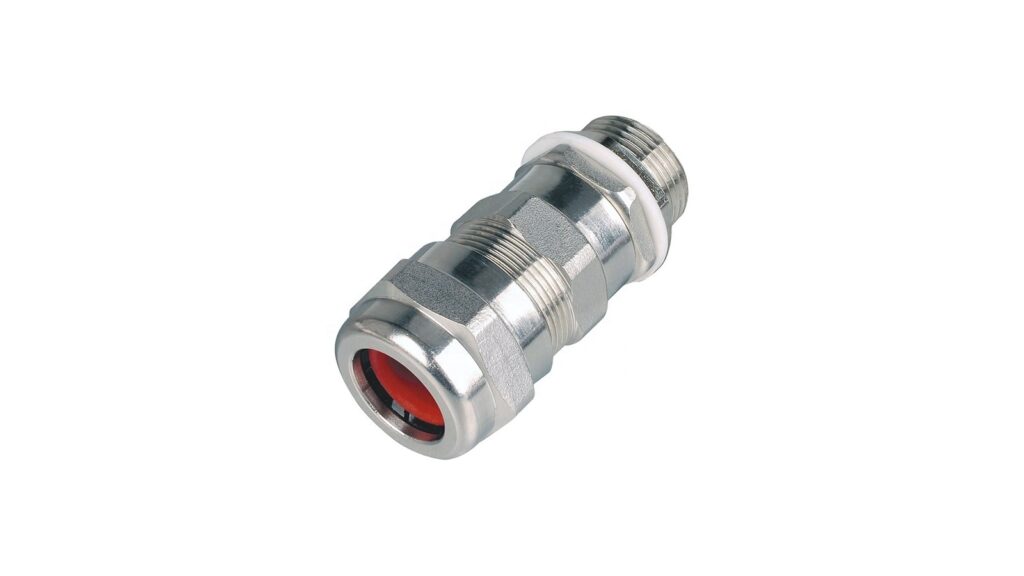
1. What makes a cable gland suitable for an explosive atmosphere?
A suitable gland is designed, assessed, marked and documented for the intended Ex protection and installation.
It can retain and seal the cable while maintaining enclosure ingress and explosion protection. The phrase "industrial cable gland" does not establish hazardous-area suitability. Review the exact marking, documents, sealing range, entry thread and instructions.
The MMAIATEXflexible conduit and cable gland categorycan support product discovery, but a category page is not proof that every listed model has a particular certification.
2. Is an IP68 cable gland automatically explosion protected?
No. IP and Ex protection address different requirements.
An IP code addresses access, solids and water. Ex protection addresses ignition in an explosive atmosphere.
An ordinary IP68 gland cannot replace a required Ex cable-entry device. The installed enclosure and gland assembly must also achieve the project's environmental requirement.
3. Can the same gland be used with Ex d and Ex e equipment?
Only if the exact marking, documents and instructions cover both.Ex denclosures control an internal explosion and flame transmission.Ex eequipment applies measures intended to prevent arcs, sparks and excessive temperatures. Confirm multiple protection claims from the exact model and documents, not appearance.
For enclosure-level factors, review theZone 1 junction box selection checklist.
4. Can one gland be used for both gas and dust applications?
Only when its marking and documents cover the required protection and equipment group. A gas marking does not establish dust suitability. Dust can add requirements for enclosure protection, surface temperature and accumulation. Gas requires the correct subgroup and protection concept.
If both hazards are present, the complete installation requires a specific assessment. Do not combine separate gas and dust claims by assumption.
5. How do I match cable diameter and entry thread?
Treat them as separate dimensions.
The actual finished cable outside diameter must fall within the gland's documented sealing range. Do not select only from conductor size or a nominal cable description.
The entry thread must match the enclosure in form, size and pitch. Correct engagement and sealing also matter. A cable that fits the seal does not prove that the gland fits the enclosure.
Do not force mismatched threads or attempt to correct them with tape.
6. What changes when the cable is armoured?
The gland must match the actual armour construction and dimensions, including wire armour, braid or another documented design.
Check armour range, clamping, bonding, earthing, corrosion and cable support. A metallic gland is not automatically suitable for every armoured cable.
For unarmoured cable, confirm the required retention and sealing. Supply the cable manufacturer's datasheet with the enquiry.
7. When is a barrier gland required?
A barrier gland is not required for every hazardous-area entry, but it should not be omitted merely because a compression gland is easier to install.
The decision can depend on:
- Enclosure protection concept
- Cable construction and potential internal gaps
- Installation arrangement
- Certificate and manufacturer instructions
- Applicable edition of the installation standard
- Local project and regulatory requirements
A barrier seal commonly controls a path around individual insulated conductors. IEC guidance distinguishes flame transmission from process gas or liquid migration. Addressing one does not automatically resolve the other.
8. Can I use an adapter or reducer?
Only when it is documented for the protection concept and permitted by the enclosure instructions.
Verify both threads, Ex marking, material, environmental sealing and mechanical security. Generic plumbing fittings are not acceptable substitutes.
Avoid unnecessary chains of adapters. Each additional interface creates another opportunity for mismatched threads, insufficient engagement, movement or sealing error.
9. What should close an unused cable entry?
Use a suitable stopping plug or blanking element that matches the entry thread, protection concept, equipment group, environmental requirement and documents.
Do not use ordinary bolts, improvised caps, adhesive, tape or sealant alone. Install the closing element according to its instructions and record unused entries during initial inspection.
10. Which gland material should I choose?
Choose material from the real environment, not appearance. Consider corrosion, salt, chemicals, UV, impact, temperature, earthing and galvanic interaction. Brass, stainless steel and non-metallic constructions have different limitations.
A general description such as "corrosion resistant" does not prove compatibility with every chemical. Request a material review when exposure is significant.
11. How is the required IP rating maintained after installation?
Follow the gland and enclosure instructions. Check any required washer or O-ring, entry condition, thread engagement, tightening method, cable range, support, bend radius and seal condition. Over-tightening can damage parts, while under-tightening can permit movement or water entry. The IP rating applies to the assembled system, not an uninstalled gland.
12. What information and documents should I request before ordering?
Provide the destination country, gas or dust application, zone, EPL or category, protection concept, subgroup, temperature, ambient range, cable type, outside diameter, armour dimensions, entry thread, IP level and environmental exposure.
Request the current datasheet, marking, certificate or declaration, cable range and instructions. Include adapters, stopping plugs and accessories in the review.
Current MMAIATEX certification status
MMAIATEX currently states that itsATEX, IECEx and CCC certification work is in progress.
Website listings do not establish ATEX, IECEx or CCC certification for a specific gland. Request current documents for the exact thread, cable range and market.
Call to action
Send the cable datasheet, enclosure marking, thread details and project requirements through theMMAIATEX contact page. Do not order from a photograph or nominal thread description alone.
Safety notice
This FAQ is general information. Cable-gland selection and installation must be completed or approved by competent persons using applicable standards, certificates, enclosure documents, cable data, instructions and local regulations.