
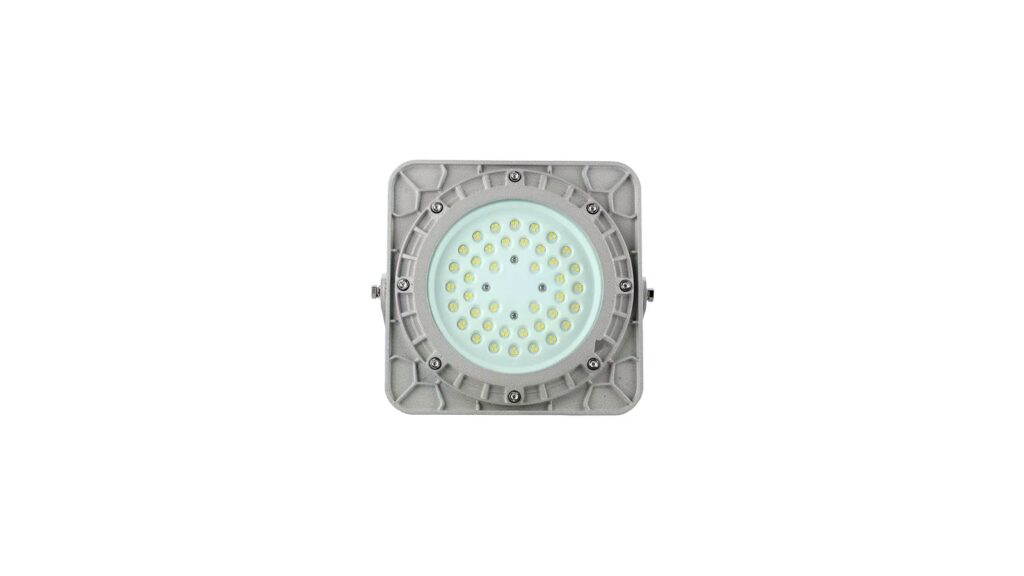
Image note: This representative website product photograph does not establish an emergency-lighting function, battery arrangement or certified configuration. Verify the exact model marking, certificate scope and current documentation.
Explosion-proof emergency lighting: define the buying question
These questions concern procurement evidence, not emergency-system design. For general fixture selection, see the explosion-proof LED lighting guide. Here, the important distinction is between a light that has an emergency function and an ordinary fixture described in a quotation that also mentions backup power. Ask the supplier to identify exactly what the offer includes before comparing its price or performance.
1. What should the purchase description identify first?
Identify the complete luminaire reference and its emergency option, not just the family name. Ask which parts of the emergency power arrangement are included, which are supplied separately and which remain the project's responsibility. Record the intended location and required function. This creates a common description for the quotation, equipment documents and the responsible designer's review, without assuming that every variant in a product family is interchangeable.
2. Which IEC reference addresses emergency luminaires?
The IEC catalogue lists IEC 60598-2-22:2021, Edition 5.0, published on December 6, 2021, for luminaires used for emergency lighting. Ask which requirements and edition the supplier's evidence actually addresses. Naming this standard in an enquiry is not proof of conformity. Its public catalogue description does not provide a complete design specification, test procedure or approval for a particular hazardous location.
3. Does emergency-lighting compliance replace Ex evidence?
No. The scopes are different. IEC 60079-0:2026, Edition 8.0, concerns general construction, testing and marking requirements for Ex equipment and components. Ask for the exact product's relevant explosion-protection documentation as well as its emergency-function evidence. Neither a general luminaire report nor a statement about a battery identifies the protection scope of the complete offered assembly.
4. Can I assume the emergency and standard variants are identical?
No. Ask for the configuration reference that distinguishes the versions and for the documents covering the offered one. An enclosure photograph or shared housing name is insufficient. If a quotation adds an emergency kit, ask who is responsible for the resulting configuration and which documentation covers it. Do not approve a substitution merely because its dimensions or normal power rating resemble those of an already reviewed fixture.
5. What should I ask about the power arrangement?
Ask where the emergency energy source is located, what equipment the supply includes, and which interfaces the project must provide. Have the supplier explain how the documented arrangement relates to the proposed model. This is an information request, not a recommendation to put a battery in a particular location. The responsible designer must assess the entire arrangement, including any separately supplied equipment and its installation environment.
6. Is normal-operation light output enough for the emergency review?
No. Request evidence that explicitly identifies emergency operation and the conditions behind the stated performance. The normal operating value should not silently become the emergency design input. Ask the lighting designer which information is needed for the actual emergency task. The separate photometric data FAQ explains how to connect calculation data to a documented configuration, but does not set emergency acceptance criteria.
7. What duration should I put in the enquiry?
Use the requirement established for your site and applicable jurisdiction by the responsible professional. Do not copy a duration from an unrelated product listing. Ask the supplier to identify the supporting evidence, operating conditions and configuration for any duration claim. This FAQ gives no universal duration, illumination target or spacing rule; those values depend on the project's emergency-lighting design and applicable requirements.
8. Does the stated ambient range cover the emergency function?
Ask explicitly. Request documentation identifying the conditions for normal operation, emergency operation and any charging or energy-storage function in the offered arrangement. Do not infer that one number in a catalogue applies to every operating state. Keep this question separate from temperature-class selection, which is explained in the temperature class and ambient temperature guide. Resolve unclear boundaries before design approval.
9. Which maintenance documents should accompany the equipment?
Request the manufacturer's instructions for the exact configuration, including the permitted inspection, maintenance and replacement arrangements. Identify who will maintain the emergency function and how the relevant records will be retained. HSE's guidance on explosive atmospheres stresses inspection, maintenance and competent personnel. This does not justify opening, modifying or testing a fixture using a generic online procedure.
10. Can a replacement battery or module be chosen by dimensions alone?
No. Ask for the manufacturer's documented replacement identity and any restrictions applying to the complete luminaire. Physical fit, connector appearance or a similar nominal rating does not establish equivalence. If the specified part is unavailable, refer the issue to the manufacturer and a competent reviewer. This article does not authorise a battery substitution, internal modification or field repair, and provides no replacement procedure.
11. What should stop purchasing approval?
Leave the technical decision open if the emergency option cannot be tied to an exact model, the documentation covers a different version, or the claimed performance lacks stated conditions. Record the specific missing item and who must resolve it. A commercial delivery date does not close a technical evidence gap. Treat an unanswered emergency-function question separately from any unresolved explosion-protection requirement so neither disappears in a combined approval.
12. Does this guide confirm an MMAIATEX emergency-lighting model?
No. It is an editorial buyer checklist, not a product announcement or model recommendation. The representative photograph does not identify an emergency configuration. Ask MMAIATEX whether a proposed requirement can be supported by exact-model documentation. Product availability, emergency performance and certification scope must be established independently for the offered item; none is confirmed by publication of these questions.
Keep the handoff specific
| Review question | Information to request | Decision boundary |
|---|---|---|
| What is being supplied? | Exact luminaire and emergency-option reference | A family name is not a configuration |
| What happens in emergency operation? | Function and performance evidence with conditions | Normal-operation data is not a substitute |
| What supports hazardous-area use? | Exact marking and applicable product documentation | An emergency claim is not Ex evidence |
| How will it be maintained? | Instructions and authorised replacement references | Physical fit is not an approval |
Current MMAIATEX certification status
MMAIATEX is the public brand of MMAIATEX Explosion-proof Technology (Zhejiang) Co., Ltd. On the review date, the About page describes ATEX, IECEx and CCC certification as in progress. This is an attributed website statement, not independent certificate-register verification. Check exact model marking, certificate scope and current documentation; do not infer that an emergency-lighting configuration is certified or available.
Safety disclaimer
This is general purchasing information, not an emergency-lighting design, legal opinion or installation instruction. A competent professional must determine the applicable requirements and assess the proposed equipment and system. Do not use this article to set testing intervals, wiring arrangements, battery substitutions, duration or illumination thresholds.
Contact MMAIATEX about an emergency-lighting enquiry
Provide the destination market, intended hazardous-area location, required emergency function and proposed configuration reference. Identify the documents your reviewer needs and any unresolved evidence gap. Contact MMAIATEX.