
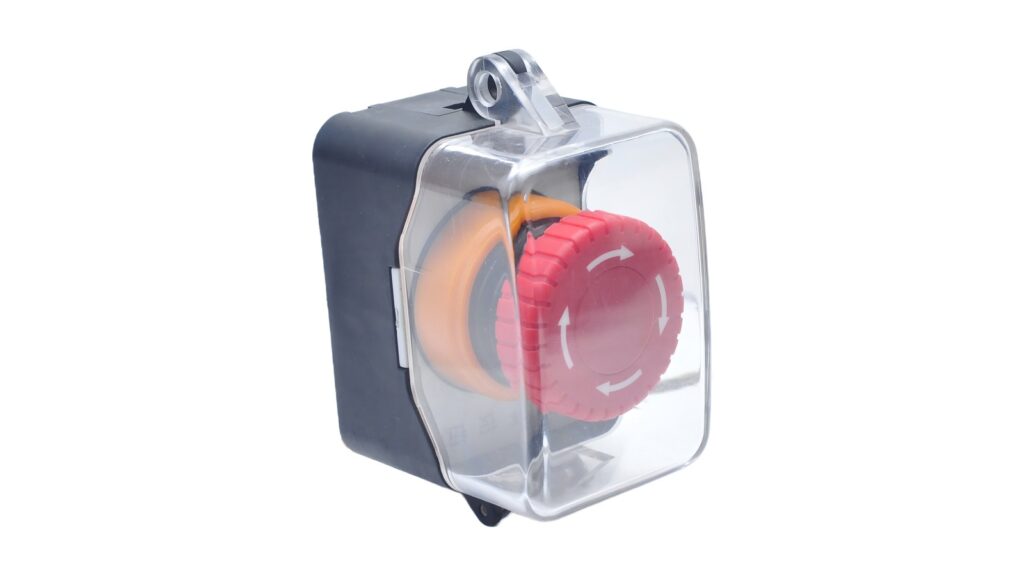
The phrase "explosion-proof emergency stop button" reflects common buyer language. The controlled marking can identify a different specific protection concept. Use the exact certificate and instructions rather than applying the search phrase as a technical approval.
How to specify an explosion-proof emergency stop button
| Evidence layer | What it answers | What it does not prove |
|---|---|---|
| Explosion protection | Whether the exact device or assembly is assessed for the classified atmosphere within stated limits | Emergency stop performance or machine risk reduction |
| Emergency stop device | Whether the device meets the applicable latching-device requirements | Performance of the complete safety-related control system |
| Machinery function | Which hazards must stop and what reset can permit | Hazardous-area conformity |
| Safety-related control system | Whether the architecture achieves and validates required risk reduction | Ex certificate scope |
| Installation and lifecycle | Whether integration, inspection, testing and maintenance are controlled | Permission to modify certified equipment |
1. What is an explosion-proof emergency stop button?
It is an emergency stop control device or completed assembly whose exact hazardous-area suitability is supported by applicable marking, certificate scope and instructions. The emergency stop function remains a separate machinery-safety question. Confirm both layers for the exact model and configuration. A product name or red operator does not establish either layer.
2. Is every red mushroom-head control an emergency stop?
No. Colour and shape support recognition, but appearance does not prove mechanical latching, contact behaviour, safety category, performance level or Ex suitability. Verify the exact model, reset mechanism, contacts, declared device standard, marking, certificate and instructions. A representative photograph must never be used as identity evidence.
3. Must the device mechanically latch?
IEC 60947-5-5:2026 applies to electrical emergency stop devices with a mechanical latching function and expressly excludes devices without that function. If the project specifies this standard, confirm the latching and reset evidence for the offered model. Non-electrical technologies and other applications require their own competent assessment.
4. Can resetting the device restart the machine?
Under the current EU Machinery Directive, disengaging an emergency stop must not restart the machinery. It may only permit a separate restart. The EU Machinery Regulation, which applies from January 20, 2027, retains that boundary. Apply the law and machinery standard current for the destination.
5. Does an emergency stop replace guards or interlocks?
No. EU machinery requirements describe emergency stop as a backup to other safeguarding measures, not a substitute. The machine risk assessment must determine guards, interlocks, protective devices, stopping strategy and residual-risk controls. An accessible button cannot correct an unsafe process design or inadequate safeguarding.
6. Is an emergency stop an energy-isolation device for maintenance?
Not by itself. An OSHA interpretation explains that motor-control stop buttons and starter circuits are not energy-isolating devices for servicing and maintenance. Apply the site's lockout or other hazardous-energy-control procedure independently. Stopping a machine does not prove that electrical, pneumatic, hydraulic or stored energy is isolated.
7. Does an Ex certificate prove the emergency stop safety function?
No. Ex evidence addresses ignition protection within the exact product and certificate scope. It does not select a required performance level or SIL, validate the machine circuit, determine stopping time or prove that every hazardous movement stops. Use the certificate verification guide for the Ex evidence layer.
8. Does IEC 60947-5-5 compliance prove the complete safety circuit?
No. It is device-level evidence. ISO 13849-1:2023 provides a methodology for safety-related parts of control systems, but its public scope says it does not choose the safety function or required performance level for a particular application. Risk assessment, architecture, integration and validation remain necessary.
9. Which hazardous-area data belong in the RFQ?
State the gas or dust area classification, required EPL or category, equipment group and subgroup, temperature class or maximum surface temperature, ambient range, protection concept, environmental conditions and destination conformity route. Request the exact marking and live certificate schedule. The Ex marking guide explains how these fields work together.
10. Which electrical and operator data belong in the RFQ?
State control voltage, contact arrangement, switching duty, required device standard, latching and reset method, terminal and conductor details, panel cut-out or enclosure arrangement, accessibility, label language and circuit diagram. Specify direct-opening or other contact characteristics only where the applicable design standard and risk assessment require them, then request exact-model evidence.
11. Can a certified operator be installed in any enclosure or control station?
No. A component certificate or operator marking does not automatically certify the completed assembly. Enclosure construction, entries, terminals, spacing, wiring, temperature, component limitations and manufacturer instructions can affect the final scope. Compare the panel push-button FAQ and control-station FAQ, and do not drill or substitute without documented approval.
12. What documents and checks are needed before handover?
Obtain the exact model datasheet, certificate and schedule, instructions, wiring diagram, declared device standard, machine risk assessment, safety-function specification, validation record, initial hazardous-area inspection and functional-test procedure. Set testing intervals from the risk, manufacturer instructions and applicable law. There is no universal interval that can be inferred from a photograph or product category.
Current MMAIATEX certification status
The public MMAIATEX About page states that ATEX, IECEx and CCC certification work is in progress. MMAIATEX Explosion-proof Technology (Zhejiang) Co., Ltd. does not present this FAQ, a red operator photograph, a product category or an IP rating as evidence that a particular emergency stop device or complete safety function is certified.
Buyers should verify exact-model marking, current certificate status and scope, schedules, instructions, risk assessment and validation evidence before selection or use.
Safety and legal disclaimer
This FAQ is general buyer education, not a machinery risk assessment, safety-function design, certificate decision, hazardous-area classification, installation approval or legal opinion. A competent machine-safety and hazardous-area team must define, validate, install, inspect and test the actual function under the standards and law applicable to the site.
Request a model-specific document review
Send the destination market, area classification, machine function, required stop behaviour, safety target, control voltage, contacts, enclosure arrangement, exact model and available certificates. MMAIATEX can identify available product records for review by the responsible engineering and EHS team.