
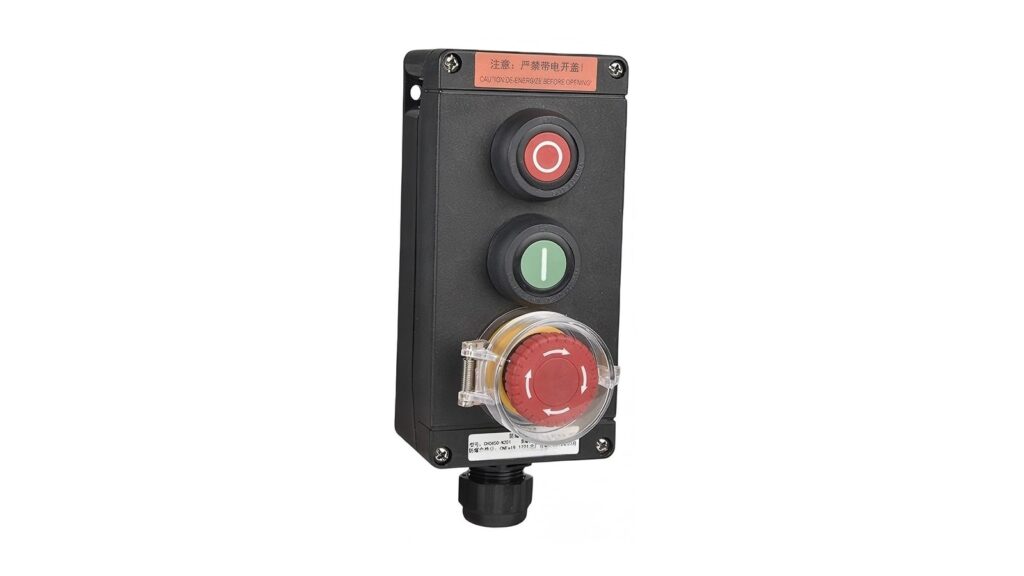
Key information for an explosion proof control station RFQ
Before requesting a quotation, provide the approved Zone, required EPL or ATEX category, gas or dust group, temperature and ambient limits, protection concept, circuit ratings, operator functions, cable-entry plan, material and environmental duty, mounting, destination country and required document route.
IEC TS 60079-46:2017 covers equipment assemblies made from individually certified items and places responsibility for the assembly with its manufacturer. Its public scope also requires assessment of aspects that extend beyond the individual item certificates. IEC 60079-14:2024 addresses installation design, equipment selection, installation and initial inspection. These are related but different stages.
1. What is an explosion-proof control station?
A control station is a completed assembly of an enclosure, operators, contact blocks, terminals, entries and internal wiring. Its hazardous-area suitability depends on the assessed exact assembly, not on any one component alone.
The buyer search term explosion-proof control station is widely used, but explosion-protected control station is more precise in international work. Not every suitable station uses a flameproof enclosure. The complete marking and certificate identify the actual protection concept or combination.
2. Can ordinary push buttons be fitted into an Ex enclosure?
Do not assume so. The operator, mounting interface, seal, contact block and enclosure opening can all affect the protection concept and assessment. A part that is electrically suitable in a non-hazardous panel is not automatically suitable in an Ex assembly.
Use only components, installation methods and configurations permitted by the exact equipment documentation. The panel-mount push button FAQ explains why a component marking does not approve the completed panel.
3. Are separate certificates for the enclosure and operators enough?
No. Separate certificates can provide evidence for individual items, but the completed assembly still needs assessment for interfaces and effects outside those certificates. IEC TS 60079-46 includes design, construction, assembly, testing, inspection, marking, documentation and assessment under the responsibility of the assembly manufacturer.
Check whether each document covers complete Ex Equipment or an Ex Component. A U suffix identifies a component that is not intended for independent use. Read the IECEx X vs U guide before treating a component certificate as a station certificate.
4. Should the station use Ex db or Ex eb?
The answer depends on the function, permitted internal equipment, construction, entries, marking and exact certificate. Ex db and Ex eb can both be associated with EPL Gb, but they use different protection principles and are not interchangeable.
The current final published flameproof enclosure standard remains IEC 60079-1:2014 as of August 29, 2026. A 2026 pre-release version is not yet the final published edition. Increased safety requirements are covered by IEC 60079-7:2015 with Amendment 1:2017. The Ex db vs Ex eb guide gives a buyer-level comparison without choosing a design for a specific project.
5. Which Zone and EPL must be specified?
Use the approved hazardous-area classification and project equipment requirement. A supplier should not infer the Zone from an industry name, photograph or process description. State whether the requirement is Zone 0, 1 or 2 for gas, or Zone 20, 21 or 22 for dust, together with the required EPL or ATEX category.
Zone and EPL are connected but not identical. The EPL guide explains how Ga, Gb, Gc, Da, Db and Dc fit into selection. A higher EPL does not correct a mismatch in group, temperature, ambient or certificate scope.
6. Can one control station be used for gas and dust areas?
Only if the complete marking, certificate and instructions cover the exact gas and dust requirements. Gas group information does not establish dust suitability, and dust group information does not establish gas suitability.
State the identified gas, vapour or combustible dust and the required group. For dust, also provide the required maximum surface temperature and dust-related environmental information. Do not infer dual suitability from enclosure appearance or an IP rating.
7. What temperature information must the buyer provide?
Provide the gas temperature class or dust maximum surface temperature requirement, the site's minimum and maximum ambient temperature, and the electrical load that can affect heating. The station must stay within the marked and documented limits for the exact configuration.
T4 does not mean an enclosure can operate in 135 C ambient air. The temperature class and ambient temperature guide separates these parameters and explains why both must match the project.
8. Which operator and circuit details belong in the RFQ?
List every function and position: start, stop, emergency stop, selector positions, key operation, indicator color, reset, meter or other device. Then state contact arrangement, voltage, frequency, current or load category, terminal requirements, labeling language and any interlock or control logic interface.
Avoid descriptions such as standard start-stop station. They leave the builder to guess the contact state, electrical duty and operator behavior. A clear function schedule supports correct engineering and later inspection.
9. How should cable entries, glands and stopping plugs be defined?
State cable construction, armour or braid, outside diameter, entry thread, entry quantity, preferred entry positions, gland material and environmental sealing requirement. Unused entries need a permitted stopping method.
The gland, adapter, stopping plug and enclosure entry must work with the station's protection concept and documents. The cable gland selection FAQ provides a more detailed RFQ checklist. Do not plan to drill spare holes after delivery unless the exact documentation and responsible approval process permit the change.
10. Are enclosure material and IP rating enough to select a station?
No. Material and IP rating are important environmental inputs, but neither establishes hazardous-area protection by itself. State corrosion exposure, UV and weather exposure, impact risk, washdown, temperature, mounting position and required ingress protection.
Aluminum, stainless steel, engineered polymer and coated materials have different application considerations. Select from the exact assessed construction rather than a generic material preference. The guide IP66 vs explosion proof explains why ingress protection and Ex protection are complementary.
11. Which documents should be supplied with the control station?
Request the certificate and complete schedule, applicable declaration, approved data sheet, arrangement drawing, wiring or terminal information, instructions, marking details, bill of installed certified items where required, and records needed for initial inspection and handover.
For IECEx evidence, compare the offered certificate with the controlled online record, including status, issue, applicant, manufacturer, equipment identity and conditions. The certificate verification guide gives a step-by-step review process.
12. What should a buyer send for a model-specific quotation?
Send one controlled requirement sheet containing the destination and conformity route, approved Zone, EPL or category, gas or dust group, temperature and ambient limits, electrical supply and circuit duties, complete operator schedule, cable and entry plan, enclosure environment, mounting, quantity, documentation list and any owner specification.
If any input is pending, mark it as pending instead of allowing an assumption to become part of the order. Final suitability remains subject to the exact model marking, certificate scope, instructions, assembly evidence and responsible project approval.
Current MMAIATEX certification status
The public MMAIATEX About page states that ATEX, IECEx and CCC certification work is in progress. A control-station photograph, product category, component certificate or educational article does not prove certification of a particular assembled station.
Review MMAIATEX controller and control box categories for product discovery only. Request current documents for the exact legal manufacturer, model, suffix, installed operators, entries and configuration before specification.
Safety disclaimer
This FAQ provides general purchasing information. It is not an area classification, assembly design, certificate, installation instruction or engineering approval. Hazardous-area equipment selection, assembly, installation, inspection, maintenance and modification must be performed or controlled by competent personnel using current project data, exact product evidence and applicable law and standards.
Request a control station review
Send MMAIATEX your controlled function schedule and hazardous-area requirements. The team can identify potentially relevant configuration information for the responsible buyer or engineer to assess.