
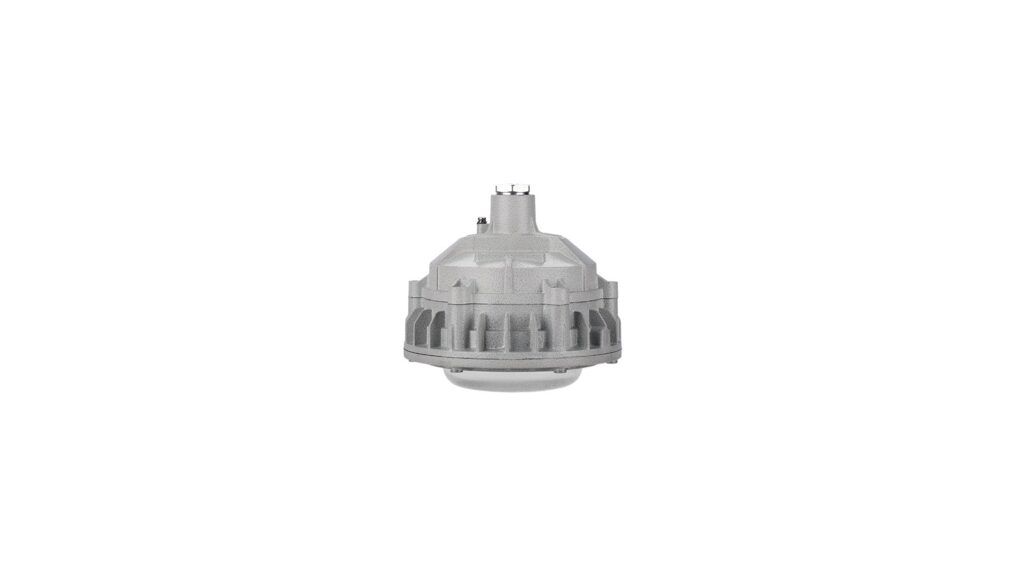
Image note: The representative website luminaire photograph is not a chemical test, release study or equipment-selection result. Verify exact model marking, certificate scope and current documentation independently.
Vapour pressure vs vapour density: keep the labels attached
The Canadian Centre for Occupational Health and Safety glossary describes vapour pressure as an absolute pressure associated with vapour above a liquid under stated test conditions. Relative vapour density compares a gas or vapour with a reference gas, normally air, at the same temperature and pressure.
A purchasing record should keep that distinction intact. A pressure value cannot fill a relative-density field simply because both appear in the physical-properties section of a safety data sheet. The short comparison below is a reading aid, not a classification method.
| Data field | What to preserve | What it does not establish |
|---|---|---|
| Vapour pressure | Reported pressure, units and temperature | A measured workplace concentration |
| Relative vapour density | Ratio, reference gas and comparison conditions | The actual path of a release in a building |
| Material identity | Supplier product name, composition information and document revision | That another product with a similar name has identical data |
| Project assessment | Approved document reference and responsible reviewer | Permission to replace an engineering review with this table |
Read abbreviations in their own source
The NIOSH Pocket Guide introduction, under Chemical and Physical Properties, explains its own notation. VP is listed in mm Hg at 68 degrees Fahrenheit unless another temperature is specified. RGasD uses air as the reference, with air equal to one. Sp.Gr is a separate property referenced to water. These are conventions for that publication, not instructions to assume every supplier uses the same layout.
For a buyer, the useful check is simple: can the next reader recover the original quantity without guessing? If a spreadsheet column says only density, add the complete property name from the source. If a pressure entry has lost its temperature, return to the document rather than filling the gap from memory. Preserve qualifying notes instead of copying only the number.
An apparent disagreement between documents is a reason to ask a focused question. It is not evidence that one supplier is necessarily wrong. First compare material identity, document revision, units and stated conditions. Keep both original records available until the responsible specialist resolves the discrepancy.
Heavier than air is not a layout drawing
CCOHS notes that vapours with relative density above one can accumulate in low areas. The word can matters. This property description does not map the real movement, mixing or accumulation of a release at a particular site. It should not become an instruction to place every detector, fan or electrical fitting at one height.
HSE guidance on hazardous-area classification considers substance properties together with release circumstances, process temperatures and pressures, ventilation and connected spaces. Those factors explain why a single property copied from a data sheet is insufficient to define a zone boundary. The HSE document is used here for these general assessment principles, not its older standard references.
For procurement, separate the chemical-data attachment from the approved area-classification record. A supplier may need both, but they answer different questions. If the classification drawing is missing, identify the missing document and its owner. Do not convert the chemical table into a provisional zone label and let that label travel into a purchase order as an approved requirement.
A practical handover for purchasing and engineering
The following workflow is an editorial document-control aid. It is not a prescribed test procedure or a substitute for a competent hazardous-area assessment.
- Identify the material actually used in the project. Retain the current supplier document and enough product information to distinguish it from similarly named materials.
- Copy each relevant property with its heading, units, temperature and footnotes. Keep a link or page reference to the original evidence.
- Record the project conditions in a separate field supplied by the responsible engineering team. Do not silently treat laboratory or reference conditions as site conditions.
- Mark unresolved differences explicitly. Assign an owner to confirm them before the evidence is used in an equipment specification.
- Link the final purchasing specification to the approved assessment and the equipment documentation that was actually reviewed.
A clear enquiry can therefore contain a short evidence index rather than a large unexplained attachment bundle. Suggested columns are document name, revision, relevant page, question, reviewer and disposition. Leave a genuinely unknown value unresolved instead of replacing it with an attractive-looking estimate.
Keep nearby properties separate too
Vapour pressure should not be relabelled as flash point, and relative vapour density should not be relabelled as an explosive limit. If the project file also contains those properties, use the separate flash point and autoignition temperature guide and LEL and UEL reading guide to keep the terminology organised.
These related articles help with reading and handover. They do not provide a combined calculation that selects an Ex protection concept, temperature class or equipment model. Ask the project reviewer which approved requirements the supplier must satisfy, then evaluate the offered configuration against those requirements.
Source note and review limits
This article was checked against the linked official CCOHS, NIOSH and HSE pages on October 14, 2026. It does not reproduce chemical-specific numerical data, determine exposure limits, calculate release rates or prescribe ventilation. Reference publications may contain older legal or standards citations; no claim is made here that every citation within them is a current project requirement.
MMAIATEX certification status
The MMAIATEX About page describes ATEX, IECEx and CCC certification as in progress. This is an attributed website statement, not independent verification of a certificate register. MMAIATEX Explosion-proof Technology (Zhejiang) Co., Ltd. should be assessed through the current documents for the exact offered model and configuration. This article and its representative photograph do not establish certification.
Safety and legal disclaimer
Chemical-property interpretation and hazardous-area equipment selection require competent, project-specific review. This article is general purchasing information, not an engineering design, site classification, installation instruction or legal opinion. Do not use it to alter operating conditions or bypass approved safety procedures.
Contact MMAIATEX
Send your approved equipment requirements and the document questions that remain open. Include the relevant material-data revision so the enquiry can be understood without guessing its basis.