
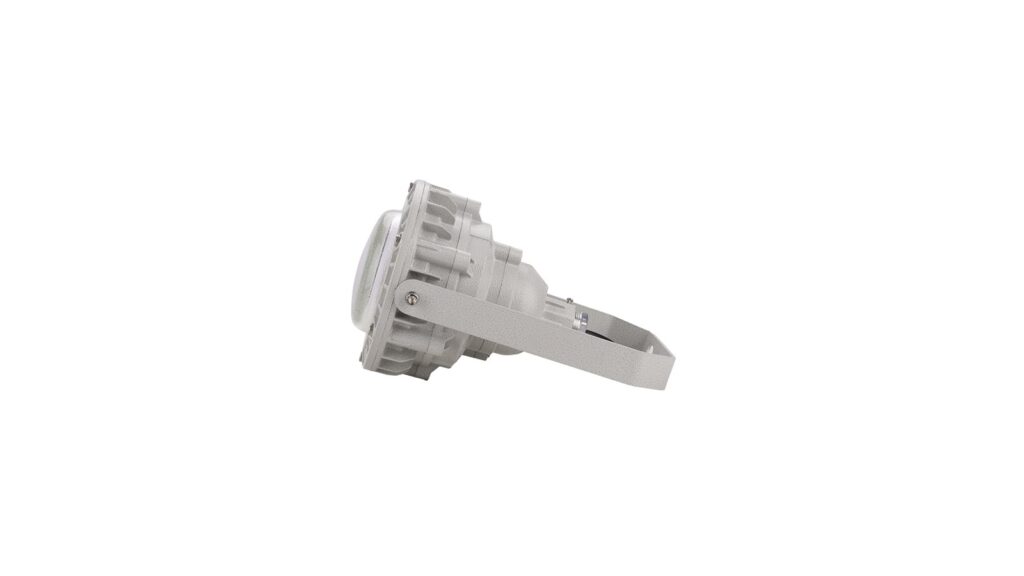
Image note: The photograph shows a representative industrial luminaire, not an inductive or capacitive sensor. Verify exact model marking, certificate scope and current documentation; appearance cannot establish a sensing function.
Inductive vs capacitive proximity sensors: define the enquiry
The questions below concern non-optical target-detection enquiries. For object detection using light, use the separate photocell selection FAQ. For an actuator physically operated by machine movement, use the limit-switch FAQ. These are different selection paths, not alternative names for the same device.
1. What is the basic difference between the two principles?
Inductive sensors detect a target through electromagnetic effects associated with conductive material. Capacitive sensors respond to changes in capacitance. OMRON's technical explanation describes these operating principles. We use that source only for general sensing concepts, not as evidence for any MMAIATEX product or an interchangeable model.
The purchasing question is whether the exact offered device has documented performance for the actual target. A sensing-family name alone does not answer it.
2. Does a metal target automatically mean every inductive model will work?
No. Identify the metal, target dimensions, approach and required detection position before comparing offers. Ask for the supplier's controlled evidence for that target and configuration. Do not substitute a catalogue's general family description for a model-specific answer.
Keep the target description attached to the quotation so a later material or geometry change is visible. The buyer should not approve an undocumented substitution simply because both targets are called metal.
3. Does capacitive mean the sensor detects every non-metal object?
No. OMRON's explanation relates detection to capacitance and the target's dielectric properties; it does not make every target or application equivalent. Identify the actual substance or object and its condition, then ask the supplier to confirm the relevant evidence.
If the target changes between products, batches or operating states, describe that variation in the enquiry. Avoid treating the words plastic, powder or liquid as a complete sensing specification.
4. Can I compare two devices using sensing distance alone?
No. A distance value needs its associated model, target and stated conditions. Ask what the quoted value represents and which controlled document defines it. Compare like-for-like information rather than choosing the largest number in two unrelated catalogues.
If one supplier provides a general range and another supplies application-specific data, mark the evidence difference. Do not invent a conversion factor or installation margin to make the entries look equivalent.
5. Why should the enquiry include the mounting arrangement?
It gives the reviewer the context needed to judge the offered configuration. Include a drawing showing the target path, sensor position, nearby structures and other devices. Ask which mounting assumptions are part of the supplier's response.
Do not infer permitted mounting from a threaded barrel or matching external dimensions. Installation distances, adjustment methods and acceptance checks must come from the exact controlled instructions and the responsible design review, not this FAQ.
6. What does IEC 60947-5-2 establish?
The official IEC 60947-5-2:2019 catalogue entry includes inductive and capacitive proximity switches within its scope. It identifies Edition 4.0, published October 18, 2019. That scope is not a certificate for a particular offered sensor and does not by itself establish explosion protection.
Record the exact standard reference claimed in the product documents. A supplier's citation should be traceable to the supplied configuration and supporting evidence, not merely printed in a comparison table.
7. Which environmental information belongs with the target description?
Provide the location-specific environmental brief and relevant operating states. Ask the supplier which documented limits apply to the proposed model and identify any unanswered condition. Avoid using an environmental adjective, such as rugged or waterproof, as the acceptance criterion.
The adverse service conditions guide explains how to organize that broader enquiry. Neither sensing principle grants a blanket environmental rating.
8. Are matching connectors proof of electrical compatibility?
No. Ask for controlled supply, output, connection and interface information for the exact ordering code. Have the responsible designer compare it with the intended receiving equipment and the approved circuit documents.
Matching connector shapes or wire counts are not enough to approve an interchange. If the documentation is incomplete, keep compatibility unresolved. Do not experiment with wiring or use a general online connection example to settle the question.
9. Does a low-voltage sensor automatically count as intrinsically safe?
No. Do not infer an Ex protection method from supply voltage or appearance. If intrinsic safety is proposed, the reviewer needs the exact device and associated-system evidence. The intrinsic-safety entity-parameter guide explains why a device label is not the entire system assessment.
A catalogue description also cannot assign the required zone, equipment protection level or gas and dust group. Those requirements come from the project assessment and applicable rules.
10. Which evidence establishes the separate Ex claim?
Review the exact legal manufacturer, model and suffix, complete marking, applicable conformity documents, scope, conditions and instructions. Verify certificate records through the relevant official source where that route provides them. Resolve differences between the offer and the documents before acceptance.
IEC 60079-0:2026, Edition 8.0 published June 16, 2026, addresses general Ex equipment requirements. Its publication does not certify an individual product or choose its protection method.
11. Can either sensing principle be used for a safety function automatically?
No. A reliable-looking detection result is not a documented safety-function assessment. Identify what the signal is intended to do and refer the required fault behaviour and validation to the responsible safety designer.
Do not describe ordinary target detection as a protective interlock solely because the sensor is installed on a hazardous process. The SIL and explosion-protection guide separates those evidence questions without assigning a safety level.
12. What should the buyer retain after the comparison?
Retain the agreed target description, exact ordering code, controlled documents and revisions, supplier responses and responsible acceptance record. Record unresolved conditions explicitly. Link any later change in target, mounting, interface or location back to that record.
This is an editorial purchasing workflow, not a mandatory list from IEC 60947-5-2. It helps reviewers see what was considered without turning a supplier enquiry into a completed installation or safety approval.
MMAIATEX certification status
The public MMAIATEX About page states that ATEX, IECEx and CCC certification is in progress. This is an attributed website statement, not independent certificate verification. MMAIATEX Explosion-proof Technology (Zhejiang) Co., Ltd. does not claim an approved inductive or capacitive model through this FAQ or its representative photograph.
Safety and legal disclaimer
These answers are general purchasing guidance, not sensor installation instructions, wiring advice, functional-safety validation or hazardous-area approval. Use current applicable requirements, exact product documents and competent professionals. Do not modify or test equipment in a hazardous location on the basis of these answers.
Contact MMAIATEX
Send the target description, intended function, proposed configuration, environmental brief, destination and required documents. Ask which relevant product records are available for your responsible engineer to review.