
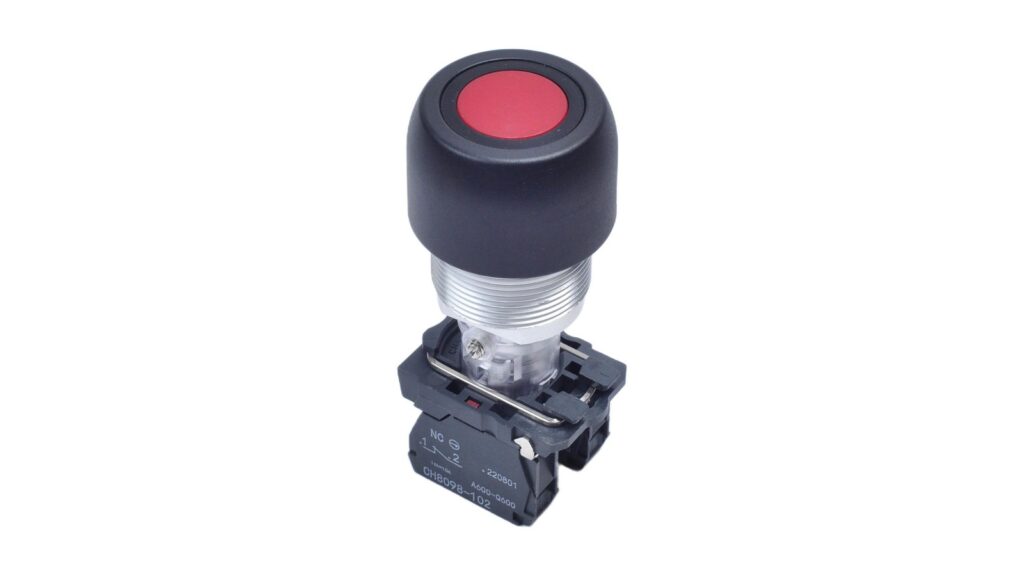
Image note: The representative photograph shows a red panel push-button and contact block. Its visible markings do not establish AC-15 or DC-13 ratings for an offered configuration. Verify exact model marking, certificate scope and current documentation.
AC-15 vs DC-13: four questions to keep separate
These are editorial buyer questions, not a record of customer enquiries or a design checklist.
| Evidence layer | Purchasing question | Do not substitute |
|---|---|---|
| Category | What kind of control duty is declared? | A general AC or DC description |
| Rating row | Which voltage and current apply together? | An isolated ampere value |
| Contact identity | Which exact block and configuration are offered? | Matching colour or terminal numbering |
| Ex evidence | What documentation covers the completed equipment? | A utilisation-category code |
1. What is the practical difference between AC-15 and DC-13?
AC-15 concerns AC electromagnetic control loads; DC-13 concerns DC electromagnetic control loads. Schneider Electric's relay technical presentation distinguishes them and gives relay, contactor and solenoid examples. That short description is not a complete category-selection rule. Give the responsible reviewer the actual load and duty, then obtain the applicable manufacturer rating instead of choosing a category from the supply type alone.
2. Where does IEC 60947-5-1 fit?
IEC 60947-5-1:2024 covers electromechanical control-circuit devices and switching elements for functions such as controlling, signalling and interlocking. Its current catalogue record identifies Edition 5.0, published March 26, 2024. The public scope provides context for the document family. It does not prove that an offered contact has been tested or that its complete assembly has Ex approval.
3. Can an AC-15 rating be used as a DC-13 rating?
Do not transfer it by assumption. Obtain the manufacturer's explicit DC-duty information for the exact contact and configuration. A table may contain both categories, but that does not make their rows interchangeable. If a quotation includes only an AC entry and the project needs DC switching, record the missing DC evidence as an open question rather than inventing a conversion factor.
4. Why is a headline ampere value insufficient?
Its meaning depends on its label. A thermal-current entry and a duty-specific operational-current entry are different records. OMRON's auxiliary-contact specification illustrates that distinction by listing thermal current separately from AC-15 and DC-13 operational-current tables. This example explains document structure only; none of that manufacturer's numerical ratings is a rating for MMAIATEX equipment. Ask which entry the quotation actually uses.
5. Which parts of a rating table should stay together?
Preserve the category, AC or DC designation, operating-voltage row, operational-current entry and the relevant conditions. Keep the model identifier and document revision with the copied row. A screenshot cropped to one number can hide the reason that number applies. If two suppliers use different layouts, make a comparison sheet that retains those labels rather than forcing every value into a single current column.
6. Does a NO or NC contact description establish its switching duty?
No. Contact state and switching-duty evidence answer different questions. The 13-14 versus 21-22 contact-numbering guide explains normal contact state and identification; it does not assign AC-15 or DC-13 performance. In a quotation, keep the required contact arrangement and the applicable duty record as separate entries. A match in one column does not close the other.
7. Does the colour or shape of a push-button identify its contact rating?
No. An operating head is not a complete electrical specification. Identify the actual contact block, its suffix and the documented head/block arrangement. The panel-mount push-button FAQ covers the broader configuration question. You can browse the listed push-button modules and operating heads to describe the family in an enquiry, but the listings do not establish a duty rating or availability.
8. Does a contactor's main-circuit rating cover its auxiliary contacts?
Do not assume so. The OMRON example separates main-circuit and auxiliary-circuit sections, with different duty tables. Preserve that circuit identity when collecting evidence. A buyer asking about an auxiliary control contact should not receive a main-power rating as though it answered the same question. Equally, this FAQ does not select a main-circuit switching or isolation device; the isolating-switch FAQ addresses that separate function.
9. Does the category code guarantee the required number of operations?
The code alone does not establish the required service life for the application. Obtain the applicable endurance information and its stated load conditions for the exact contact. Manufacturer specifications can distinguish mechanical and electrical endurance. Record the project's expected switching duty as a requirement for review, not an assumed capability. This article supplies no operating-cycle target or maintenance interval.
10. What if a supplier proposes a different contact block?
Treat it as a configuration change to review, even if the front operator looks unchanged. Compare the new identity, contact arrangement and duty-specific documentation with the original enquiry. Keep the proposed change visible in the quotation comparison. Do not close the issue merely because both records contain AC-15 or DC-13; the category is one part of the evidence, not the complete acceptance decision.
11. Do AC-15 and DC-13 establish explosion protection?
No. IEC 60079-0:2026 addresses a separate general scope for Ex Equipment and Ex Components. A utilisation category does not identify the complete equipment's protection concept, marking or current certificate scope. Keep electrical-duty records and Ex evidence distinct but connected to the same offered configuration. A contact photo, category code or component document cannot approve an unspecified finished assembly.
12. What information makes the enquiry useful?
Provide the full proposed contact and operator references, the load description, AC or DC supply information, required contact arrangement and expected switching duty. Attach the rating table or quotation line needing clarification. Identify the complete assembly and destination requirements where relevant. Ask a specific question, such as which documented row covers the proposed duty, rather than requesting a blanket statement that the contact is suitable for everything.
Current MMAIATEX certification status
MMAIATEX is the public brand of MMAIATEX Explosion-proof Technology (Zhejiang) Co., Ltd. On the review date, its About page describes ATEX, IECEx and CCC certification as in progress. This is an attributed website statement, not independent verification of a current product certificate. Verify the exact offered model, marking, certificate scope and current documentation before acceptance.
Safety and legal disclaimer
This FAQ provides general purchasing information, not category selection for an unidentified load, circuit design, wiring instructions, endurance testing or Ex approval. It supplies no model-specific ratings. Competent project parties must assess the actual duty, controlled manufacturer information, finished configuration and applicable requirements.
Contact MMAIATEX
Send the proposed contact or operator reference, load description and the exact rating question. Include the complete table or datasheet page so its conditions remain visible.