
What the three IEC 60947-3 functions mean
| Device function | Core purpose | Procurement question |
|---|---|---|
| Switch | Makes, carries and breaks current under stated circuit conditions | Can the exact device operate the intended load and duty? |
| Disconnector | Provides isolation when open under its stated requirements | Is the exact device documented for the required isolation function? |
| Switch-disconnector | Combines stated switching and disconnection functions | Does the evidence cover both the load duty and isolation duty? |
These functional terms do not replace the separate Ex assessment. IEC 60947-3:2020+AMD1:2025 CSV covers these device types within its stated voltage scope. Exact ratings, utilisation category, instructions and project rules remain decisive.
1. What is an explosion-proof isolating switch?
It is a market description for an isolation device intended for hazardous-area equipment. The phrase does not identify the formal switching function, type of protection, EPL, group, temperature limits or certificate scope. Translate it into separate functional and Ex requirements, then connect both to the exact model and assembly.
2. What is the difference between a switch, a disconnector and a switch-disconnector?
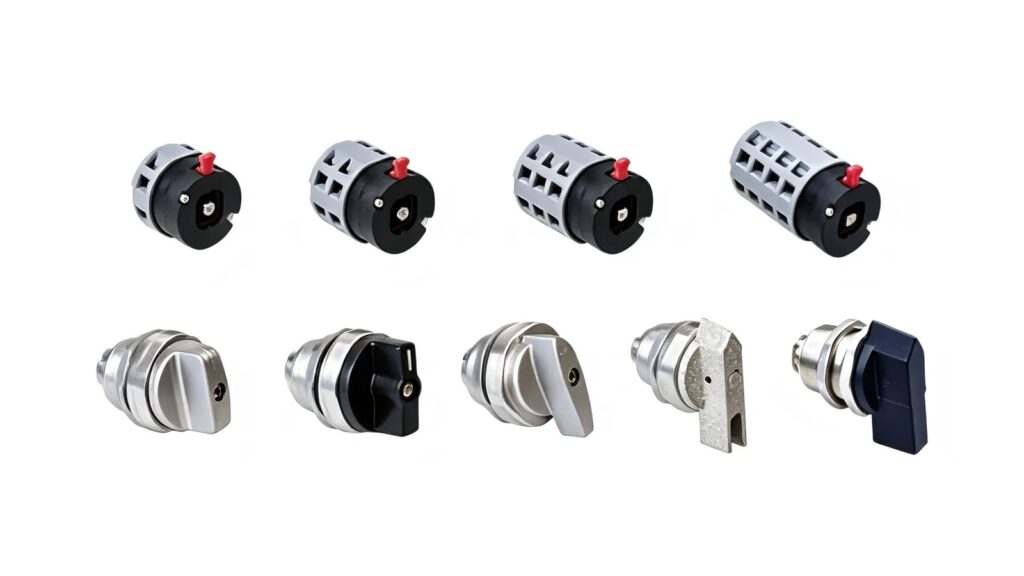
A switch is selected to make and break current under defined service conditions. A disconnector is selected to provide an isolation function when open. A switch-disconnector is intended to perform both stated functions. Similar handles can conceal different capabilities, so do not infer the formal function from appearance or an informal product name. Ask for the exact IEC 60947-3 designation, utilisation category and supporting product documentation.
3. Is an isolating switch the same as a selector switch or emergency stop?
No. A selector switch commonly commands a control function, while an emergency-stop device initiates an emergency action within a safety system. Neither is automatically suitable for energy isolation. The explosion-proof selector switch FAQ explains maintained and spring-return control duties. The explosion-proof control station FAQ covers the wider station assembly. The circuit designer must define each function instead of substituting devices by handle shape.
4. Can every isolating switch make and break the normal load?
No. A disconnector may be intended to isolate only after another device has removed the load. A switch or switch-disconnector may have a stated making and breaking duty, but that duty still must match the actual load and operating conditions. Confirm whether the device will open a running motor, heater, lighting circuit, transformer, capacitive load or another load, and whether operation is normal, occasional or emergency. Never assume that a current rating alone establishes load-breaking ability.
5. Which voltage, current, frequency and pole details are required?
State system voltage, AC or DC, frequency, continuous current, poles, conductor arrangement and every source that must be isolated. Include neutral treatment, auxiliary circuits and backfeeds where relevant. The designer must address overload and short-circuit protection. Appearance or a label current alone cannot approve the circuit.
6. Why must the utilisation category and load type be stated?
The same rated current can represent different switching duties. Load characteristics affect making current, breaking current, arcing and endurance. The enquiry should identify the real load and required utilisation category rather than asking only for an ampere value. The current IEC 60947-3:2020+AMD1:2025 consolidated page publicly lists high-efficiency motor switching categories among the fourth edition's significant changes. That standard-level information does not prove a particular product rating, so verify the exact manufacturer's data.
7. What short-circuit coordination evidence is needed?
Request short-circuit information with the specified upstream protective device, prospective fault level and coordination conditions. A conditional short-circuit rating depends on the documented combination, not the isolator alone. Include the protective-device type and rating in the approval file. Any field substitution requires responsible engineering review.
8. What changes for DC circuits or high-efficiency motors?
DC interruption can impose different pole arrangements, voltage limits and critical-current behavior. High-efficiency motors can also present switching duties that differ from older assumptions. State DC polarity and pole connection, or the motor characteristics and intended operation, then use the exact manufacturer's tables and instructions. Do not transfer an AC rating to DC, join poles or infer a motor-duty category without explicit documentation for that configuration.
9. Does a lockable OFF handle prove safe isolation?
No. A lockable handle can support control of unintended operation, but it does not by itself prove a disconnector function or create a safe-isolation procedure. A site procedure must identify every energy source, disconnect it, secure against reconnection, address stored energy and prove dead where required. UK HSE guidance in HSR25 and HSG85 provides useful UK safety context. Other jurisdictions and sites may impose different or additional rules.
10. Which hazardous-area information must match?
Provide the gas or dust classification, Zone or other applicable system, required EPL or category, group, temperature class or maximum surface temperature, ambient range and environmental conditions. Then compare those requirements with the complete marking and certificate schedule for the exact assembly. The Ex marking guide shows how to read the identity as a chain. An IP code or Zone number on its own cannot establish suitability.
11. Why must the complete assembly be assessed?
The operating handle, shaft, seals, switch body, enclosure, terminals, bonding, entries, stopping plugs and accessories interact. A part that fits mechanically may not be part of the assessed construction. Confirm the exact bill of materials, drawings, assembly instructions and any specific conditions of use. The representative CH1290 isolating-switch page can help describe the requested form, but a category page or image is not evidence for a project.
12. Which documents and site checks are required before approval?
Request the legal manufacturer, exact model and suffix, electrical ratings, IEC 60947-3 function and utilisation category, complete Ex marking, current certificate or declaration, schedules, drawings, terminal diagram, instructions and accessory list. Match the delivered nameplate and assembly to those records. A competent party must then verify installation, conductor termination, bonding, entries, mechanical operation, isolation procedure and initial inspection before energisation.
RFQ checklist for an explosion-proof isolating switch
- Define switch, disconnector or switch-disconnector duty.
- State AC or DC voltage, frequency, current, poles, load and utilisation category.
- Provide the prospective fault level and required protective-device coordination.
- Identify every energy source, auxiliary circuit and possible backfeed.
- State Zone or other classification, EPL or category, group, temperature and ambient range.
- Define handle position indication, accessibility and site locking requirements.
- Request exact-model switching evidence, Ex evidence, drawings and instructions.
- Require delivered-item and installation verification by competent parties.
Current MMAIATEX certification status
The public MMAIATEX About page states that ATEX, IECEx and CCC certification work is in progress. MMAIATEX Explosion-proof Technology (Zhejiang) Co., Ltd. does not present this FAQ, a product name, an OFF indication, an IP rating, a photograph or a representative product page as proof that a specific isolating switch or assembly is certified.
Verify the exact legal manufacturer, model, suffix, complete marking, current certificate status and scope, schedules, drawings, switching duty, accessories and installation conditions before selection or use.
Safety and legal disclaimer
This FAQ provides general procurement education. It does not design a circuit, classify a hazardous area, establish safe isolation, select protective devices, interpret a certificate or approve equipment. Competent parties must apply current standards, licensed project documents, exact manufacturer instructions, site procedures and applicable law. Opening one device must never be assumed to make equipment safe.
Request an exact-model evidence review
Send the circuit duty, load, ratings, isolation requirements, hazardous-area classification, destination market and required document list. MMAIATEX can identify available exact-model information for review by the responsible engineering, EHS and compliance teams.