
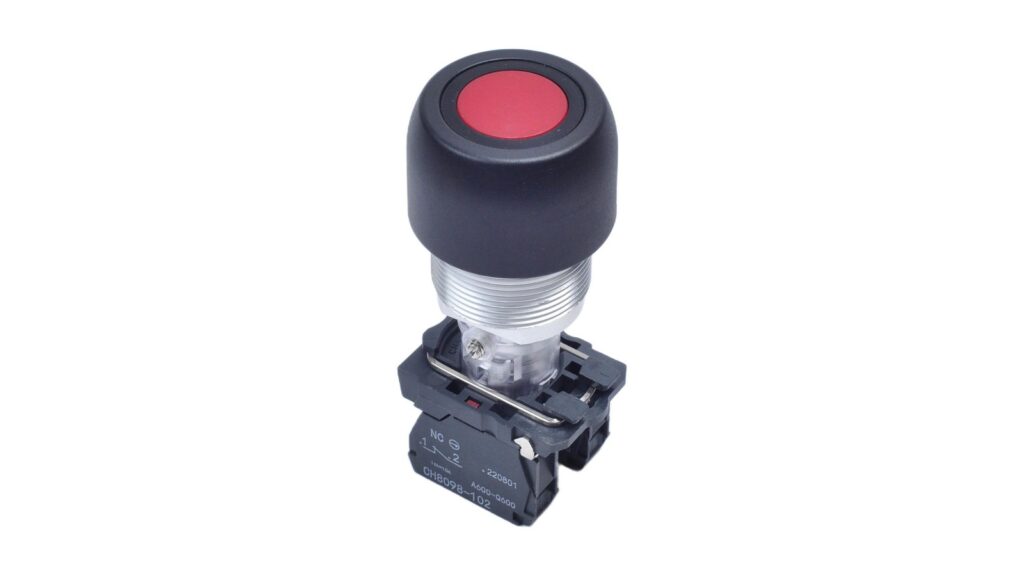
Image note: The representative photograph shows a red push button. It does not show an endurance test or establish an operation count, electrical duty or service life. Verify exact model marking, certificate scope and current documentation.
Mechanical vs electrical endurance: keep the claim complete
OMRON's Basic Switches terminology describes mechanical durability with unenergized contacts and electrical durability under rated load, each subject to stated operating conditions. This is a manufacturer's explanation, not a universal numerical rating or a quotation from an unread IEC test clause.
The following editorial comparison separates four statements that can otherwise be compressed into an ambiguous "life" column.
| Statement received | What the buyer still needs | Conclusion not established |
|---|---|---|
| Mechanical operation count | Applicable device and mechanical conditions | The same count while switching a load |
| Electrical operation count | Associated load and operating conditions | Suitability for a different circuit duty |
| Maximum operating frequency | The exact frequency definition and conditions | Total endurance or calendar lifetime |
| Service-life claim in years | Its separate basis and application limitations | A direct consequence of a catalogue operation count |
1. What is the main difference between the two counts?
The electrical-load basis is different. Read the manufacturer’s definition beside the number rather than treating the words mechanical and electrical as interchangeable headings. If only one count appears in a quotation, ask which claim it represents. Leaving that distinction unresolved prevents a meaningful comparison even when the figure looks generous.
2. Which figure matters when a contact switches a load?
The relevant electrical-duty evidence must address that load. A mechanical count can provide separate information, but it does not fill the missing electrical claim. Keep the two rows visible in the comparison. Do not discard one or automatically choose the larger count as the overall rating of the proposed switch.
3. Are operations and cycles always interchangeable units?
Do not assume so without the product document's counting convention. Ask what event is counted and whether the statement refers to an operating sequence or another defined unit. Retain the original unit in the comparison sheet. A purchasing team should not silently double or halve a supplier's figure to make two differently labeled offers appear comparable.
4. Does a minimum count mean the same thing as a typical count?
No. They are different claims, even if the displayed numbers match. Preserve qualifiers such as minimum, typical, maximum or reference value exactly as documented, and clarify an unqualified number. A comparison that removes qualifiers may imply a guaranteed boundary where the original statement supplied only a different kind of information.
5. Can an electrical count be transferred between load duties?
Not without evidence covering the new duty. Keep the stated load beside its endurance figure instead of copying only the count. The AC-15 vs DC-13 guide explains utilisation-category reading; this FAQ addresses the separate question of what a repeated-operation statement supports. One completed review does not settle the other.
6. Why is operating frequency a separate comparison field?
Frequency and a cumulative operation count answer different questions. One concerns how frequently an operation is described; the other concerns how many operations the endurance statement covers. OMRON's A22 specification table, updated November 4, 2025, lists operating-frequency and durability information separately. Its figures are not ratings for MMAIATEX products.
7. Can a head-only figure describe an assembled push button?
Not automatically. Establish whether the statement covers an operating head, a contact block or a named complete combination. Record that subject beside the count. The listed panel-mounted control components provide catalogue context for enquiries, but their appearance does not establish an endurance claim for an assembled device.
8. Does lower operating force imply longer endurance?
No endurance conclusion follows from a force figure alone. Force and travel describe different mechanical quantities from a repeated-operation claim. Use the operating force and travel FAQ to identify those quantities, then keep their comparison separate. An easier-to-press appearance or reported feel is not a substitute for documented endurance evidence.
9. How should two offers with incomplete claims be compared?
Mark the unresolved field instead of ranking the headline numbers. In a hypothetical comparison, Offer A supplies an identified mechanical count while Offer B supplies a loaded electrical count. The useful result is "different claim types supplied," not "A lasts longer." Ask each supplier to address the same clearly defined question before treating the rows as alternatives.
10. Can an operation count be converted directly into years?
A simple division does not create a supported service-life promise or maintenance interval. It would add assumptions about use and conditions that the count alone does not establish. If a calendar-life statement is needed, identify its separate basis with the responsible manufacturer and project team. This FAQ makes no reliability forecast or replacement schedule.
11. Does an endurance statement prove hazardous-area approval?
No. IEC 60947-5-1:2024, Edition 5.0, concerns control-circuit devices within its scope. IEC 60079-0:2026 addresses general Ex construction, testing and marking requirements. Neither a standard title nor an operation count establishes the exact assembly's approval. The complete model and applicable conformity evidence require their own review.
12. What makes an endurance clarification useful?
Frame one precise mismatch: the claim type, count unit, qualifier, load basis or device combination is missing or different. Attach the relevant excerpt with its heading and notes, rather than a detached number. Explain the duty being compared without inventing a target rating. This lets the reply address the actual uncertainty instead of returning another generic catalogue claim.
Current MMAIATEX certification status
The public MMAIATEX About page describes ATEX, IECEx and CCC certification as work in progress. This is an attributed company statement, not independent verification of a model certificate. MMAIATEX Explosion-proof Technology (Zhejiang) Co., Ltd. does not present this FAQ, representative photograph or third-party terminology as evidence of its products' endurance, certification or available ratings.
Safety and legal disclaimer
This article supports purchasing comparisons. It does not authorize testing, wiring, modification, maintenance intervals or use in an explosive atmosphere. Competent parties must review the exact manufacturer's current documents, applicable standards, assembly evidence and site requirements. Do not operate equipment to discover its endurance limit.
Contact MMAIATEX
Include the exact operating-head and contact references, the endurance statement with its notes, and the particular comparison field needing clarification in an enquiry.