
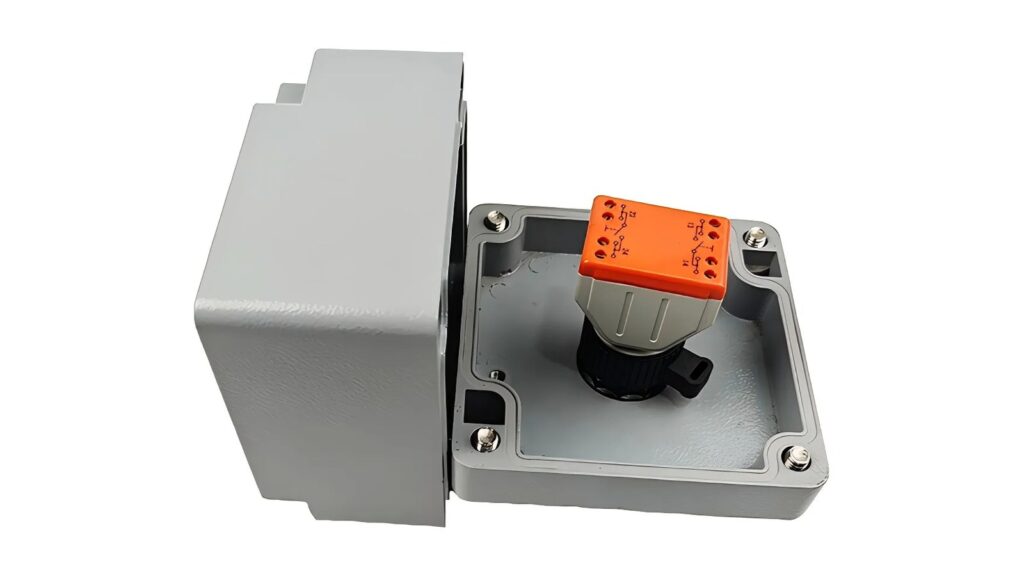
Image note: The representative photograph shows an open control enclosure and an orange contact component. It does not show an electronic input circuit, low-energy test or measured performance. Verify exact model marking, certificate scope and current documentation.
IEC 60947-5-4: what the public scope establishes
The current IEC catalogue record lists IEC 60947-5-4:2002+AMD1:2019 CSV, Edition 2.1, published May 22, 2019. This is an existing standards topic, not an announcement of a newly issued 2026 edition.
Its public scope concerns separable contacts such as control-circuit switching elements. It distinguishes an area at or above 10 V, typically 24 V, with possible electrical erosion, and an area below 10 V, typically 5 V, with negligible electrical erosion. Programmable-controller inputs and electronic circuits are given as examples. These are scope descriptions, not a recommended supply voltage or a rating for any MMAIATEX product.
The public description does not provide a complete acceptance procedure for an unidentified device. A buyer should use it to recognize the relevant evidence question, then refer the actual specification and assessment to competent parties with the applicable documents.
Start with the input, not the largest rating
A purchasing enquiry that says only "control contact" leaves the reviewer to infer the destination circuit. Identify the receiving equipment and the relevant input documentation. Keep the proposed contact's full reference beside that information. If the input model or circuit description is not yet available, state that gap openly rather than treating a generic catalogue rating as a completed match.
The AC-15 versus DC-13 guide addresses electromagnetic control-load categories. That is a different question from whether a supplied record supports the proposed electronic-input duty. A familiar category code should not make the second question disappear from the quotation review.
Likewise, the mechanical versus electrical endurance FAQ explains operation-count claims. Keep that review separate. A large count, without an applicable statement about the intended input duty, does not answer every contact-performance question.
Sort documents by what they actually show
The following is an editorial purchasing aid, not a list of mandatory documents prescribed by an unread clause of the standard.
| Item supplied | Useful information to identify | Question still open |
|---|---|---|
| Standard number in a quotation | Exact edition and the claim being made | Which offered contact and duty does the claim cover? |
| General contact datasheet | Model, configuration and qualified rating statements | Does the document address the particular electronic input? |
| Blank test report form | Form identity and its stated standards basis | Where are the product-specific findings, if claimed? |
| Completed report or technical statement | Issuer, subject, revision, conditions and conclusions | How do its limits relate to the offered item and project? |
Do not turn a missing answer into an assumed failure or a presumed pass. "Not yet established from the documents supplied" is a useful review status. It tells the next reader exactly what remains unresolved without making a claim the evidence cannot support.
A report form is not a product result
The official IECEE TRF 60947-5-4B:2023 listing identifies a Test Report Form, Edition 2.0, published November 24, 2023. Its stated applicability includes IEC 60947-5-4:2002 and Amendment 1:2019, together with specifically listed IEC 60947-1 references.
The distinction matters when someone forwards a document cover or catalogue link as "the test report." A form's title identifies a document type. It does not identify a tested specimen, a completed assessment or its outcome. Ask which material was actually supplied, and keep its name accurate in the review record.
Where a completed record is offered, preserve its own edition references. Do not silently replace them with newer dates to make the file look current. Ask the responsible reviewer to address any difference between the project's required basis and the record's stated basis. This article does not decide the acceptability of a particular edition or report.
Compare two incomplete offers without inventing a winner
Consider a hypothetical purchase of an operator and contact arrangement for an electronic input. Offer A provides a general switching table and a link to the standard. Offer B names the intended input duty but leaves the exact contact-block suffix unresolved. Neither description alone closes the purchasing question.
For A, the useful follow-up concerns the connection between the supplied rating information and the input duty. For B, it concerns which exact component the statement covers. Listing those two gaps separately is more informative than scoring the offers by the quantity of paperwork or the largest displayed current.
The listed control modules and operating heads can help identify a product family when preparing an enquiry. Catalogue presence and a matching appearance do not establish low-energy performance, availability or a documented head-and-contact combination.
Keep the clarification narrow enough to answer
Prepare a short evidence note with the following information:
- The complete proposed operator and contact references, retaining suffixes.
- The receiving equipment or input reference and the relevant project document.
- The exact claim being checked, with its original heading and conditions.
- The supplied record's identity, revision and stated standards basis.
- The specific unresolved link between the offered configuration, input duty and supporting record.
Send the question to the party responsible for that information. The aim is a traceable answer to a defined uncertainty, not a blanket assurance that a contact is suitable for all electronic circuits. Retain the answer with the quotation so a later substitution does not inherit it without review.
Current MMAIATEX certification status
The public MMAIATEX About page describes ATEX, IECEx and CCC certification as in progress. This is an attributed website statement, not independent verification of a current certificate. MMAIATEX Explosion-proof Technology (Zhejiang) Co., Ltd. does not present this guide, representative photograph or cited test-method scope as evidence that an offered model is certified.
Safety and legal disclaimer
This guide supports document review. It supplies no test circuit, test voltage selection, current threshold, wiring instruction or acceptance criterion. Low-energy contact terminology is not an intrinsic-safety approval. Competent parties must assess the actual circuit, complete equipment, current manufacturer documents and applicable hazardous-area requirements. Do not modify or energize equipment to resolve a documentation gap.
Contact MMAIATEX
Include the proposed contact reference, receiving-input reference and the particular evidence question in your enquiry. Attach the relevant document page with its conditions intact.