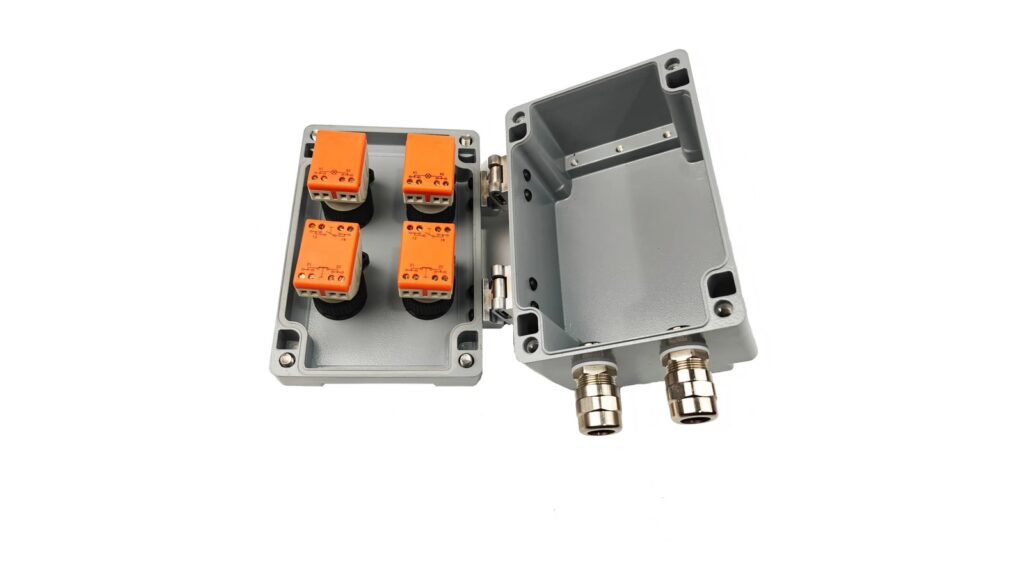
Image note: The representative photograph shows an open control enclosure with orange components. It is not a material analysis or evidence of RoHS or ATEX conformity. Verify exact model marking, certificate scope and current documentation.
RoHS vs ATEX: identify the claim before the material
The European Commission's RoHS overview identifies Directive 2011/65/EU and its restricted-substance purpose. The Commission's ATEX page identifies Directive 2014/34/EU and its explosive-atmosphere product scope. Neither overview establishes the status of a particular catalogue item.
Start a purchasing review by asking what the supplier means by the statement received. Does it describe a material grade, a named component, a finished device or a product family? Avoid expanding a narrow statement into a complete-assembly conclusion. Conversely, do not reject useful material information simply because it is not a product certificate.
Applicability also needs review. An industrial description or an intended hazardous-area location is not, by itself, a conclusion that RoHS applies or does not apply. The responsible compliance reviewer should establish the relevant product scope and exclusions under current legislation.
Why whole-product weight is the wrong shortcut
RoHS uses the concept of a homogeneous material: a material of uniform composition, or a combination that cannot be separated into different materials through mechanical processes. The Commission's RoHS FAQ, question 9.8, explains that concentration limits concern individual homogeneous materials rather than a combined average across an entire device.
For a buyer, the useful question is what the submitted information actually represents. A report referring only to a housing material leaves a different question from a declaration identifying the complete offered control assembly. Do not convert one into the other by adding the mass of unrelated parts.
The same FAQ's question 7.3 explains why constituent parts, including non-electrical parts, matter when used in equipment within RoHS scope. That does not make every separate purchasing part an independently regulated finished device. Keep the supplied-item classification and the material information distinct.
Read the coverage, not just the compliance heading
This table is an original purchasing aid. It identifies questions to ask, not mandatory document titles or an assessment procedure.
| Information received | Clarification worth requesting | Conclusion to avoid |
|---|---|---|
| Statement naming a polymer grade | Which offered parts use that grade and revision? | All materials in the assembly are covered |
| Report naming one metal part | Does it include any relevant surface treatment in its stated scope? | The report necessarily describes the complete component |
| Declaration listing several order codes | Is the exact offered variant included? | Every similarly named product is included |
| Statement citing an exemption | Which application and current provision support the claim? | An unrestricted exemption applies to the entire brand |
For an enquiry involving the listed control boxes and controllers, identify whether the request concerns an empty housing, an individual part or a proposed complete arrangement. The catalogue provides a starting point for that description, not evidence of any material or regulatory claim.
Three mismatches to catch in a supplier reply
A housing statement is attached to a complete-box quotation
Suppose a hypothetical offer describes a control box with installed components, but the attached material statement names only the enclosure. Ask which supplied items the statement covers and what supports the remaining material claims. Do not mark the whole offer covered merely because the enclosure is the largest visible item.
The correction is a scope explanation, not a demand that the supplier invent a new certificate. Preserve the supplier's original statement and ask for the missing relationship in terms that the technical reviewer can check.
A material description has no component reference
A document might identify a material but not connect it to the offered component. Request the relevant part reference and the basis for that connection. A similar colour, a photograph or an informal description such as standard plastic does not establish material identity.
If the supplier changes a component variant, ask whether the earlier material information still describes it. This is a document-specific question, not an assumption that every variant differs or that none can share evidence.
An exemption reference has no application explanation
Treat an exemption reference as a qualified claim requiring its own scope review. Ask the supplier to identify the provision, the application being claimed and the relevant product category and dates. Have the responsible reviewer check the current legal text; this article does not provide an exemption schedule or decide eligibility.
Do not confuse that question with whether the equipment is outside the directive's scope. An exemption for a specified application and an exclusion from scope are different propositions. Record which one the supplier is actually asserting before asking for more information.
Keep material content separate from other component questions
Restricted-substance information does not establish contact performance, insulation performance or explosion-protection suitability. Those questions need their own applicable evidence. The existing EMC versus ATEX guide addresses the separate electromagnetic-compatibility distinction, not chemical composition.
Likewise, an ordinary purchasing reference to a component does not settle its legal status under ATEX. Use the ATEX component-attestation guide for that separate document question. Avoid asking a material declaration to serve as an incorporation assessment.
Source dates and limits
The Commission overview pages were checked on October 27, 2026. The linked RoHS FAQ is dated December 12, 2012 and is non-binding guidance; its material-level explanation is used here, not its historical implementation dates or exemption lists. Current legislation and competent product-specific review govern an actual decision. The examples and table are editorial purchasing guidance, not official forms.
Current MMAIATEX certification status
MMAIATEX is the public brand of MMAIATEX Explosion-proof Technology (Zhejiang) Co., Ltd. On the review date, its About page describes ATEX, IECEx and CCC certification as in progress. This is an attributed website statement, not independent certificate verification. No RoHS conformity, material test result or exact-model Ex approval is announced here.
Safety and legal disclaimer
This article is general purchasing information, not legal advice, a chemical-analysis method, a conformity assessment or permission to install equipment. Competent responsible parties must determine applicable requirements and assess the actual product. Do not dismantle, sample or test equipment using this guide.
Contact MMAIATEX
Send the offered product reference, the material statement received and the precise coverage question. Identify whether you are asking about a part, housing or complete proposed assembly. Contact MMAIATEX.