
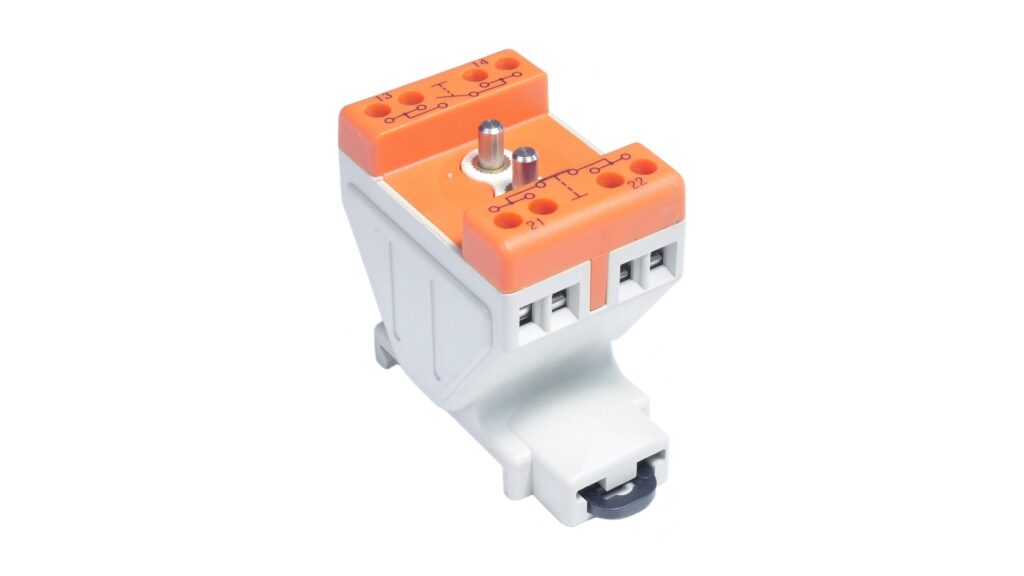
Image note: The representative photograph shows a contact block with terminals, not a resistance measurement. It establishes no contact or insulation resistance, current rating or approved combination. Verify exact model marking, certificate scope and current documentation.
Contact resistance vs insulation resistance: start with the electrical question
A component can need a conducting connection in one place and electrical separation in another. Asking whether its resistance is simply "high" or "low" omits which function is being discussed. The useful purchasing question is what the stated result describes, not which quotation has the larger number.
The following comparison is an editorial reading aid. It supplies no acceptance limits or test instructions.
| Entry in a comparison | Electrical question | Mistake to avoid |
|---|---|---|
| Contact resistance | What resistance is reported for the identified conducting contact path? | Treating it as an insulation result |
| Insulation resistance | What resistance is reported across the identified insulating separation? | Treating it as contact performance |
| Resistance without a path | Which connection or separation was assessed? | Guessing the subject from a unit alone |
| Resistance without a condition | What stated configuration or condition does the entry describe? | Carrying the number into a different situation |
For a catalogue enquiry, the listed control modules and operating heads provide product-family references. A front operating head and a contact module are different subjects; a listing does not establish which part a resistance statement covers. Identify the proposed combination before assigning a figure to it.
What the public IEC records establish
The public scope of IEC 60512-2-2:2003 concerns measuring resistance across mated contacts or a contact and measuring gauge. Its catalogue record identifies Edition 1.0, published May 16, 2003. IEC 60512-3-1:2002, Edition 1.0 of February 22, 2002, instead addresses insulation-resistance assessment of electromechanical components, essentially connectors.
These are bounded connector-method examples of the distinction, checked on the review date. They are not universal test requirements for every control switch. Their public summaries do not provide a complete procedure, a suitable limit for the offered product or an authorization to perform a test. A supplier citing either reference must still identify its relevance to the actual item.
A capital letter changes the unit, not the question
NIST's SI prefix table distinguishes lowercase m, milli, from uppercase M, mega. Consequently, 1 mΩ is 0.001 Ω, while 1 MΩ is 1,000,000 Ω. These are unit identities, not suggested product values or acceptance thresholds.
Keep that capitalization when transferring information from a PDF into a spreadsheet. Writing both as "mohm" can erase an enormous distinction. If the source is unclear, obtain an unambiguous unit rather than deciding from the magnitude what the author probably intended.
Correct conversion still does not make unlike quantities comparable. Converting a contact-path value and an insulation-path value into ohms leaves two different electrical questions. A common unit is necessary for numerical comparison, but it does not create a common subject or purpose.
Keep contact state and the described boundary attached
Where a report distinguishes open and closed contacts, preserve that distinction with the result. A figure referring to one state should not be relabelled as an unrestricted property of the complete device. Likewise, a terminal-to-terminal statement is incomplete for comparison unless the particular terminals and their relationship are clear.
Do not resolve ambiguous endpoints by opening equipment or using a meter. This is a document-reading task. A marked diagram or the manufacturer's explanation can identify the subject without turning the buyer into a test operator.
The creepage versus clearance guide addresses geometric distances. Knowing the distance label does not supply a resistance result. Conversely, a resistance statement does not disclose the required geometry. Keep a dimensional question in its own part of the review.
Read qualifiers before ranking two offers
A limit, an observed result and a typical value are different kinds of entries. Preserve words such as "maximum," "minimum" or "initial" if the supplied document uses them; do not strip them away to create a cleaner spreadsheet. This advice is about accurately representing the supplier's statement, not assigning those qualifiers to an unspecified product.
Consider a hypothetical comparison in which one attachment gives a bounded initial statement and another gives a result after a separately described assessment. Even if the headings and units match, a lower or higher displayed number does not by itself establish the preferred offer. First identify the difference in the claims. The responsible reviewer can then decide what comparable information is needed for the project.
Another hypothetical error occurs when a quotation answers an insulation question with a contact-resistance line. The response may be genuine information, but it answers the wrong question. The appropriate outcome is an unresolved insulation entry, not a failed product verdict and not an invented equivalent result.
A resistance entry is not the complete control-duty answer
For electronic-input applications, the low-energy contact evidence guide asks a separate question about the applicable contact duty and supporting evidence. A resistance number should not be used to silently close that wider question. Nor should a voltage label, operation count or photograph be substituted for the missing resistance statement.
The practical output of this guide is a comparison that keeps each quantity meaningful. It does not select a model, diagnose a fault, predict heating or prescribe a pass/fail value. An apparently tidy row with the wrong subject is less useful than a clearly identified question awaiting clarification.
Current MMAIATEX certification status
The MMAIATEX About page describes ATEX, IECEx and CCC certification as in progress. This is an attributed company statement, not independent certificate verification. MMAIATEX Explosion-proof Technology (Zhejiang) Co., Ltd. makes no model-specific resistance or approval claim through this article.
Safety and legal disclaimer
This is purchasing interpretation, not electrical testing, maintenance, insulation design or permission to modify equipment. No instrument setting, test voltage, current, limit or procedure is provided. Competent parties must assess the exact equipment, manufacturer documentation and applicable requirements. Do not energize, open or test equipment using this guide.
Contact MMAIATEX
For a component enquiry, include the proposed reference, the original resistance entry with its unit and qualifiers, and whether your question concerns a conducting contact or an insulating separation.