
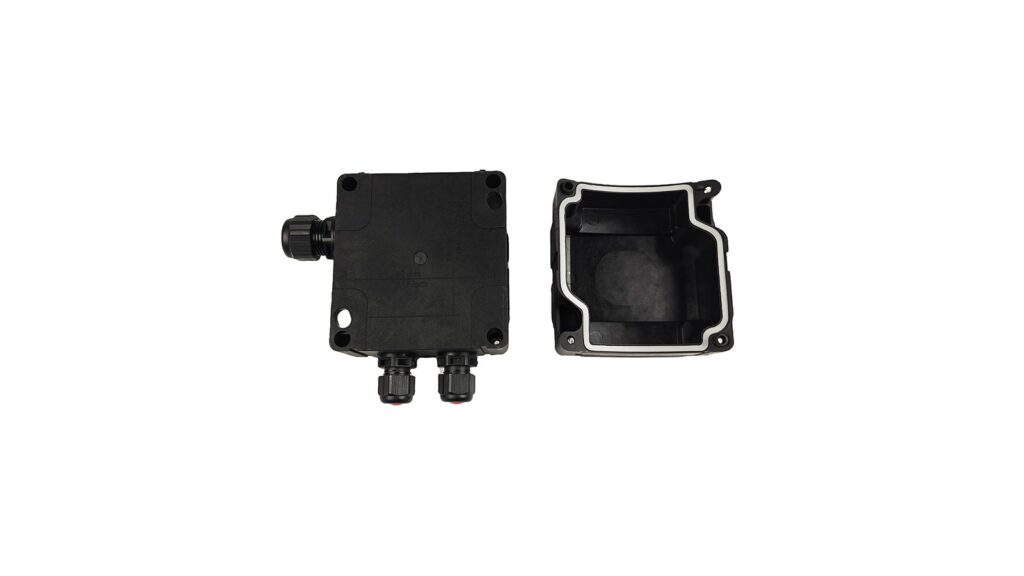
Image note: The representative photograph shows a black junction-box enclosure with cable entries and a perimeter gasket. No terminals are visible. It is not a comparison of screw and spring mechanisms or evidence of connection performance. Verify exact model marking, certificate scope and current documentation.
Screw vs spring terminals: separate the choices
These are editorial buyer questions, not recorded customer enquiries or wiring instructions. Manufacturer examples explain terminology only; they are not MMAIATEX product specifications or evidence that a particular termination option is supplied.
| Term in an offer | What it describes | What still needs identification |
|---|---|---|
| Screw connection | A screw-operated clamping arrangement | Actual clamp design and conductor conditions |
| Spring connection | A spring-based clamping arrangement | How the particular connection is actuated |
| Direct push-in | A conductor-entry feature | Which conductor forms and preparations it covers |
| Connection option | A proposed product variant | Its exact reference and place in the assembly |
1. What is the basic difference between screw and spring connections?
The distinction concerns how the conductor is clamped. A screw connection uses a screw-operated arrangement; a spring connection relies on a spring to provide contact force. Phoenix Contact's spring-connection explanation illustrates the latter. For a purchasing comparison, name the mechanism before discussing convenience. Neither label alone establishes a current rating, approved conductor combination or suitability for the proposed enclosure.
2. Does screwless always mean direct push-in?
No. The same manufacturer's spring-cage examples include tool-operated arrangements, while direct push-in is a separate conductor-handling feature. Keep the clamping principle separate from the action needed for the particular conductor. A quotation saying only "spring terminal" therefore does not answer an enquiry specifically about direct entry. Ask which variant is offered rather than assuming a photograph of a small opening identifies the mechanism behind it.
3. Does a screw terminal always press a bare screw tip onto the conductor?
No. Phoenix Contact's screw-connection page describes tension-sleeve and wire-guard arrangements. These examples show why the word "screw" is insufficient to reconstruct the internal contact arrangement. If conductor protection or the clamp design matters to the enquiry, compare the identified variant's description. Do not reject or accept a proposal on an imagined screw-tip geometry that the actual product documentation does not show.
4. Why does conductor form matter to a push-in claim?
Because the advertised handling feature can be conditional. The manufacturer's Push-in explanation distinguishes direct connection of rigid or ferruled conductors from handling flexible conductors without ferrules. This is a specific technology example, not a universal installation rule. In a comparison, keep the intended conductor description unchanged and check whether each offer's stated feature actually applies to it. Otherwise, the offers may be answering different questions.
5. Are ferrules mandatory for every spring terminal?
That cannot be concluded from the spring label. As a counterexample to a blanket rule, Phoenix Contact's Push-X description identifies a different arrangement covering flexible conductors without ferrules. This is not a recommendation to omit preparation on another terminal. Use the exact offered variant's permitted conductor and preparation information; neither a technology-family name nor another manufacturer's example overrides its instructions.
6. Does the same nominal conductor size make two variants interchangeable?
No. Matching one designation does not establish that the conductor form, preparation and termination arrangement also match. The nominal conductor cross-sectional area guide explains the size designation separately. Here, hold that designation constant while comparing the actual conditions attached to each offer. Do not silently replace an unprepared-conductor enquiry with a prepared-conductor answer just because both documents display the same nominal size.
7. Can a connection opening accept more than one conductor by assumption?
No such permission follows from its appearance or connection-family label. If the proposed arrangement involves multiple conductors at one connection point, state that explicitly and obtain the applicable manufacturer's confirmation of the combination. Do not infer it from spare-looking space or a claim about a different product. An enquiry that originally concerned one conductor should not be treated as unchanged when its proposed arrangement becomes different.
8. What access question is worth resolving before ordering a box?
Establish whether the proposed internal layout accommodates the access described for the actual connection variant. This is a layout-review question, not permission to modify an enclosure or improvise a tool. The listed control and junction boxes are relevant catalogue starting points, but their listing does not establish a particular internal terminal arrangement. Identify the proposed box and terminal variant together rather than purchasing from an isolated terminal image.
9. Is one technology automatically vibration-proof or maintenance-free?
Do not turn a claim for an identified manufacturer's range into a universal property of every screw or spring connection. Ask what the statement covers and whether it applies to the offered combination and application. This FAQ supplies no vibration qualification or maintenance interval. Comparing documented claims is useful; assigning a general winner to two broad technology names is not a substitute for the actual product assessment.
10. Can ratings and accessories carry over when the connection type changes?
Do not carry them over without an explicit basis for the revised item. A proposed alternative needs its own identity; retaining the enclosure name or terminal pitch does not establish that every accessory or rating remains applicable. The terminal-block selection FAQ addresses those wider selection questions. Today's comparison narrows the mechanism choice, rather than approving the complete combination or replacing that wider review.
11. Does a terminal-block standard reference approve an Ex assembly?
No. IEC 60947-7-1:2025, Edition 4.0 published April 15, 2025, covers screw and screwless clamping terminal blocks for copper conductors within its scope. That scope is not an exact-model approval or permission to substitute a connection technology in hazardous-area equipment. The responsible parties must assess the proposed arrangement and its current applicable documentation. A general standard reference cannot establish that every preparation or configuration is permitted.
12. What does a useful comparison look like in practice?
Consider a hypothetical enquiry specifying a particular flexible-conductor preparation. One offer names a spring connection; another describes direct push-in for a different preparation. The meaningful difference is not simply screw versus spring or faster versus slower. Identify which offer actually addresses the stated conductor condition and which describes an alternative. Keep any proposed change visible for review instead of marking both replies equivalent because both mention a terminal connection.
Current MMAIATEX certification status
The MMAIATEX About page describes ATEX, IECEx and CCC certification as in progress. This is an attributed company statement, not independent certificate verification. MMAIATEX Explosion-proof Technology (Zhejiang) Co., Ltd. makes no connection-option availability, interchangeability or approval claim through these answers.
Safety and legal disclaimer
This article supports purchasing comparison, not conductor preparation, wiring, maintenance or substitution. It specifies no torque, stripping dimension, conductor size, tool action or test. Competent parties must assess the exact equipment and manufacturer instructions. Do not open, alter or connect equipment using this FAQ.
Contact MMAIATEX
Include the proposed box or component reference, the named connection variant and the conductor form and preparation being compared. Identify whether the reply is intended to meet the original enquiry or propose a different arrangement.