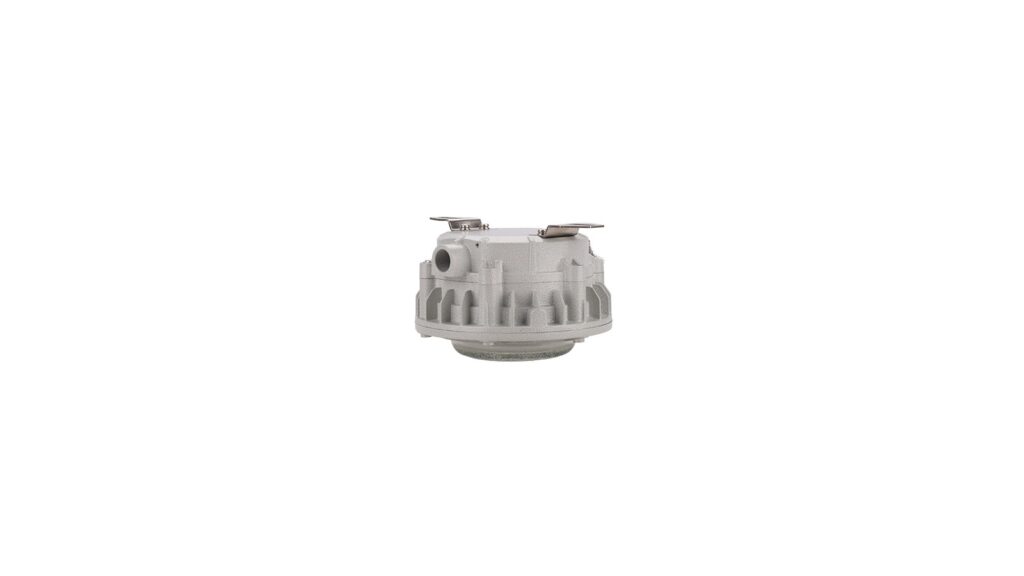
Image note: The representative website photograph shows an industrial luminaire, not an electromagnetic-field measurement or a tested installation. It establishes no exposure level, operating performance or approval. Verify exact model marking, certificate scope and current documentation.
IEC 62493 EMF assessment: identify the exposure question
The current IEC 62493 consolidated publication is IEC 62493:2015+AMD1:2022, edition 2.1, published June 15, 2022. Its public description addresses induced internal electric fields and specific absorption rate around lighting equipment. This is not a claim about the light level delivered to a work surface.
The 2015 base-publication record remains separately identifiable. An attachment mentioning only the base year may therefore prompt a question about the complete reference used. Do not silently add an amendment to a supplier's statement, or conclude from the year alone that the offered product fails. This guide reports the current public catalogue references, not the full assessment requirements or a newly issued 2026 standard.
The purchasing question should name its subject: what evidence or documented rationale supports the lighting equipment's human-EMF-exposure assessment? A vague request for a radiation certificate can invite an answer about another issue. Clear terminology helps the responsible reviewer receive the right material without implying that a particular certificate must exist.
EMC evidence answers a different question
The European Commission's EMC explanation concerns equipment disturbance and immunity. That is a compatibility question. A human-exposure question should not be marked complete simply because the supplier has supplied an EMC attachment.
Retain a valid attachment for the purpose it actually serves. If it arrives in response to the wrong question, describe the response accurately and keep the original question open. Asking for clarification does not require declaring the document worthless or the luminaire unsafe.
Our EMC versus ATEX evidence guide discusses a different separation between compatibility and explosion-protection requirements. Today's additional distinction is that neither label automatically answers a human-EMF-exposure enquiry. Do not collapse these reviews into one compliant tick.
No test and no assessment are not equivalent statements
IEC's public description identifies product types for which compliance can be established without a test. It also notes that CISPR 15 compliance was removed as a prerequisite in the second edition. These points defeat two simplistic purchasing rules: require a new test for every luminaire, or treat an EMC result as the exposure conclusion.
They do not tell a buyer that any particular LED fixture qualifies for a no-test route. That determination needs the applicable criteria and competent assessment of the actual product. A catalogue picture, low-power description or supplier's unexplained no-test sentence cannot supply that reasoning.
The useful request is narrower: identify the assessment basis being claimed and explain why it covers this offered item. Where that explanation is not available, record it as unresolved. Do not invent a failed test, but do not relabel an unsupported assertion as completed review either.
Compare the meaning of four supplier replies
This table is an original enquiry aid, not an IEC checklist, a mandatory document list or a conformity-assessment procedure.
| Reply received | What the reply actually leaves to resolve | Useful purchasing follow-up |
|---|---|---|
| An EMC report only | Whether the human-exposure question has been addressed | Request the separate assessment basis for that question |
| A reasoned no-test assessment explanation | Whether its stated criteria and coverage fit the offered item | Send the complete explanation to the responsible reviewer |
| A bare statement that LEDs need no test | Why the claimed route applies to this product | Ask for the identified basis rather than accepting the slogan |
| A general EMF standard reference | Why that scope was selected for the equipment | Request the applicability rationale and exact reference |
Do not rank these replies by attachment count. A short, well-supported explanation and a long report can serve different purposes. The reviewer needs the basis and its applicability, not a competition over document length.
A general standard needs a scope explanation
The public scope of IEC 62311:2019 concerns equipment for which no dedicated product or product-family human-EMF-exposure standard applies. Consequently, a general EMF reference should not be treated as an automatic substitute for a lighting-specific reference.
If such a document is supplied, ask the responsible party to explain why that scope was used. Do not infer that the document is invalid merely from its number, and do not choose an alternative assessment method yourself. The clarification should preserve the supplier's actual rationale for the qualified reviewer to consider.
Make the next enquiry specific
Consider a hypothetical offer that includes a compatibility report and a note saying no EMF test was necessary. The next enquiry should not simply demand another certificate. Identify the unresolved relationship: which assessment basis supports that note, and how does it apply to the proposed luminaire? Keep the response with the offer it explains.
Use the listed industrial luminaires and floodlights to name a catalogue reference for the enquiry. The archive does not prove that any particular report exists. If the offer changes, ask whether the earlier rationale still covers the new configuration rather than copying its conclusion automatically.
Human EMF exposure is also different from the optical-radiation question addressed by our photobiological safety guide. Keep that distinction visible when a supplier uses broad words such as radiation or lighting safety.
Current MMAIATEX certification status
The MMAIATEX About page describes ATEX, IECEx and CCC certification as in progress on the review date. This is an attributed website statement, not independent certificate verification. MMAIATEX Explosion-proof Technology (Zhejiang) Co., Ltd. makes no model-specific EMF assessment or approval claim in this guide.
Source and safety boundary
The linked public IEC descriptions establish limited publication scopes, not the full standards or a decision for a particular product. This is purchasing information, not medical advice, an exposure assessment, workplace clearance or permission to test or install equipment. Competent responsible parties must determine applicable requirements. Do not energize, open or measure equipment using this article.
Contact MMAIATEX
Include the proposed luminaire reference, the exact exposure-related statement received and whether the uncertainty concerns a test, an assessment rationale or the selected standard scope.