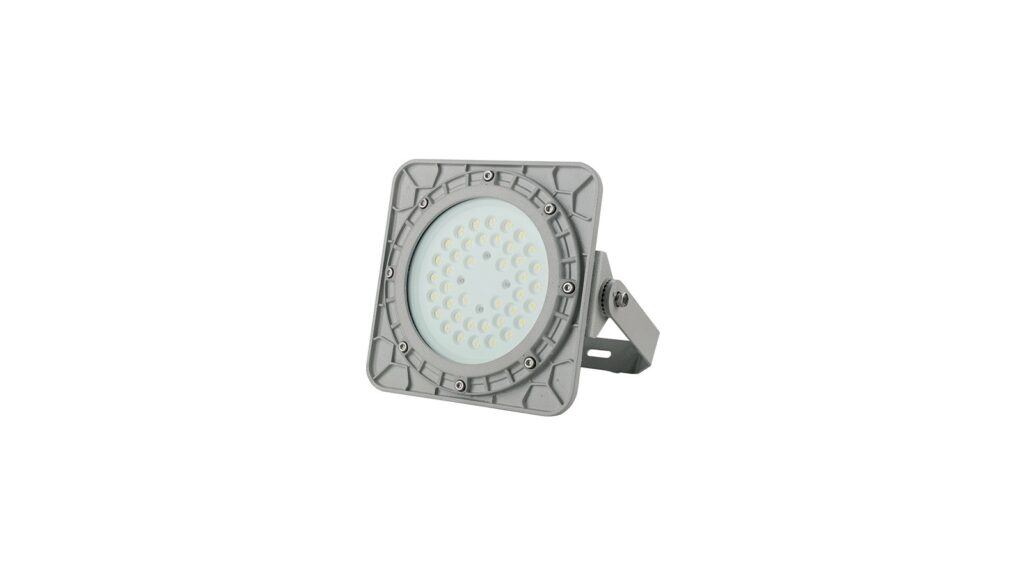
Image note: This representative website photograph shows a bracket-mounted luminaire. It does not establish a photobiological risk classification, safe viewing distance, light output or certification. Verify exact model marking, certificate scope and current documentation.
IEC 62471-7 photobiological safety: read the scope first
The IEC 62471-7:2023 catalogue page describes sources and luminaires that predominantly emit visible radiation and are used for illumination or signalling. It identifies edition 1, published on February 16, 2023. On the review date, the supplied copy includes the June 2023 and September 2024 corrigenda and the July 2025 interpretation sheet.
Those publication details help identify a document; they do not prove that an offered luminaire was tested. Nor is this a newly announced 2026 standard. Ask the responsible reviewer which requirements and edition apply to the actual product and destination market. Do not convert the catalogue's stability date into a product-certificate expiry date.
For an enquiry, write the question in plain terms: what documented assessment supports the proposed luminaire's optical-radiation safety in its intended use? A standard number without a matching product identity leaves that question open.
Keep three lighting questions separate
Buying a luminaire for a hazardous area can involve several different reviews. The following table is an original purchasing aid, not a conformity-assessment procedure or a complete list of product obligations.
| Buyer question | Evidence to identify | What it does not prove alone |
|---|---|---|
| What supports the human light-exposure assessment? | Assessment reference, covered configuration and associated user information | Explosion-protection approval |
| What supports hazardous-area suitability? | Exact Ex marking, applicable certificate scope and equipment instructions | Photobiological assessment or workplace lighting performance |
| What supports the lighting calculation? | Matching photometric data, project inputs and calculation assumptions | Either of the two safety conclusions above |
IEC 60079-0:2026 addresses general construction, testing and marking requirements for Ex equipment and components. That is why an Ex reference should not be treated as an answer to every question about emitted light.
There is another potential source of confusion: IEC 60079-28:2025 concerns optical-radiation ignition in explosive atmospheres. Its defined scope includes particular optical systems and exclusions. It is not interchangeable with a human-exposure assessment, and its applicability must not be assumed merely because a product emits light.
Turn a broad claim into an identifiable document
A quotation might say that a light meets a photobiological safety requirement while supplying only a family brochure. Start by recording what is actually stated. Does the claim name the complete luminaire, a light-source component or an unspecified range? Keep those identities separate until the supplier explains their relationship.
Use the listed industrial lighting families to identify the product reference for an initial enquiry. The category contains luminaire listings, but it does not establish that a particular assessment report is available. A catalogue picture is not a substitute for the document covering the offered configuration.
The existing photometric-data buyer FAQ addresses files used in lighting calculations. Keep that handoff separate: a usable calculation file should not silently become the evidence for a different safety claim.
A report-identification worksheet for purchasing
The worksheet below is editorial guidance for organising questions. It is not a mandatory IEC form, a list of test conditions or an instruction to perform an assessment yourself.
- Record the offered identity. Copy the complete luminaire reference and quoted options from the offer, not from a visually similar catalogue item.
- Name the claimed evidence. Record the report or assessment reference, issuing organisation and document revision supplied for review. Leave missing information explicitly unresolved.
- Identify the assessed item. Ask whether the document concerns a source component, a complete luminaire or a defined family, and how the offered item is connected to it.
- Capture the stated use. Retain the supplier's description of intended use and relevant user information. Ask the project reviewer whether it corresponds to the proposed application.
- Record the review outcome. Keep the responsible reviewer's conclusion separate from purchasing's confirmation that a document was received.
This distinction matters when documents arrive in stages. Received does not mean applicable; applicable does not mean accepted. A short status note can preserve those differences without inventing a technical conclusion.
Compare two offers without inventing a risk rating
Consider a hypothetical comparison. Offer A supplies a document for an LED source. Offer B supplies an assessment identifying a complete luminaire. Neither should be accepted or rejected solely because its document bundle is larger. Ask what each document actually covers and what supports its connection to the offered configuration.
If the source-level evidence is intended to support a luminaire-level conclusion, request the documented rationale for the responsible reviewer. Do not calculate a risk classification from the photograph, wattage or the presence of an LED array. Equally, do not presume that a complete-luminaire report covers every alternative optic or operating option.
When an offer changes, record the changed configuration beside the assessment reference. Ask whether the earlier conclusion remains applicable. Keeping the original offer and clarification together prevents an unresolved substitution from disappearing into a renamed file.
Boundaries of this guide
This article identifies questions to ask about evidence. It does not prescribe exposure limits, viewing distances, risk-group labels or protective measures. Public IEC catalogue pages support the scope distinctions above, not a detailed assessment method or a universal legal obligation. Use controlled product documents and the applicable full standards for the actual review.
Current MMAIATEX certification status
MMAIATEX is the public brand of MMAIATEX Explosion-proof Technology (Zhejiang) Co., Ltd. On the review date, its About page describes ATEX, IECEx and CCC certification as in progress. This is an attributed website statement, not independent certificate verification. Request current evidence for the exact offered model before acceptance.
Safety and legal disclaimer
This is general purchasing information, not a photobiological assessment, medical advice, lighting design or engineering approval. Competent professionals must establish the relevant product and workplace requirements. Do not inspect a source by looking into an energised luminaire, remove protective parts or alter an installation based on this article.
Contact MMAIATEX
Send the proposed luminaire reference, quoted options, intended application, destination market and the specific assessment document you need clarified. Keep photobiological, photometric and Ex documentation questions separately identified.