
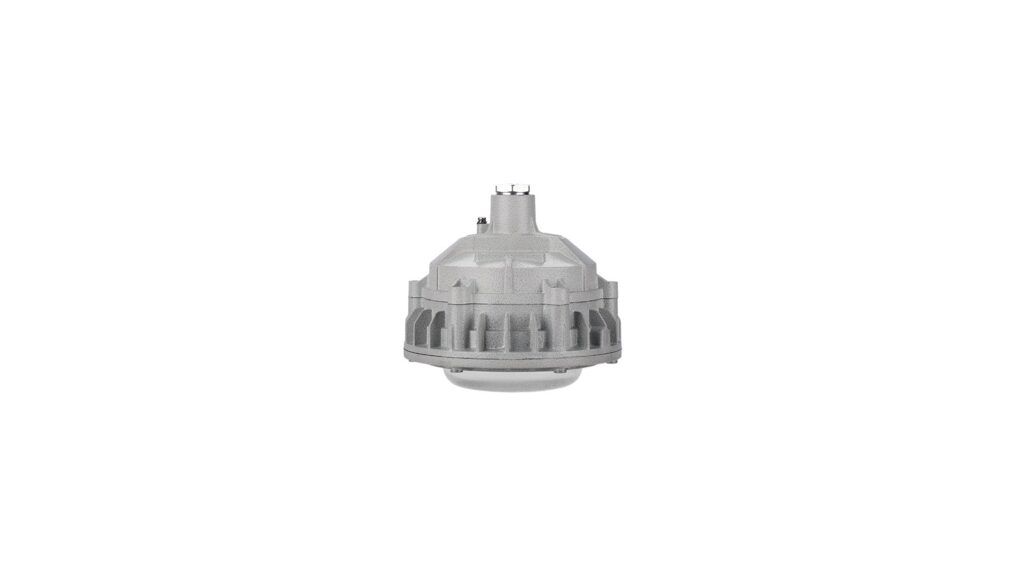
Image note: The representative photograph shows a luminaire, not a lifetime test. It does not demonstrate LED maintenance, driver reliability or whole-fixture service life. Verify exact model marking, certificate scope and current documentation.
LED lumen maintenance vs luminaire lifetime: separate the records
The US Department of Energy's metrics overview distinguishes LM-80 measurement of LED package, array and module maintenance from TM-21 projection of long-term flux maintenance. Measurement and projection answer different questions; neither label should lose its specimen identity when copied into a quotation.
The Illuminating Engineering Society's October 2018 position explains why a component result is not a complete-luminaire lifetime statement. The housing, optics and drive circuitry introduce other possible failure mechanisms. That dated position supports the distinction; it is not used here to prescribe today's standard editions or a numerical projection limit.
Use the following comparison to classify a document before asking whether its result meets the project brief.
| Record | What it addresses | Question for the reviewer |
|---|---|---|
| Component measurements | Observed maintenance for the tested LED source | Which specimen and conditions belong to the result? |
| Maintenance projection | A modelled extension from supporting data | What method, edition and assumptions are identified? |
| Complete-luminaire evidence | Performance or reliability of the assembled fixture | What configuration and failure criteria are covered? |
| Warranty terms | The supplier's stated commercial commitment | What is covered, excluded and required for a claim? |
These are separate review fields, not four interchangeable ways to express the same number. A document may answer one field well while leaving another unanswered.
Build a lifetime-claim evidence card
For each quotation, create one short record containing the supplier's exact claim and the information needed to interpret it. The following is an editorial purchasing worksheet, not a test method or a standard-mandated form.
- Claim as written. Preserve the original wording, document revision and date. Do not shorten a qualified result into an unqualified headline.
- Object being described. Record whether the claim names an LED source, a light engine or the complete quoted luminaire. Keep any missing identification visible.
- Result type. Mark the result as measured, projected, declared or a warranty term according to the supplied document. Ask for clarification when the document does not say.
- Supporting reference. Retain report identifiers and the method editions actually used. A standard number in a brochure is not a substitute for the relevant record.
- Connection to the offer. Record the proposed ordering code and the supplier's explanation connecting it to the evidence. Do not invent equivalence between variants.
- Unresolved question and owner. Name the question requiring a response and who will review it. Keep an unanswered field open rather than filling it with an assumption.
This record makes a follow-up precise. Instead of asking whether the product has a long life, the buyer can ask which part of a particular claim has evidence and which part remains a declaration.
Compare supplier replies without flattening their scope
Consider two hypothetical replies. One identifies the LED source and attaches a projection report. Another offers a complete-fixture warranty with no maintenance report. Neither reply can simply be ranked above the other because its headline contains a larger number. They have provided different types of information.
Place the replies in the same worksheet columns. Record which questions each answers and send the missing questions back separately. Do not convert a warranty period into a test duration or treat a projection as an observed operating history. This comparison identifies a documentation gap; it does not establish that either product is suitable or unsuitable.
If a supplier revises the offered model during clarification, retain the earlier revision and identify what changed. Ask which supporting documents still apply to the revised offer. This is especially useful when a commercial comparison has several alternatives under a similar product name: the buyer needs a consistent record, not an assumed family-wide result.
Keep the lighting task and the life claim in different fields
The current catalogue includes listed luminaires and lighting components. Use the listing to identify the product family for an enquiry, not as evidence of a particular lifetime. State the exact configuration under discussion before attaching a supplier's maintenance document to it.
Initial lighting information still has a separate job. The photometric-data buyer FAQs explain how a file and report are connected to an offered fixture for a lighting calculation. A lifetime discussion should not replace that task-specific review. Similarly, CCT versus CRI addresses appearance and colour fidelity, not how long the complete fixture will operate.
For a new project, start with the broader explosion-proof LED lighting questions, then attach the lifetime-claim evidence card as a separate part of the enquiry. Keep the questions short enough that the supplier can respond to each with a document, an explanation or an explicit statement that evidence is unavailable.
Certification status and claim boundaries
As reviewed on October 20, 2026, the MMAIATEX About page describes ATEX, IECEx and CCC certification as in progress. This is the company's published statement, not independent verification of a certificate for any model. MMAIATEX Explosion-proof Technology (Zhejiang) Co., Ltd. is the legal entity identified for this article.
A maintenance report, a catalogue image and a warranty do not establish explosion-protection approval. Obtain the exact model marking, applicable certificate scope and current documentation separately. This article makes no lifetime, availability or performance claim for a listed MMAIATEX product.
Safety and legal disclaimer
This guide supports document reading and purchasing clarification. It does not specify a safe replacement interval, predict a failure date, validate a lighting design or authorise repairs or component substitution. Qualified personnel must review the actual installation requirements and manufacturer documentation. Do not use a projected life figure as permission to defer required inspection or maintenance.
Contact MMAIATEX
For a lighting enquiry, include the catalogue reference, exact life claim being compared, report identifiers, proposed configuration and the questions still unanswered. Separate the desired commercial terms from the technical evidence needed for review.