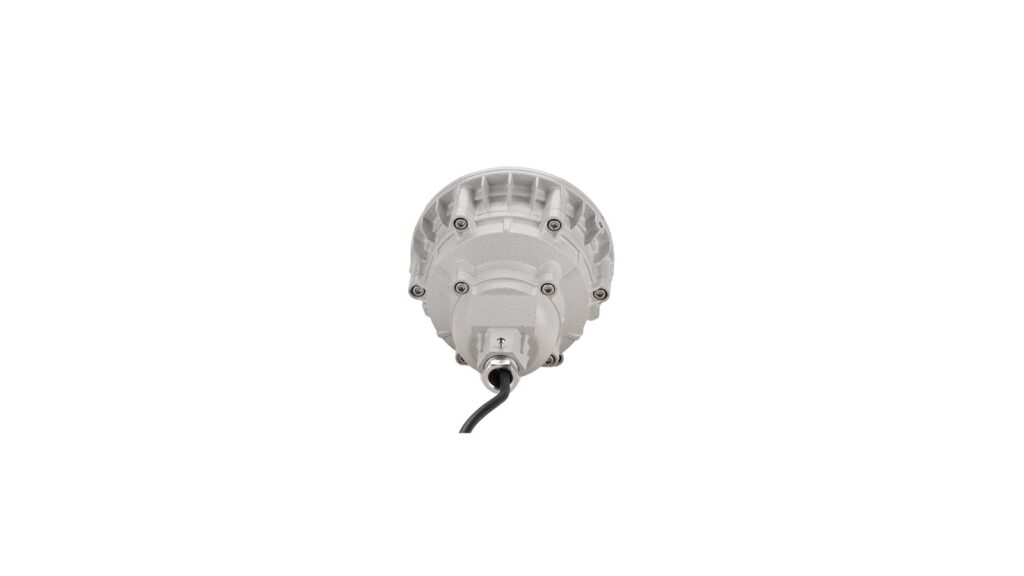
Image note: The representative photograph shows a gray luminaire rear housing, cable entry and cable. It is not a photograph of a procurement system, test or today's publication event. Verify exact model marking, certificate scope and current documentation.
MMAIATEX lighting data-entry guides: when the form loses the answer
Consider a hypothetical buyer entering one identified lighting reply into a procurement form. The form requires a test-report upload, one numerical light-output entry and a yes/no answer about temporal effects. The reply contains more qualified information than those fields can hold.
This example is an editorial scenario, not a customer incident or an announcement of a new MMAIATEX system. The problem is not whether the buyer can complete every field. It is whether the completed record would still say what the source says.
A forced entry can look tidy while becoming less accurate. Renaming a rationale as a test report, entering zero for an unavailable quantity or selecting no when an effect has not been addressed would each create a different statement. None becomes justified because the form refuses a blank.
First preserve the source, then flag the field mismatch
Keep the original reply associated with the offered reference and document revision. Identify the particular field that cannot represent it faithfully. The record owner can then determine an appropriate way to retain the qualification or revise the field, within the organization's own controls.
Do not bypass a required review, invent an approval status or relabel an attachment just to make the record save. A note explaining the limitation is not itself a technical acceptance decision. Its purpose is to prevent the data-entry step from silently manufacturing one.
The following comparison is an original reading aid, not a company form, software feature or mandatory purchasing procedure.
| Source reply | Inadequate destination field | Meaning that must not be invented |
|---|---|---|
| An explanation of an assessment route | Test-report upload only | A completed test that the explanation does not claim |
| Total luminous flux, with no surface result | Mandatory lux value | A calculated illuminance or a measured zero |
| A statement about one named temporal effect | Yes/no for every temporal concern | A universal finding of no effect |
The correction belongs to how the answer is represented. It does not decide whether the supplier's underlying explanation is sufficient.
Use the new guides to identify the lost meaning
The IEC 62493 EMF assessment guide distinguishes a documented assessment rationale from both an unexplained omission and an EMC-only response. In the example, an explanation should remain an explanation when it enters the record. Its applicability still needs competent review; the buyer must not convert it into an exemption or a completed test.
The lumens, candela and lux guide explains why a source total cannot fill a surface-result field without the missing context. The right response to a compulsory lux cell is not to derive a convenient number from the lumen entry. Nor does an absent lux result mean zero illumination. Preserve the supplied quantity and identify the unanswered one.
The flicker and stroboscopic-effect FAQs separate named visual effects, metric purposes and operating conditions. A yes/no field that combines those concerns can erase a qualification. Keep the effect and condition attached to the reply instead of expanding a limited statement into a universal negative finding.
A focused note to the record owner
Describe the mismatch in practical terms: which source sentence needs recording, which required field changes its meaning, and which qualification would disappear? Ask how to retain the original response and its unresolved question without inventing a value or altering the review status.
For example, a useful internal note could say that the supplied figure is a lumen total while the form requires a surface illuminance value. That note identifies a record-format problem; it does not propose a conversion or claim the installation is inadequately lit. Clearly separating those outcomes keeps the correction proportional.
The listed industrial luminaires and floodlights provide references for a product enquiry. Their presence does not establish that a particular report, optical result or temporal assessment is available. The three published guides explain distinctions; they do not supply missing product evidence or announce a new review service.
Current MMAIATEX certification status
The MMAIATEX About page describes ATEX, IECEx and CCC certification as in progress on the review date. This is an attributed website statement, not independent certificate verification. MMAIATEX Explosion-proof Technology (Zhejiang) Co., Ltd. does not present this content update as a certification, test or product-performance milestone.
Safety and legal disclaimer
This update concerns purchasing records, not exposure assessment, lighting design, measurement, machinery safety or legal approval. Qualified responsible parties must assess exact equipment and current requirements. Do not operate, modify or test equipment to fill an incomplete form.
Contact MMAIATEX
Include the offered luminaire reference, the original statement and the specific field or question needing clarification. Keep the source's existing qualifications visible.