
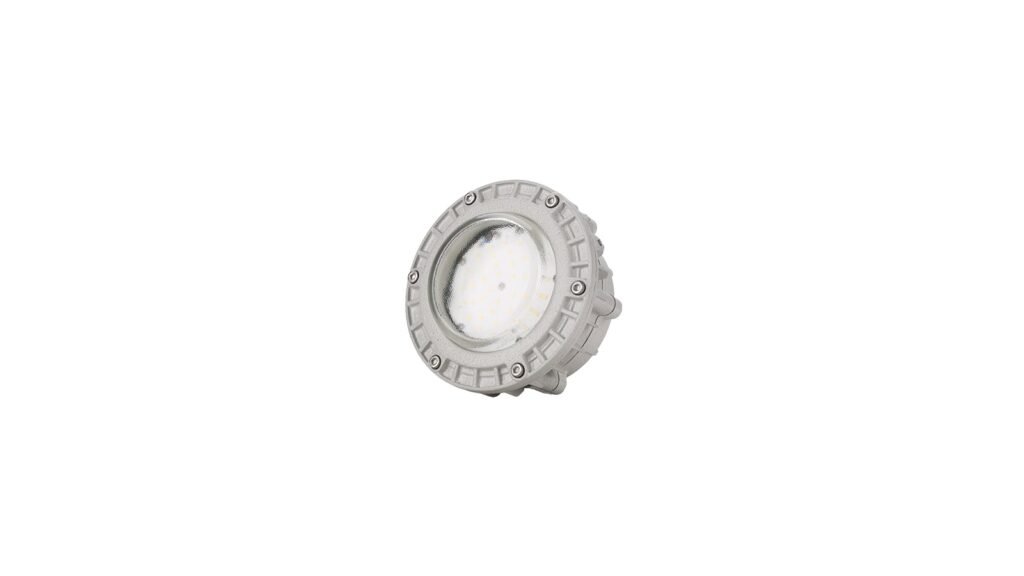
Image note: The representative photograph shows a compact round gray luminaire with a textured glass lens and bolted housing. It is not a temporal-light measurement or a motion-perception assessment and establishes no flicker or stroboscopic performance. Verify exact model marking, certificate scope and current documentation.
Flicker vs stroboscopic effect: ask a precise question
These are editorial buyer questions, not records of customer complaints. The comparison below organizes an enquiry without setting a performance threshold or prescribing a test.
| Information received | Useful purchasing question | Unsupported conclusion |
|---|---|---|
| A named visual effect | Which concern does the statement address? | Every temporal effect is covered |
| A metric and result | What method and applicability accompany it? | The number is a universal safety score |
| A stated operating condition | Does it cover the option being considered? | Every other setting is equivalent |
| An unqualified marketing label | What defined claim supports the wording? | No further clarification is needed |
1. What does direct flicker mean here?
The US Department of Energy's flicker research overview describes direct flicker as visual unsteadiness perceived by a stationary observer with a fixed gaze. Use that meaning when identifying the question in a quotation. If a supplier uses "flicker" more broadly, ask what its wording includes. Clarifying terminology is more useful than assuming two suppliers have evaluated the same effect because they use the same short label.
2. What distinguishes the stroboscopic effect?
It concerns the perception of a moving object under modulated light, rather than only unsteadiness in a stationary view. DOE distinguishes this motion-related response. For purchasing, name the relevant visual task without attempting a demonstration. This FAQ supplies no rotating-object experiment, operating-speed advice or permission to judge machine motion from its appearance. A lighting comparison must not become an informal machine-safety assessment.
3. Is temporal light modulation the same as a visible effect?
Temporal light modulation describes variation in light over time; the visual effect is a response to that variation. Keep the stimulus and the claimed response distinct. A sentence describing a waveform is not automatically a conclusion about every observer or task. Conversely, a casual statement that someone noticed no problem is not a complete description of the light's time-dependent behavior. Ask which claim the supplier is actually making.
4. Is the phrase flicker-free enough to compare offers?
Not without a defined basis. Ask the supplier to explain the effect, applicable metric or assessment and the conditions attached to that phrase. This is not an instruction to invent a threshold on the supplier's behalf. If the explanation remains qualitative, record it as qualitative. Do not turn an unqualified headline into a numerical guarantee or assume that its commercial meaning is identical across different manufacturers.
5. Does an SVM result cover every temporal-lighting concern?
No. The public scope of IEC TR 63158:2018 describes an objective stroboscopic-effect visibility meter with bounded general-indoor applicability. That is not a universal score for all tasks or environments. Preserve the method and its applicability beside the result. A reviewer must determine whether the evidence answers the actual project question; the existence of a reported value does not make that decision automatically.
6. Why should the report edition and qualifications remain visible?
Because a method description can contain important limitations. The current CIE 249:2022-Cor1 page explains a correction concerning the qualifications of an SVM calculation method in that report. It does not say all SVM results are invalid. Identify the method actually cited and retain its qualifications for the responsible reviewer instead of treating either an old reference or a correction notice as an automatic acceptance or rejection.
7. Does a full-output statement settle a dimmed operating condition?
Do not assume so. DOE identifies loading and dimming among relevant conditions when assessing temporal-light behavior. State which offered operating modes need clarification, then ask what information covers them. The existing lighting dimming FAQ addresses the separate control-interface and behavior questions. This article does not supply a dimming setting, define a minimum output or instruct a buyer to alter the equipment to collect missing data.
8. Does a CC or CV driver label answer the question?
It does not provide an optical temporal-performance result. The constant-current versus constant-voltage FAQ explains which output quantity the label describes. Keep that identification separate from the stated behavior of the complete offered luminaire. If a supplier replies to a flicker question with only a driver-mode label, identify the remaining question instead of inferring a result or proposing a replacement driver.
9. Can a product photograph or short video serve as acceptance evidence?
A static product photograph contains no time-resolved measurement. A short video supplied without an identified assessment basis should not be promoted into a formal result. Use the listed industrial luminaires and floodlights to identify the offered family, then ask what documented information is available for that configuration. This FAQ gives no camera settings, smartphone test or equipment-operation procedure for creating substitute evidence.
10. What should a temporal-light report make clear?
The reported quantity, method reference, covered configuration and operating condition should be identifiable to the reviewer. CIE TN 012:2021 provides measurement recommendations intended to support consistent reporting; its public description is not a product assessment. Preserve the report's own terms rather than renaming different metrics "flicker score." If an attachment omits the condition relevant to the quotation, keep that specific gap visible.
11. Does a favorable result establish health, machinery or Ex safety?
Not through this FAQ. No medical assurance, machine-safety conclusion or explosion-protection approval is made here. A temporal-lighting statement must not be used to close those separate reviews. Competent parties need the actual application, current requirements and exact equipment documentation. In particular, do not rely on the apparent motion of machinery as evidence that it is stopped or safe to approach.
12. What is a useful follow-up to a mismatched answer?
Imagine a hypothetical enquiry about motion-related appearance in a specified lighting mode. The reply supplies only a general flicker-free label for another mode. Identify both differences: the effect being addressed and the condition covered. Ask the supplier to explain the relevance of the supplied statement or provide an appropriately scoped answer. This avoids treating a real but differently scoped claim as either equivalent evidence or a failed product test.
Source scope and current certification status
IEC identifies TR 63158 as Edition 1.0, published March 19, 2018, with its July 2018 corrigendum included. The other sources above were checked on October 31, 2026. Only public scopes and brief explanations are used; no full paid assessment method, numerical criterion or medical conclusion is reproduced.
The MMAIATEX About page describes ATEX, IECEx and CCC certification as in progress. This is an attributed company statement, not independent certificate verification. MMAIATEX Explosion-proof Technology (Zhejiang) Co., Ltd. makes no model-specific temporal-lighting or approval claim through these answers.
Safety and legal disclaimer
This is purchasing clarification, not lighting measurement, medical advice, machine assessment, installation or repair guidance. Do not look into an energized source, operate machinery for a demonstration, open equipment or change its controls using this article. Qualified reviewers must determine the actual requirements and acceptance basis.
Contact MMAIATEX
Include the proposed luminaire reference, the operating mode being considered and the exact temporal-lighting statement that needs clarification. Identify whether your question concerns direct visual unsteadiness or a motion-related effect.