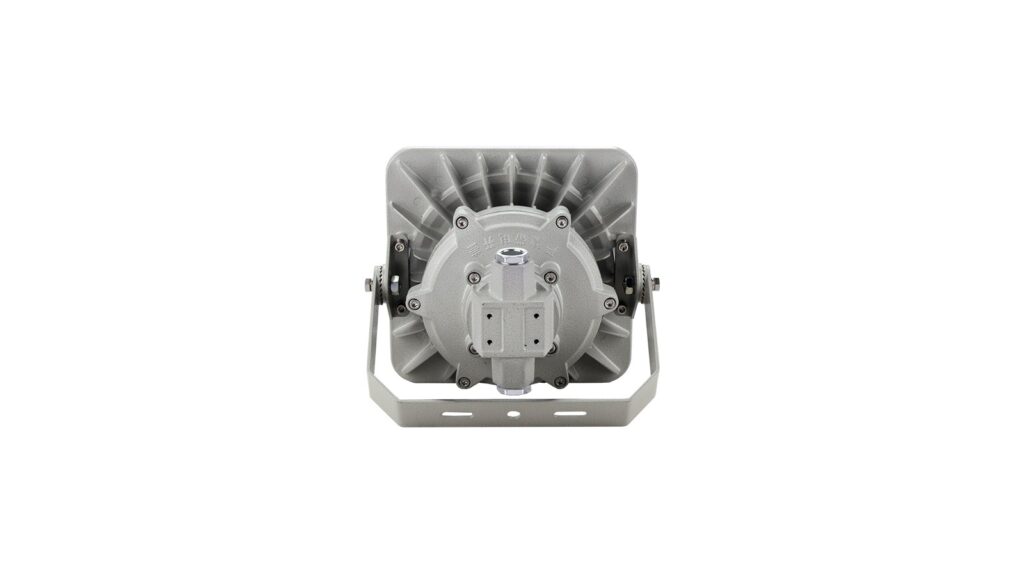
Image note: The representative photograph shows a luminaire's rear housing and U-shaped mounting bracket. The internal driver is not visible. The image establishes no CC or CV output mode, rating or compatibility. Verify exact model marking, certificate scope and current documentation.
Constant current vs constant voltage: identify the output statement
The manufacturer's Signify Advance explanation supports the basic CC/CV distinction. Its product-specific replacement and programming advice is not transferred to MMAIATEX equipment. The comparison below is an editorial reading aid, not a connection guide.
| Information shown | First interpretation question | What remains open |
|---|---|---|
| CC designation | Which output current is declared? | Applicable voltage range and offered combination |
| CV designation | Which output voltage is declared? | Associated module and current requirements |
| Input voltage | Is this the supply-side statement? | The regulated output mode |
| Power rating alone | What object and condition does it describe? | CC/CV identity and compatibility |
1. What does a CC driver description tell the buyer?
It identifies current as the regulated output quantity. The associated voltage range still matters; a CC label is not a statement that any LED load can be used.
In a quotation, keep the mode designation beside the actual offered configuration. If the supplier provides only a family brochure, ask which entry describes the offered luminaire. Do not choose a configuration on the supplier's behalf because one row looks familiar.
2. What does a CV driver description tell the buyer?
It identifies voltage as the regulated output quantity. The LED module needs appropriate current regulation; "CV" does not mean the module's other requirements disappear.
For a purchasing comparison, distinguish a statement about the driver from one about the complete luminaire. A supplier can clarify the intended combination without the buyer inferring internal circuitry from an external photograph. A generic CV label is not a complete ordering description.
3. Does the luminaire's supply voltage identify its driver output mode?
No. A supply-side statement does not answer the output-regulation question. Read the field label before using the number in a comparison.
If a response repeats the mains input when the enquiry asked about the LED-side output, point out the mismatch explicitly. Keep both questions visible rather than replacing one with the other. This is a clarification of the offer, not a reason to open the equipment and investigate its terminals.
4. Can matching wattage establish that two drivers are interchangeable?
No. A power figure alone does not identify the regulated output quantity or establish an approved combination.
Imagine two hypothetical quotations that both use the phrase "same power driver" while neither names the output mode. The useful next question is what complete driver/module configuration each offer describes. Ranking them as equivalent at that stage would hide the unresolved issue. This example assigns no parameters to any real model.
5. How should a buyer treat a voltage or current range?
Keep the range attached to its label and stated conditions. Do not turn one endpoint into an assumed operating setting.
Ask whether the document describes the exact supplied configuration, a broader configurable family or another limitation. The answer should come from the responsible manufacturer. A range in a brochure is not permission for a buyer to select settings, combine modules or make a field adjustment.
6. What if a configurable driver is offered without its supplied setting?
The configuration remains an open quotation question. Ask the supplier to identify the declared as-supplied configuration and its relationship to the offered luminaire.
Do not substitute a setting taken from an older quotation or a visually similar product. If the response changes before order acceptance, retain the superseded description so reviewers can see what changed. This is a record of the offer, not an instruction to read or program hardware.
7. Does a dimming interface identify whether the output is CC or CV?
No. The control-interface question and output-regulation question should be answered separately.
The existing lighting dimming FAQs cover interface and operating-behavior clarification. Do not copy a dimming acronym into the CC/CV column or assume that a familiar control option resolves module compatibility. One response may contain both answers, but it should identify them distinctly.
8. Can a photograph, connector or housing shape settle the question?
No. Visible similarity is insufficient to establish the output mode or approved internal combination.
Use the listed lighting range to identify the luminaire being discussed. The category is a browsing destination, not a promise that separate drivers are supplied. A photographed housing can help identify an enquiry, but a concealed driver cannot be classified from that photograph.
9. How should a buyer handle an unclear or mixed mode description?
Ask the manufacturer to identify the actual output behavior and applicable configuration instead of forcing an ambiguous statement into a CC or CV checkbox.
The current IEC 62384:2020 catalogue record covers performance of LED controlgear designed for constant voltage or current and notes that departures from pure types do not automatically exclude controlgear. That scope does not classify an unidentified product or supply its missing ratings.
10. Does an LED-driver performance standard establish Ex approval?
No. A performance-standard reference is not proof of explosion protection for the completed luminaire.
IEC 60079-0:2026 addresses general construction, testing and marking requirements for Ex equipment and components. Keep the complete-equipment evidence separate from the driver's output description. Neither the existence of a standard nor a generic document demonstrates that a particular MMAIATEX model holds a certificate.
11. Does understanding the output mode authorize a replacement?
No. Correctly interpreting CC or CV answers a terminology question, not a repair or substitution decision.
The Ex spare-parts purchasing FAQs explain the separate identity and technical-release questions. Refer a proposed change through the appropriate manufacturer and competent review process. This article does not authorize opening a luminaire, changing its driver, rewiring modules or treating a generic component as an approved alternative.
12. What clarification is useful before accepting the quotation?
Ask for a clear statement of the offered luminaire, its declared output mode and the applicable as-supplied configuration. Identify any unanswered field precisely.
For example: "The offer identifies a driver family but does not identify which output configuration is supplied with this luminaire." That hypothetical wording addresses a concrete gap without prescribing the answer. Keep the supplier's clarification linked to the quotation revision, then leave technical acceptance to the responsible reviewer.
Source and certification boundaries
IEC 62384:2020, Edition 2.0, was published May 13, 2020; its catalogue was checked on the review date. Only its public scope is summarized, not its full requirements. Signify is cited for general principles, not as a supplier relationship, approval or source of MMAIATEX ratings.
The MMAIATEX About page, reviewed October 22, 2026, describes ATEX, IECEx and CCC certification as in progress. This is a company statement, not independent verification. The legal entity identified here is MMAIATEX Explosion-proof Technology (Zhejiang) Co., Ltd.
Safety and legal disclaimer
These answers support purchasing clarification only. They provide no wiring, load configuration, programming, testing or repair procedure. Qualified personnel must assess the actual equipment and applicable requirements. No driver interchangeability or hazardous-area suitability is established here.
Contact MMAIATEX
For a lighting enquiry, provide the catalogue reference, quotation revision and the exact output description that needs clarification. Do not remove covers or alter equipment to obtain information for this enquiry.