
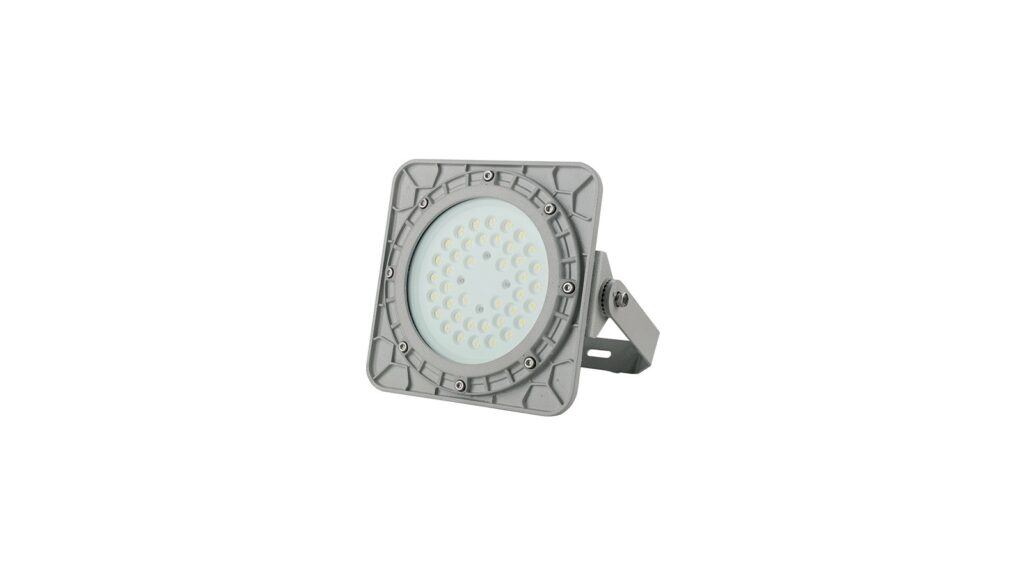
Image note: The representative photograph shows a square luminaire front with a circular array of multiple LEDs. It is not a power or light-output test and establishes no power factor or efficacy. Verify exact model marking, certificate scope and current documentation.
Luminaire power factor vs efficacy starts with the units
The DOE-hosted LED Luminaire Lifetime report defines power factor using real and apparent power. Only that stable definition from the September 2014 report is used here. The DOE commercial and industrial lighting guidance, marked updated June 2023, explains luminous efficacy as luminous flux divided by electrical input power.
The following comparison is an editorial aid for reading an offer, not an electrical-design or test procedure.
| Quotation field | Quantity represented | What it cannot answer alone |
|---|---|---|
| Input power, W | Real electrical input power | How much light the luminaire produces |
| Apparent power, VA | A different AC input quantity | The light output or luminous efficacy |
| Power factor, PF | Ratio of real to apparent power | The lumens produced per input watt |
| Luminous efficacy, lm/W | Light output per electrical input power | The power factor or Ex approval |
This distinction is useful before any ranking begins. A column with a clear unit can expose a mismatched response that a broad heading such as "efficiency" would hide. Preserve the supplier's original terminology until its meaning is clear.
Repair an ambiguous comparison sheet before scoring offers
Imagine a hypothetical tender sheet with one field called "electrical efficiency." One bidder inserts PF, another enters lm/W, and a third supplies input wattage. The sheet now contains three different answers, not three comparable levels of the same property.
Split the field into the quantities the project actually needs. Keep a separate space for the source reference and applicable operating condition. Do not convert a missing answer into zero, or fill the blank by copying a figure from a similar-looking catalogue entry. A blank means the answer is not yet established; zero would communicate something different.
When returning the question to a bidder, name the missing quantity rather than asking for "better efficiency data." For example: "The response identifies input power, but the luminous-efficacy field remains unanswered." This wording isolates the gap without rejecting the offer or suggesting that the supplied figure is false.
Equal values do not make two lighting offers equivalent
Consider two hypothetical offers that state the same PF but provide different efficacy claims. Matching the electrical ratio does not settle the optical comparison. The buyer still needs to establish which complete luminaire and stated condition each efficacy figure describes before using it in a decision.
Reverse the example: two offers state the same lm/W, but one omits PF. The optical ratio does not fill the electrical blank. Mark that question as unresolved instead of inferring equivalence from the apparently matching lighting performance.
Neither example requires invented product numbers. Their purpose is to show why a single "best efficiency" score can conceal missing information. If a project uses weighted scoring, the responsible team should decide which distinct criteria belong in it and how they are assessed. This article supplies neither a weighting formula nor a universal acceptance value.
Keep the object and operating condition attached to the figure
A number should stay connected to the object it describes. If a supplier gives a driver-only document while the quotation is for a complete luminaire, ask which submitted information establishes the offered luminaire's stated performance. Do not silently relabel a component figure as a complete-product result.
Likewise, a broad product-family brochure may contain several alternatives. Highlight the exact option being compared. Where a value is described as typical, maximum or measured, retain that qualifier in the comparison; removing it can turn a limited statement into an apparent guarantee.
An operating condition belongs beside the result, not in an unrelated email that later readers may miss. The buyer's role here is to preserve the supplier's declared basis and flag an inconsistency. It is not to devise a new measurement method, calculate an undocumented rating or change a driver setting to obtain a preferred result.
Separate this decision from other lighting questions
Browse the listed lighting range to identify the catalogue reference for an enquiry. A product card or photograph is a starting identifier, not a source of assumed watts, lumens or PF. An enquiry should name the offered option rather than attaching a numerical claim to the whole category.
For a lighting-layout handoff, the photometric-data FAQs address the file, report and configuration used in the design process. That is a different task from sorting the input and output quantities discussed here. A favorable ratio alone does not complete a lighting-layout assessment.
For color-related questions, the CCT vs CRI guide separates appearance from color fidelity. Do not use a single electrical or optical-efficiency figure to close those questions either. Keep the comparison focused enough that each specialist can see which decision remains theirs.
Source limits and certification status
The DOE sources support the terminology above. Their dated examples, US federal purchasing thresholds and cost assumptions are not applied to MMAIATEX products or presented as global requirements. No energy-bill saving, model ranking or performance improvement is promised.
IEC 60079-0:2026, Edition 8.0, concerns general construction, testing and marking requirements for Ex equipment and components. An input or output performance figure does not replace the applicable explosion-protection evidence.
As reviewed on October 22, 2026, the MMAIATEX About page describes ATEX, IECEx and CCC certification as in progress. This is the company's published statement, not independent certificate verification. The legal entity identified here is MMAIATEX Explosion-proof Technology (Zhejiang) Co., Ltd. No rating or certification of a listed luminaire is established by this article.
Safety and legal disclaimer
This guide is for quotation interpretation, not circuit sizing, power-factor correction, testing, installation or approval. Qualified personnel must assess the actual equipment and project requirements using applicable documentation. Do not open a luminaire, change components or alter settings to resolve an ambiguous quotation through this guide.
Contact MMAIATEX
For a lighting enquiry, include the catalogue reference, the offered option and the precise field that needs clarification: input W, VA, PF or lm/W. Attach the relevant supplier statement with its qualifier and operating condition intact.