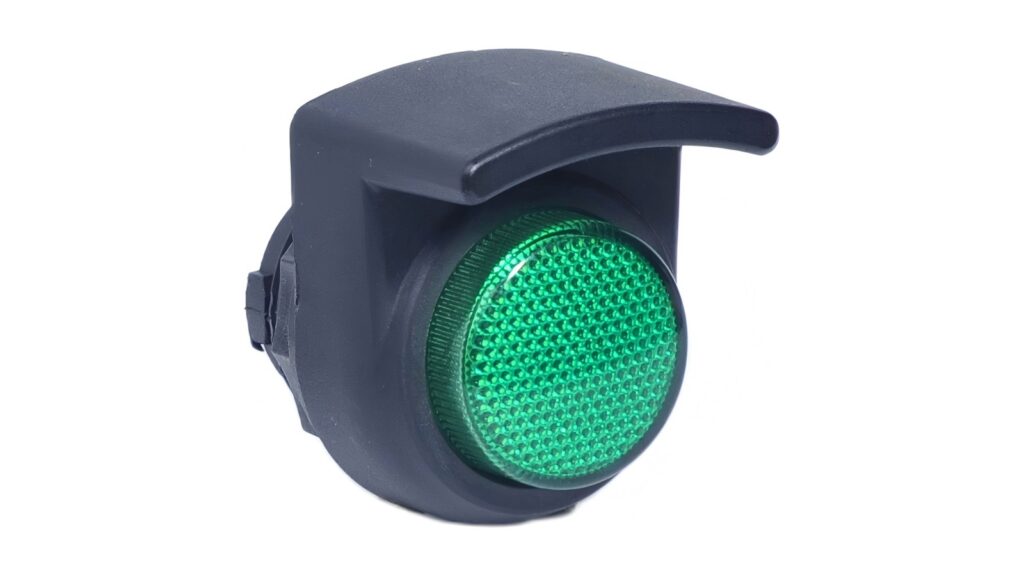
Image note: The representative photograph shows a green indicator in a hooded housing. It is not a photograph of today's publication, an engineering review or a test. Verify exact model marking, certificate scope and current documentation.
MMAIATEX control review resources: one discussion, different objects
Consider a hypothetical purchasing email about a proposed operator station for a machine. A machine-project colleague needs to locate the station in the wider arrangement. A component reviewer is concerned with an insulation detail. Another colleague is comparing the operating characteristics of the proposed push-button combination.
All three may refer to the same quotation, but they are not examining the same object. Forwarding the whole email with a general instruction to check the controls leaves that distinction hidden. The useful handover explains which part of the discussion the recipient can resolve. The roles below are illustrative, not a prescribed organisation chart or a reported customer case.
From purchasing to the machine-project colleague
The buyer passes the offered station designation and the project document that uses it. The machine-project colleague can then identify how that item relates to the machine arrangement and who owns an unresolved interface record.
The new machine electrical scope guide supports that conversation. Its subject is the relationship between the machine-level record and the individual supplier's document. A useful response points purchasing to the relevant drawing relationship or identifies who must clarify it. It does not turn a local station drawing into a whole-machine assessment.
From the component reviewer back to purchasing
The component reviewer needs the drawing detail for the actual offered combination, not merely the machine's overall layout. The new creepage and clearance guide explains why an air route and an insulation-surface route must be identified before a distance statement can be meaningfully compared.
That colleague can return a bounded document question: which path and endpoints does the supplier's statement describe? Purchasing can send that question to the document owner without inventing a dimension or deciding whether the distance is acceptable. The resulting component clarification remains different from the machine colleague's drawing relationship.
From purchasing to the operator-specification colleague
The colleague considering operation needs the identified head/contact combination and the original mechanical entries. A family photograph or the general station designation cannot replace those records.
The new push-button operating-force and travel FAQs help keep quantity labels, units, qualifiers and configuration together. The colleague can identify whether the quoted statements are comparable before considering the project's operating needs. A readable comparison is not an ergonomic assessment, a replacement approval or confirmation of a machine safety function.
Make the return message identify its object
Suppose the component reviewer has clarified which drawing detail describes the offered combination. A short return message could say:
This is an illustrative editorial message, not a supplier response or an acceptance statement. It tells the buyer what information can now be passed on and prevents a comment about one drawing detail from being copied into a general approval field.
The machine-project colleague can still need a coordinated drawing update. The operator-specification colleague can still need an identified mechanical entry. Neither person should have to reconstruct which object the component reviewer meant. If the offered combination changes, tell the affected reviewers what changed instead of forwarding an old conclusion without its context.
Use the catalogue to name the item under discussion
The website's listed controllers and control boxes provide family references for a station or control-box enquiry. They do not establish that the seller supplies the whole machine or takes responsibility for its integration.
The listed panel-mounted operating and indicating components can help distinguish a component enquiry from a complete station discussion. Their listings do not prove a particular insulation geometry, operating characteristic, approved combination or current availability.
What changed today
The verified event is publication of the three linked English guides in Industry Insights, Technical Knowledge and FAQs. Each guide has its own review date, sources and boundaries. The handover example above is a way to use those resources, not a newly launched company procedure or service. No completed assessment, customer installation or certification milestone is announced.
Current MMAIATEX certification status
MMAIATEX is the public brand of MMAIATEX Explosion-proof Technology (Zhejiang) Co., Ltd. As reviewed on October 21, 2026, its About page describes ATEX, IECEx and CCC certification as in progress. This is an attributed website statement, not independent certificate verification. Publication of these resources does not establish certification or performance for any pictured or listed item.
Safety and legal disclaimer
This update supports communication about documents, not machine design, insulation assessment, mechanical testing or installation approval. Responsible project parties must determine applicable requirements and assess the exact configuration. Do not open, modify, test or operate equipment on the basis of the hypothetical handover.
Contact MMAIATEX
Send the proposed product reference, the document being discussed and the specific question still requiring clarification. State whether it concerns the machine relationship, an insulation detail or the operating-characteristic record.