
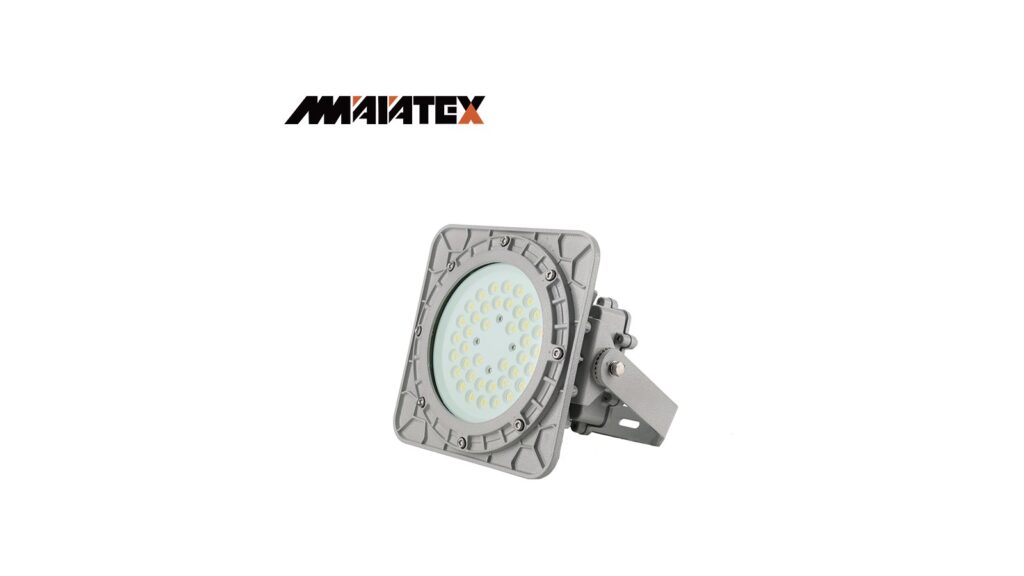
1. What does "explosion-proof LED lighting" mean?
It is a broad search phrase for lighting intended for certain explosive atmospheres. It is not one universal certification name and it does not identify a single protection technique. Compliance with the general luminaire safety standard IEC 60598-1 does not by itself establish explosion protection.
The exact luminaire may use one or more types of explosion protection and must carry model-specific marking and documentation. Start by defining the installation country and approved hazardous-area classification, then compare the complete marking and certificate scope.
2. Can I choose a light from the Zone number alone?
No. The Zone is an essential input, but it describes the expected occurrence of the explosive atmosphere, not every requirement for the equipment.
A useful enquiry also includes the required Equipment Protection Level or ATEX category, gas or dust group, temperature limit, ambient range, electrical supply, mounting, ingress protection, corrosion conditions, cable entry and documents. The guide Equipment Protection Levels Explained shows how Ga, Gb, Gc, Da, Db and Dc relate to Zones without treating them as identical labels.
3. Are gas-area and dust-area LED lights interchangeable?
Not automatically. Gas, vapour and mist atmospheres use different group and temperature information from combustible-dust atmospheres. A product suitable for a gas application is not automatically suitable for dust, and the reverse is also true.
Check whether the exact marking and certificate scope cover the required atmosphere family. Dust applications may also require a dust subgroup, a specific maximum surface temperature, ingress protection and consideration of dust layers or deposits.
4. Which certification documents should I request?
Request the documents required by the destination market and project. Depending on the route, this may include an IECEx Certificate of Conformity, an ATEX EU-type examination certificate, an EU Declaration of Conformity, schedules, instructions and production-quality evidence.
Do not accept a certificate for a similar fixture or a different suffix. The legal manufacturer, model, options, marking and conditions must align. The IECEx Online Certificate System is the official public record for IECEx certificate status. Our certificate verification guide provides a structured comparison workflow.
5. What temperature information matters for an LED fixture?
For gas atmospheres, check the required T1 to T6 temperature class. For dust atmospheres, check the permitted maximum surface temperature and the project method used to account for dust characteristics and layers.
Also verify the exact ambient temperature range. A fixture can meet the required gas T-class and still be unsuitable if the site's maximum or minimum ambient temperature falls outside the documented range. Read Explosion-Proof Temperature Class vs Ambient Temperature for a detailed explanation.
6. Is wattage enough to compare LED lights?
No. Wattage describes electrical input or a rated power condition; it does not by itself tell the buyer how much useful light reaches the work area.
Ask for the exact model's luminous flux, beam distribution or photometric file, efficacy where relevant, and any output change associated with ambient temperature or configuration. Compare these values against a lighting design for the real mounting height, spacing, surface reflectance and task.
Do not invent a one-for-one replacement from wattage alone. Two fixtures with similar input power can have different optics, thermal limits and light distribution.
7. Which optical details should be included in the enquiry?
State the required light level or project lighting calculation when available. Also define:
- Flood, wide-area, focused or pathway distribution
- Mounting height, spacing and aiming constraints
- Required luminous flux or maintained performance basis
- Correlated colour temperature when the project specifies it
- Colour-rendering requirement for inspection or task work
- Glare, shielding or visual-comfort constraints
- Need for a photometric file for the lighting calculation
These are lighting-design inputs. They do not replace the hazardous-area approval fields.
8. Can I substitute a driver, LED module or terminal with a similar part?
Not without evidence that the exact substitution is permitted. The driver, LED module, terminals, seals and enclosure form one assessed configuration. A component with similar dimensions or power does not automatically preserve the Ex marking, temperature result or certificate scope.
Provide the supply voltage, frequency, phase where applicable, tolerances, switching or control method and any project requirements for power factor, inrush, surge protection or earthing. Confirm that the exact driver and electrical configuration are included in the equipment documents. Options can change ratings, heat generation and certification records.
9. Is an emergency LED light the same as a standard fixture?
No. An emergency or backup-lighting function adds components and operating modes, such as a battery, charger, monitoring circuit or separate emergency supply. These can affect thermal performance, maintenance and certification scope.
State the required emergency duration, operating mode, supply arrangement, test or monitoring function and applicable emergency-lighting rules. Then request evidence for the exact complete configuration rather than combining a normal luminaire with an unverified backup component.
10. Does IP66 prove the light is explosion protected?
No. IEC 60529 classifies enclosure ingress protection. An IP code addresses access, solid-object and water ingress; it does not by itself establish suitability for an explosive atmosphere.
An Ex luminaire may need both an appropriate explosion-protection marking and a suitable ingress-protection rating. The two fields answer different questions. See IP66 vs Explosion Proof for the evidence buyers should compare.
11. What mounting and cable-entry details should I define?
Specify the real installation, including wall, ceiling, pole, pendant, bracket or floodlight mounting; orientation and adjustment; vibration or impact conditions; and access for inspection and maintenance.
For cable entry, provide the cable construction and diameter, entry thread and quantity, armour or braid details, sealing method, gland material, environmental seal and any stopping plugs or adapters. The gland and fixture entry must be compatible with the protection concept and exact documents.
Our Explosion-Proof Cable Gland Selection FAQ explains the cable information to collect.
12. What should I send in an explosion-proof LED lighting RFQ?
Send enough information for a model-specific review:
- Destination country and required regulatory or certification route
- Approved Zone and required EPL or ATEX equipment category
- Gas or dust group and the identified material
- Gas T-class or dust maximum surface-temperature requirement
- Minimum and maximum ambient temperature
- Supply voltage, frequency and control or emergency function
- Required light output, distribution, mounting height and photometric data
- Mounting type, orientation, vibration and mechanical constraints
- Required IP rating, corrosion resistance and environmental conditions
- Cable construction, entry thread, quantity and gland requirements
- Exact certificate, declaration, schedule, instructions and inspection-document needs
- Quantity, delivery destination and requested model or product family if known
The MMAIATEX Ex Light Fittings category can help identify product families for an initial enquiry. Treat it as a discovery page, not as certification evidence.
A final buyer check before approval
Before approving a fixture, compare the delivered unit, nameplate, purchase order, data sheet, certificate, schedule, declaration and instructions. Confirm that the legal manufacturer, exact model and all option suffixes match.
Do not infer compliance from a photograph, category name, video, test icon or the presence of the word "Ex." Product approval belongs to the complete evidence set and the responsible project process.
Current MMAIATEX certification status
The public MMAIATEX About page states that ATEX, IECEx and CCC certification work is in progress. A product listing in the lighting category does not prove that every model or configuration has a completed certificate.
Request current documents for the exact legal manufacturer, model, suffix and configuration. Verify the certificate status, scope, temperature limits and special conditions through the applicable official system before approval.
Safety disclaimer
This FAQ provides general product-research information. It is not a lighting design, area-classification study, certificate, declaration of conformity, installation instruction or engineering approval. Hazardous-area classification, lighting design, equipment selection, installation and inspection must be completed by competent personnel using current project data, applicable rules and exact product documents.
Request an LED lighting review
Send MMAIATEX the approved classification, required documents, temperature and ambient limits, electrical supply, optical duty, mounting, cable entries and environment. The team can then identify potentially relevant product information for the responsible buyer or engineer to assess.
Primary sources
- IEC 60079-0:2026, Equipment general requirements
- IEC 60079-14:2024, Electrical installation design, selection and installation
- IEC 60079-31:2022, Dust ignition protection by enclosure
- IEC 60529, Degrees of protection provided by enclosures
- IEC 60598-1:2024, General requirements and tests for luminaires
- IECEx Certified Equipment Scheme guidance
- IECEx Online Certificate System