
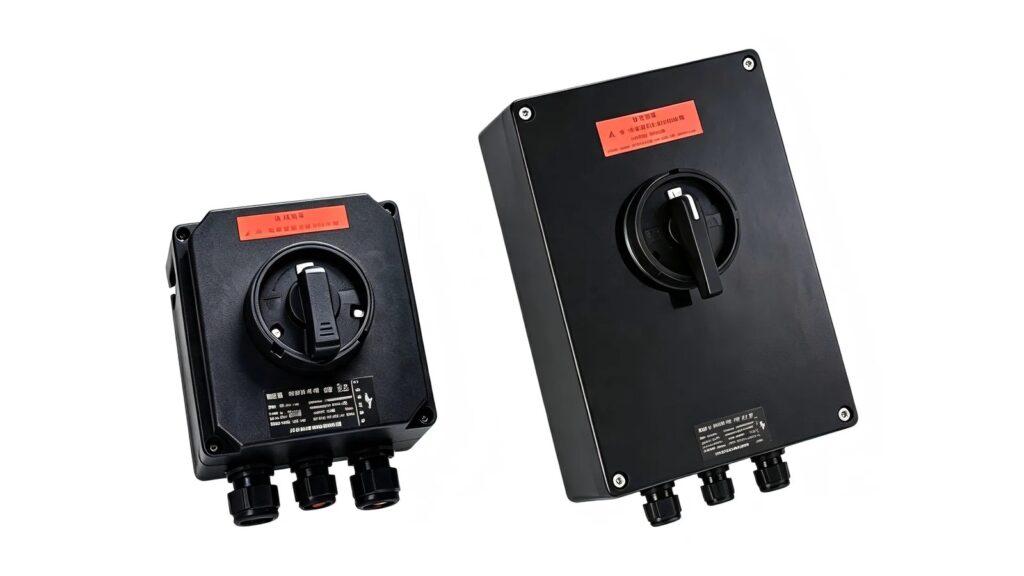
What the two markings mean
The letters after Ex identify the type and level of protection used by equipment or an Ex Component.
Ex dbis flameproof enclosure protectiondwith level of protectiondb. IEC 60079-1:2014 contains the construction and testing requirements for flameproof enclosures intended for explosive gas atmospheres.Ex ebis increased safety protectionewith level of protectioneb. IEC 60079-7:2015, together with its 2017 amendment, covers design, construction, testing and marking for increased-safety equipment and Ex Components.
Both standards supplement the general requirements in IEC 60079-0:2026. The code must be read with the rest of the marking, including group, temperature information and EPL.
As reviewed on August 28, 2026, the IEC lists IEC 60079-1:2026 as a pre-release Final Draft International Standard during its voting period through September 4, 2026. It should not be described as the final published replacement for IEC 60079-1:2014 yet.
Ex db contains an ignition without transmitting it
A flameproof enclosure is not designed on the assumption that its interior will always remain free of an ignition source. Its protection depends on enclosure strength, flamepaths, joints, entries, fasteners and other controlled construction details.
If an explosive gas atmosphere enters the enclosure and is ignited internally, the enclosure is designed and tested to withstand the pressure and prevent the explosion from being transmitted through its joints to the surrounding atmosphere under the covered conditions.
This principle explains why apparently small physical details matter. A changed joint, damaged thread, incorrect fastener, added hole or unapproved entry can affect enclosure integrity or the controlled path through which hot gases could pass.
Ex db does not mean that any component can be placed inside any flameproof box. Internal volume, heat, pressure effects, component arrangement, entries and the exact assessed construction remain part of the certificate and manufacturer documentation.
Ex eb prevents ignition sources by increased safety
Increased safety uses additional measures to prevent arcs, sparks or excessive temperatures within the conditions covered by the standard. IECEx competency guidance identifies characteristics such as temperature rise, maximum power dissipation, protection devices, certified components, creepage and clearance distances, absence of sparking contacts and enclosure entries.
An Ex eb terminal box may therefore use suitably assessed terminals, conductors and connections arranged within defined electrical, spacing and thermal limits. It is not simply an ordinary box with an Ex label.
The official IEC 60079-7 summary also distinguishes eb from ec. Level eb is associated with EPL Gb or Mb, while level ec is associated with EPL Gc. The exact protection level must be read from the complete marking and documents.
Ex db vs Ex eb comparison
| Selection question | Ex db | Ex eb |
|---|---|---|
| Protection principle | Contains an internal explosion and prevents flame transmission through controlled enclosure construction | Avoids arcs, sparks and excessive temperatures through increased-safety design measures |
| Main IEC product standard | IEC 60079-1 | IEC 60079-7 |
| Typical design focus | Enclosure strength, flamepaths, joints, fasteners, threaded holes and entries | Connections, terminals, spacing, temperature rise, power dissipation, protection devices and entries |
| Sparking parts | May be enclosed when included in the assessed flameproof design | Sparking contacts are not treated as ordinary permitted contents under Ex eb |
| Opening and maintenance concern | Flameproof joints, threads, covers and fasteners require strict protection and inspection | Terminal condition, conductor security, spacing, seals and temperature-related limits require control |
| Cable-entry concern | Gland and entry must suit the flameproof technique, cable and exact documentation | Gland and entry must suit increased safety, cable, environmental sealing and exact documentation |
| Can it be changed freely? | No | No |
| Is EPL alone enough to choose? | No | No |
This is a conceptual comparison. Exact product construction and permitted use come from the current certificate, schedule, marking and instructions.
The same EPL does not mean the same equipment
Both Ex db and Ex eb can appear with EPL Gb for gas applications, but EPL describes the equipment protection level, not the complete protection method or product function.
A buyer must still check:
- Gas group such as IIA, IIB or IIC
- Temperature class and permitted ambient range
- Electrical rating and maximum dissipation
- Enclosure material, environmental rating and corrosion duty
- Cable-entry method, thread, quantity and fitted accessories
- Exact internal components, terminals, operators and options
- Certificate number, issue, status, schedule and special conditions
- Installation, inspection and maintenance instructions
The article Equipment Protection Levels Explained shows why two products with EPL Gb can still differ in many essential fields.
Can one assembly use both Ex db and Ex eb?
Yes, an assessed equipment assembly can use more than one type of protection. A common concept is a flameproof section for parts that can spark and an increased-safety terminal section for field connections. The complete marking can list more than one protection code.
That does not authorize a buyer to combine separate parts independently. The assembly, interfaces, entries, internal wiring, temperature result and exact components must be included in the applicable design and documentation.
When a marking contains multiple codes, use the Ex marking guide and certificate schedule to identify which protection applies to which part.
Cable glands and stopping plugs are protection-specific
A gland is not selected only by thread size. Record the cable type, armour, outside diameter, sealing method, entry thread, enclosure protection technique, group, environmental duty and certificate conditions.
For Ex db, the gland and entry arrangement must preserve the flameproof protection covered by the enclosure documentation. For Ex eb, the entry must preserve increased safety and the environmental sealing required by the exact equipment.
Adapters, reducers and stopping plugs also require exact-document review. The explosion-proof cable gland FAQ provides the cable information buyers should collect.
Do not treat enclosure appearance as evidence
Two black or stainless-steel enclosures can look almost identical while using different protection techniques, groups, ambient limits or certificate scopes. A thick wall does not prove Ex db, and a terminal rail does not prove Ex eb.
Use the nameplate to identify the exact product, then compare it with the controlled documents. The certificate verification guide explains how to match the applicant or manufacturer, model, marking, issue and status.
A buyer workflow for Ex db and Ex eb
- Obtain the approved hazardous-area classification and destination-market requirements.
- Record the required EPL or category, gas group, temperature class and ambient range.
- Define the electrical function, including any switches, contactors, terminals or electronics.
- Identify which protection technique is required or permitted for each function.
- Define cable type, entries, glands, mounting and environmental duty.
- Compare the exact model and configuration with the certificate and schedule.
- Check instructions, special conditions and initial-inspection requirements.
- Freeze the approved configuration before manufacturing or site work.
The IEC 60079-14:2024 buyer checklist places these equipment checks inside the wider installation process.
Common Ex db and Ex eb mistakes
- Reading
dbandebas quality grades instead of different protection techniques - Assuming EPL Gb makes two enclosures interchangeable
- Installing ordinary sparking contacts in an Ex eb enclosure
- Ignoring temperature rise or maximum power dissipation in an Ex eb design
- Changing Ex db cover bolts, flamepaths, threads or entries without exact authorization
- Selecting a cable gland by thread size alone
- Applying a gas protection code to a dust application
- Accepting a certificate for a related enclosure rather than the exact configuration
- Using a photograph or wall thickness as certification evidence
Current MMAIATEX certification status
The public MMAIATEX About page states that ATEX, IECEx and CCC certification work is in progress. An Ex db or Ex eb phrase in a product title or image is not proof that a specific model has a completed certificate.
Request current documents for the exact legal manufacturer, model, suffix and configuration. Verify the protection techniques, certificate status, scope and conditions through the applicable official system before approval.
Safety disclaimer
This article provides general educational information. It does not design an enclosure, choose a protection technique for a project, authorize components or entries, interpret a certificate or provide installation instructions. Equipment selection, assembly design, installation and inspection must be completed by competent personnel using current standards, project data and exact product documentation.
Request an Ex db or Ex eb product review
Send MMAIATEX the destination country, approved Zone, required EPL or category, gas group, temperature and ambient requirements, electrical function, internal components, entries, cable details, mounting and required documents. The team can then identify potentially relevant enclosure or control-equipment information for the responsible engineer to assess.
Primary sources
- IEC 60079-1:2014, equipment protection by flameproof enclosures d
- IEC 60079-1:2026 pre-release version and voting status
- IEC 60079-7:2015, equipment protection by increased safety e
- IEC 60079-7:2015 Amendment 1:2017
- IEC 60079-0:2026, equipment general requirements
- IECEx competency outcomes for flameproof and increased-safety protection