
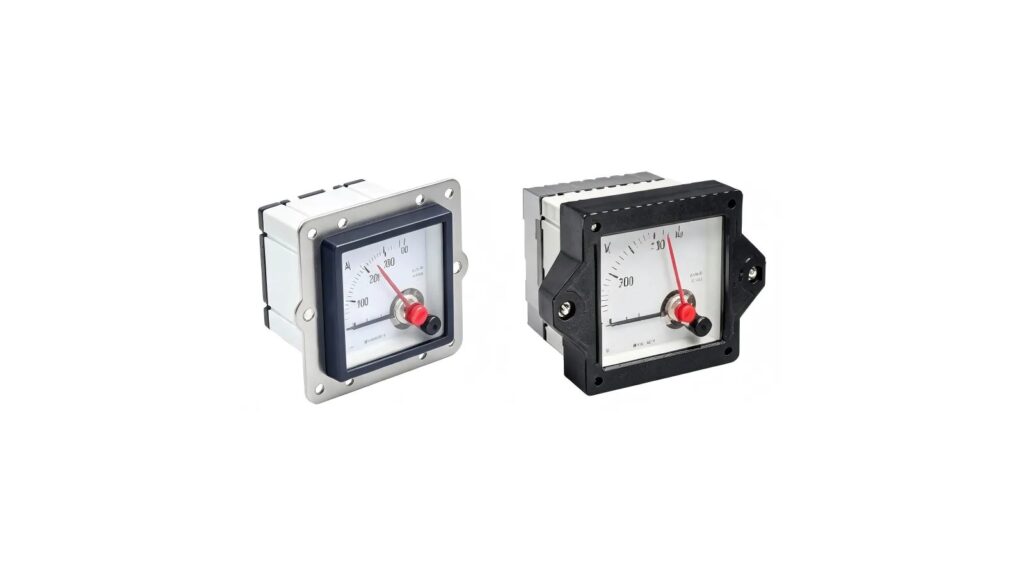
Key information for the procurement enquiry
| Selection field | Examples of the required decision | Why it matters |
|---|---|---|
| Measured quantity | Current, voltage, frequency or another stated quantity | Determines the instrument function and applicable standard part |
| Input | Direct input, current transformer secondary, shunt or transducer signal | Must match the circuit and accessory relationship |
| Display | Scale start, scale end, unit, graduation and orientation | Prevents a readable face from representing the wrong electrical value |
| Installation | Panel cutout, depth, terminals, enclosure and wiring method | Controls mechanical and electrical integration |
| Hazardous area | Zone or division, gas or dust group, EPL or category, temperature and ambient range | Defines the required explosion-protection evidence |
| Documents | Exact model, marking, certificate status, schedule, drawing and instructions | Connects the offered item to verifiable evidence |
1. How should an explosion-proof panel meter be specified?
Start with the electrical measurement, not the appearance. State whether the meter is an ammeter, voltmeter or another instrument, then give the input range, displayed range, unit, supply or auxiliary needs, accuracy requirement and accessories such as a current transformer or shunt. Add the panel cutout, available depth, terminal arrangement, wiring method and environmental conditions. Finally, state the hazardous-area classification and evidence required for the exact assembly.
2. Is the displayed scale the same as the electrical input?
Not always. An analogue meter may display a process or primary-circuit value while receiving a different input through a current transformer, shunt, series resistor or transducer. For example, the face cannot be used to infer the terminal input or accessory ratio. Ask for the exact scale, input specification, connection drawing and required accessory data as one matched set. Never substitute a similar-looking meter without recalculating and approving the measurement chain.
3. Which standards describe analogue ammeters and voltmeters?
IEC 60051-1:2016 gives definitions and general requirements for direct acting indicating analogue electrical measuring instruments and accessories. IEC 60051-2:2018 adds special requirements for analogue ammeters and voltmeters and is used with Part 1. These measuring-instrument standards do not by themselves prove suitability for an explosive atmosphere. The Ex construction, marking, certificate and installation must be verified separately.
4. Does a meter marked for panel mounting become explosion-proof after installation?
No. Panel mounting describes a mechanical arrangement, not an explosion-protection conclusion. The complete configuration may depend on the meter, mounting interface, host enclosure, terminals, seals, wiring and certificate schedule. A component and a finished item can also have different conformity roles. Request evidence for the exact supplied configuration and confirm whether any host enclosure or assembly conditions remain the integrator's responsibility.
5. What hazardous-area details must the buyer provide?
Provide the applicable zone or division system, gas or dust classification, group, EPL or equipment category, temperature class or maximum surface temperature, ambient range and any special environmental condition. Do not translate a Division requirement into a Zone marking, or the reverse, by name alone. The Class I Division 1 vs Zone 1 guide explains why these systems are not automatic equivalents.
6. Which electrical ratings need to match?
Confirm the measured circuit, input type and magnitude, frequency for AC measurements, overload or transient conditions, insulation needs, auxiliary supply where present, and terminal ratings. If the meter uses a current transformer, shunt or transducer, identify its ratio, output, class, burden and approved connection. The responsible electrical designer must check the complete measurement circuit rather than matching only the number printed at the end of the scale.
7. How should accuracy be specified?
Define the accuracy needed for the actual decision the meter supports and the operating portion of the scale. Also consider the associated transformer, shunt, transducer and wiring because the panel meter is only one source of measurement error. IEC 60051 terminology can structure the request, but the buyer must use the exact manufacturer's data and project rules. Do not invent an accuracy class from the face layout or assume every scale option has identical performance.
8. What mechanical dimensions should be checked?
Check the front dimensions, panel cutout, panel thickness range, mounting hardware, rear depth, terminal clearance, reading orientation and service access. Verify that the complete assembly preserves the host enclosure and Ex construction. A larger cutout, adapter plate or field drilling can change the assessed configuration. Before modifying an enclosure, read the MMAIATEX guide on drilling or modifying an explosion-protected enclosure.
9. Do IP ratings prove explosion protection?
No. An IP code describes protection against access, solid objects and water under the applicable enclosure test framework. Explosion protection addresses ignition hazards through a protection concept and conformity evidence. The two may both be required, but one does not replace the other. The IP66 vs explosion-proof guide explains the distinction and why buyers must verify both claims for the exact model.
10. What markings and documents should be requested?
Ask for the legal manufacturer, exact model and suffix, serial or batch identification where applicable, electrical ratings, complete Ex marking, ambient range and warnings. Then request the current certificate or declaration appropriate to the market, every relevant schedule or annex, product drawing, terminal diagram, installation instructions and accessory details. Use the Ex marking guide and certificate-verification workflow to match the physical item to the documents.
11. Can one panel meter be replaced by another with the same face size?
Not without a controlled equivalence review. The replacement can differ in input, scale relationship, accuracy, terminals, insulation, depth, mounting details, ambient limits, protection concept and certificate scope. It may also depend on a specific accessory or host assembly. Record the original identity and every comparison field, then obtain approval from the responsible engineering and compliance functions before substitution or return to service.
12. What should be sent to MMAIATEX for a panel-meter review?
Send the destination market, area classification, gas or dust information, required EPL or category, ambient range, measured quantity, circuit input, displayed scale, unit, accuracy need, transformer or shunt data, panel drawing, cutout, terminal preference and document list. Include photographs only as supporting context. They cannot replace the nameplate, drawing, certificate schedule or exact model identity.
Current MMAIATEX certification status
The public MMAIATEX About page states that ATEX, IECEx and CCC certification work is in progress. MMAIATEX Explosion-proof Technology (Zhejiang) Co., Ltd. does not present this FAQ, a meter scale, an IP rating, a panel cutout, a product category or a representative photograph as proof that a particular meter or assembly is certified.
Verify the exact legal manufacturer, model, suffix, complete marking, current certificate status and scope, schedules, drawings, accessories, instructions and project requirements before selection or use.
Safety and legal disclaimer
This FAQ provides general buyer education. It does not design a measurement circuit, select a current transformer or shunt, establish accuracy, modify an enclosure, classify a hazardous area, interpret a certificate or approve equipment. Competent parties must apply current standards, exact product documentation, circuit calculations, safe-work procedures and applicable law.
Request a panel-meter evidence review
Send the electrical measurement, input and scale details, installation drawing, hazardous-area requirements and destination-market document list. MMAIATEX can identify available exact-model information for review by the responsible engineering and compliance team.