
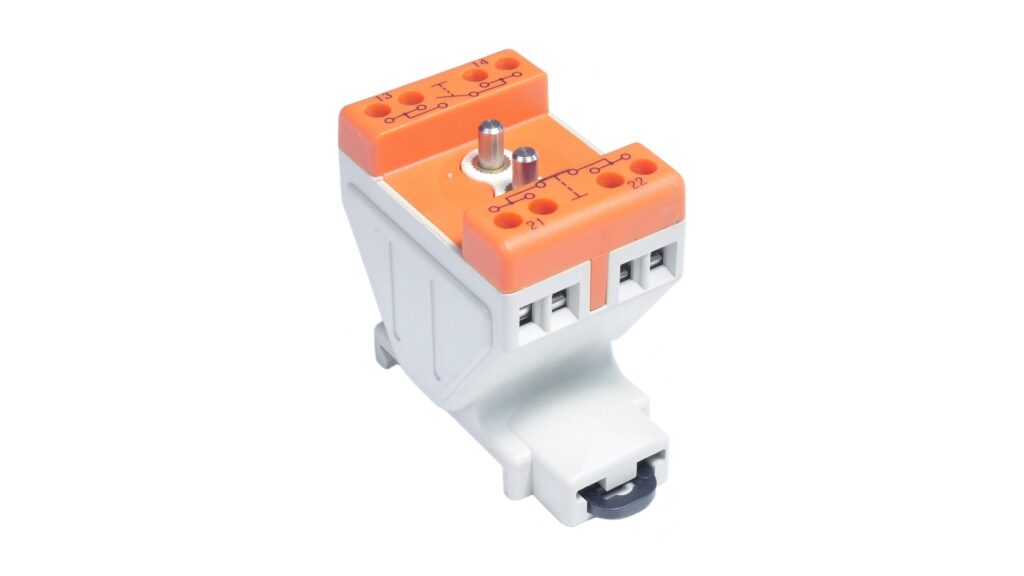
Image note: The representative photograph shows a control contact block, not a distance measurement or insulation test. It establishes no clearance, creepage or voltage rating. Verify exact model marking, certificate scope and current documentation.
Creepage vs clearance: name the path first
The ISO public terminology page reproduces these terms from the IEC vocabulary. Its clearance entry cites IEC 60050-426, while its creepage entry cites IEC 60050-151. The distinction is about where the path runs, not whether one quoted number looks more generous than another.
Use the comparison below to identify what a supplier has actually described. It is an editorial document-reading aid, not a procedure for measuring equipment.
| Information presented | What needs identifying | What remains unresolved |
|---|---|---|
| Clearance dimension | Air path and both conductive endpoints | Whether the applicable assessment accepts it |
| Creepage dimension | Insulation surface and both endpoints | Whether the documented configuration is applicable |
| Unlabelled distance | Quantity, route and drawing reference | Even the meaning of the number |
| Product photograph | Visible family and orientation | Hidden geometry, dimensions and approval |
An answer such as "insulation distance confirmed" is still ambiguous if it never names the quantity. Ask the author to identify the corresponding drawing detail or statement, rather than supplying a label on the author's behalf.
Keep the standard's scope separate from the product claim
The current IEC 60664-1 catalogue record identifies IEC 60664-1:2020+AMD1:2025 CSV, Edition 3.1, published May 6, 2025. It concerns insulation coordination for low-voltage equipment, including clearances, creepage distances and solid insulation, within its stated application limits.
That scope does not make every control component suitable for every installation. A reference to the standard should lead to the applicable assessment and exact product documentation, not an assumption that a catalogue image demonstrates conformity. Nor does the publication date establish which edition a particular product was assessed against.
Explosion protection has a separate evidence boundary. IEC 60079-0:2026, Edition 8.0, describes general construction, testing and marking requirements for Ex Equipment and Ex Components. This article does not turn either standard's existence into a certification statement for a model.
Follow one drawing reference through the comparison
Start with the document that contains the disputed dimension. Record its identifier and revision, then preserve the label used by its author. Do not replace "clearance" with a generic "gap" in the purchasing summary: the shorter wording can remove the distinction the reviewer needs.
Next, identify the two conductive parts named in that detail. A dimension between two terminals and one between a terminal and another part cannot be treated as matching merely because both are on the same page. If the endpoints are not identified, mark that as a clarification question instead of guessing from a small illustration.
Then connect the detail to the offered configuration. A drawing for a module alone and a drawing for an assembled arrangement may describe different objects. Ask which document applies to the quotation's exact combination and whether a later revision supersedes it. This is a comparison of records, not an instruction to disassemble or measure anything.
Finally, retain the technical review decision separately from the supplier's dimensional statement. "Document received" and "accepted for this project" should not become the same status. The first can be recorded by the purchasing team; the second needs the responsible assessment and its stated basis.
Two offers can contain numbers without answering the same question
Consider a hypothetical comparison. Offer A attaches a labelled surface-path detail for a particular contact-block configuration. Offer B includes an overall product drawing with an unlabelled dimension. Copying both values into a single spacing column would suggest a comparison that the documents do not support. The useful follow-up is to identify B's quantity and endpoints, not to rank the two values.
In another hypothetical case, both documents use the same term, but one refers to an earlier component revision. The label now matches; the configuration may not. Ask the document owner to connect the applicable revision to the offered part. Keep the earlier record visible until the relationship is resolved, so a later reviewer can see why the comparison changed.
Neither example proves that an offer is unsafe or noncompliant. They identify an evidence mismatch that prevents a meaningful comparison. That narrower conclusion is more useful than either rejecting a product on appearance or accepting an undocumented equivalence.
Connect the question to the appropriate product record
The catalogue's listed panel-mounted control components provide a starting reference for an enquiry. They do not supply an insulation assessment for every possible combination. Identify the listing and offered configuration before forwarding a geometry question.
If the difficulty is interpreting voltage labels, use the separate Ue, Ui and Uimp guide. Those labels should not be substituted for the path description discussed here. For conductor and accessory questions, the terminal-block buyer FAQs address a different part of the decision.
Do not resolve an unclear drawing by changing the product. The enclosure modification FAQs explain why proposed changes need their own controlled review. This guide grants no permission to alter internal geometry.
Source and certification boundaries
The ISO page above is a terminology source that reproduces IEC definitions. Its host document concerns motorcycle energy-storage systems; it is not presented as a product standard for these control components. No dimensional requirements from that document are applied here.
As reviewed on October 21, 2026, the MMAIATEX About page describes ATEX, IECEx and CCC certification as in progress. This is the company's published statement, not independent certificate verification. MMAIATEX Explosion-proof Technology (Zhejiang) Co., Ltd. is the legal entity identified here. No listed product is claimed to have a verified spacing, rating or certificate through this article.
Safety and legal disclaimer
This guide supports document clarification, not insulation design, field measurement, repair or installation approval. It supplies no acceptable distance or calculation method. Qualified personnel must assess the actual equipment, applicable requirements and manufacturer documentation. Do not open, modify or test equipment to resolve a purchasing question using this article.
Contact MMAIATEX
For a control-component enquiry, include the catalogue reference, offered combination, drawing identifier and the exact path or label that needs clarification. Keep the project assessment separate from the question about the document.