
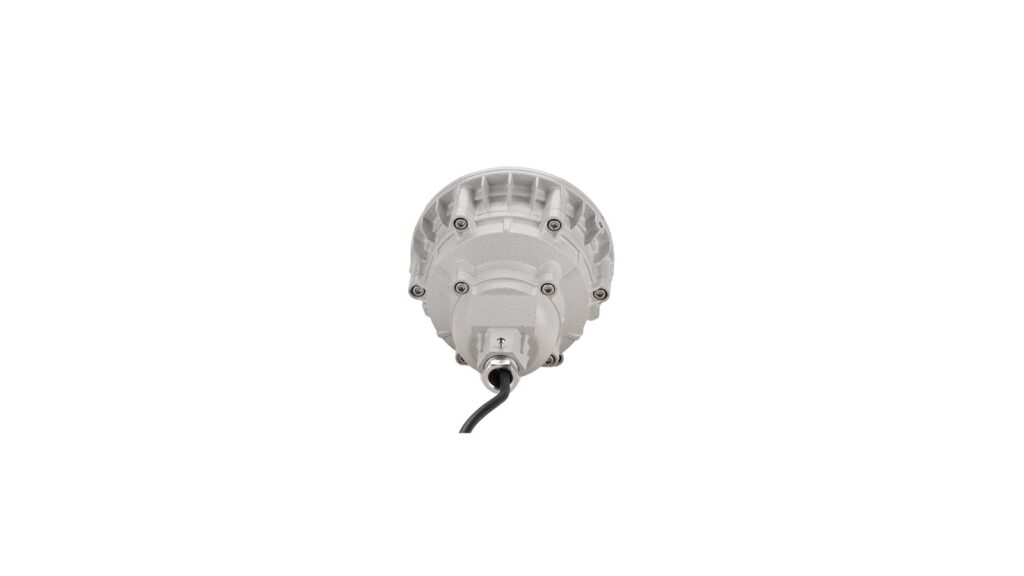
Image note: The representative photograph shows the rear housing of a luminaire. It is not a photograph of today's publication, an internal driver or a performance test. Verify exact model marking, certificate scope and current documentation.
MMAIATEX luminaire offer review resources: before the ranking
Consider a hypothetical comparison between two lighting offers. Both contain a product-family name, a standard reference and several electrical entries. Purchasing wants to decide which offer is better, but the comparison is not yet describing like-for-like information.
The first offer leaves its luminaire variant unclear. The second names a variant, but its figures have been copied into a spreadsheet under a broad efficiency heading. A driver description elsewhere in the file refers to a configurable family without identifying the supplied arrangement.
These are not three examples of a low-performing product. They are three different obstacles to understanding the offers. Giving each obstacle the same generic status, such as "technical information pending," conceals what needs to change before comparison can continue. The example below is original editorial guidance, not a customer case or a mandatory purchasing procedure.
First establish what the safety statement describes
For the unidentified variant, a more favorable numerical figure would not resolve the problem. The buyer still would not know which offered item the safety statement describes.
The new IEC 60598-1 luminaire safety guide connects the general and relevant particular references with the identified configuration and supporting assessment. It also explains why different publication years alone do not establish a mismatch.
In the hypothetical comparison, that guide helps isolate the first task: obtain a sufficiently clear description of the offered variant and the relationship claimed for its documents. This does not decide whether the product is acceptable. It establishes what the responsible reviewer is being asked to assess.
Then correct a comparison that mixes different quantities
The spreadsheet problem is different. Even if both items were clearly identified, placing PF and lm/W in one efficiency column would not create a meaningful ranking.
The new luminaire power factor versus efficacy guide explains the electrical and optical quantities separately. In this example, the immediate correction belongs to the comparison itself: name the separate quantities and preserve the meaning of each supplied entry.
Do not mark an offer down simply because the spreadsheet asked an ambiguous question. Equally, do not assume that correcting the heading supplies a missing answer. A properly named column can still remain unanswered. That is an information gap to identify, not a value to invent.
Keep an unidentified driver configuration unresolved
The remaining obstacle concerns the actual arrangement being offered. A family description or supply-side entry does not necessarily identify the declared LED-side output configuration.
The new constant-current and constant-voltage driver FAQs contain twelve buyer questions that clarify those descriptions without authorizing replacement or programming. They help keep an output-mode question separate from a wattage comparison or a control-interface question.
For the hypothetical offers, this means retaining the uncertainty until the supplier identifies the as-supplied configuration. It does not mean selecting a setting for the supplier, assuming two drivers are interchangeable or asking purchasing to investigate concealed components.
A clarified comparison is still not an acceptance decision
The distinctions above allow a more precise progress note. One part of the comparison may now refer to an identified variant. Another may have correctly labelled quantities but still lack a value. A third may still await clarification of the offered output arrangement.
Those states can coexist. Completing one does not make the whole offer ready for acceptance, and leaving one unresolved does not prove the product is unsuitable. The responsible project team can see what is now comparable and what remains outside the comparison, without a premature overall score hiding the difference.
Use the website's listed luminaires and floodlights to name the family involved in an enquiry. A listing is not evidence that every option is available or that separate drivers are supplied. The three new guides provide explanatory resources, not missing model documents or a new company review service.
What this publication confirms
The three linked pages are the direct evidence of today's content update in Industry Insights, Technical Knowledge and FAQs. Each carries a dated review, source links and its own limitations. This company article adds an illustrative comparison workflow rather than repeating their technical explanations.
No completed test, customer installation, production activity or new product capability is announced. The hypothetical offers and purchasing discussion are not records of MMAIATEX transactions.
Current MMAIATEX certification status
MMAIATEX is the public brand of MMAIATEX Explosion-proof Technology (Zhejiang) Co., Ltd. As reviewed on October 22, 2026, its About page describes ATEX, IECEx and CCC certification as in progress. This is an attributed website statement, not independent certificate verification. Publication does not change a model's certification status or establish its performance.
Safety and legal disclaimer
This update supports quotation clarification, not lighting design, electrical testing, driver selection, modification or legal approval. Qualified responsible parties must assess the exact equipment and applicable requirements. Do not open, adjust or operate equipment on the basis of this hypothetical comparison.
Contact MMAIATEX
Send the lighting reference, quotation revision and the particular obstacle preventing comparison. State whether the uncertainty concerns the identified variant, a performance-field label or the supplied driver configuration.