
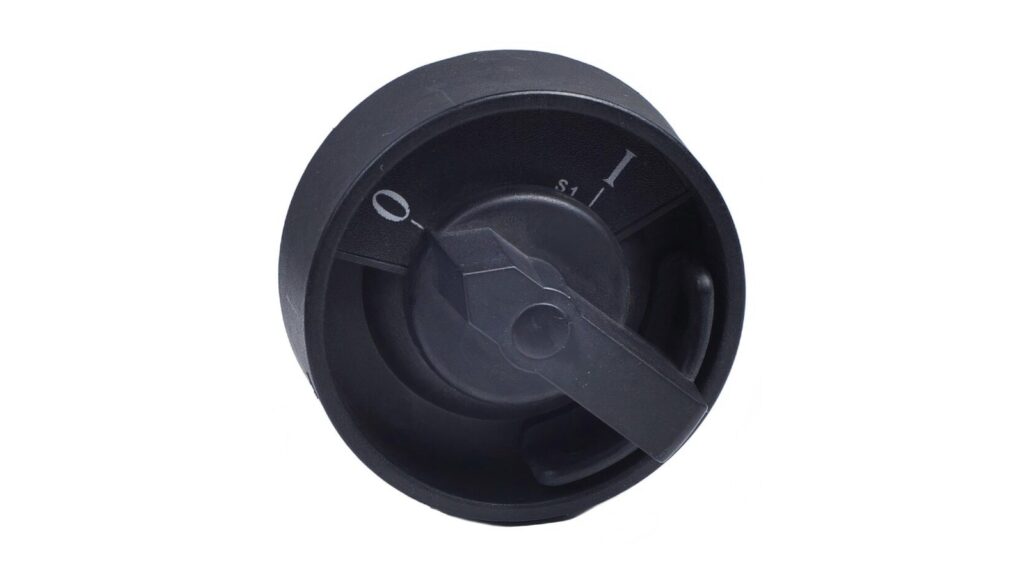
Image note: The representative photograph shows a black rotary operating head. Internal contacts and timing measurements are not visible; the image establishes no bounce, switching time or control function. Verify exact model marking, certificate scope and current documentation.
Contact bounce vs switching time: name the interval
These are editorial buyer questions, not reported customer enquiries or instructions for collecting waveforms. The following table organizes an enquiry without defining a universal timing specification.
| Information supplied | Purchasing interpretation | Missing item to clarify |
|---|---|---|
| Bounce-time entry | A particular transition-related interval | Its documented start and end events |
| Switching-time entry | A separately defined timing claim | Which phases its definition includes |
| Input-system response entry | A statement about the receiving system | Its relationship to the contact event |
| Unlabelled time value | Insufficient information for comparison | Quantity, unit and event definition |
1. What does contact bounce mean in the source used here?
OMRON's Basic Switches terminology, Section 12, associates bounce with the moving contact colliding with the fixed contact. Its explanation concerns basic-switch behavior. It does not supply a timing specification for an unidentified panel operator. In an enquiry, identify the actual contact device before applying terminology from another product family. A similar-looking front face cannot establish that the same timing statement applies.
2. Is bounce time the same as total switching time?
Not in the cited OMRON description, which includes unstable, reverse and bounce periods within contact switching time. That is an attributed definition, not a universal rule for every catalogue. If one offer reports bounce and another reports switching time, ask for each definition before ranking their numbers. Do not subtract, add or relabel entries unless the responsible technical source explicitly establishes the relationship for those records.
3. Must the operating and releasing events be identified?
Yes. A useful timing statement should identify the transition it describes. Ask whether the supplied entry concerns operation, release or another defined event rather than assuming one value covers all actions. Keep the wording used in the source document. If a quotation gives only a generic response-time line, the missing event is a specific clarification issue, not evidence that the device is either fast enough or unsuitable.
4. Are matching time units enough to compare offers?
No. Two entries can use the same unit while measuring different intervals. Preserve the start event, end event and quantity label beside the unit. Converting seconds to milliseconds would not resolve a difference in what the documents describe. A purchasing comparison should first establish that the intervals answer the same question, then pass the actual values and their conditions to the responsible reviewer.
5. Why retain maximum, typical or other qualifiers?
Because those words are part of the claim being supplied. Do not present a typical entry as an upper bound, or remove a maximum qualifier to create a cleaner table. If the qualifier is absent, ask what the source intends rather than choosing one. Two statements can be clearly identified yet still require different treatment against the project requirement; purchasing should expose that difference rather than normalize it away.
6. Does a receiving-system timestamp describe the contact alone?
Not by itself. Establish what the recorded event represents and which system produced the record. A controller log, displayed indication and contact-related statement should not be assigned the same meaning without an explanation from the responsible parties. Ask where the event definition comes from and which part of the system the timing claim concerns. This is a document-interpretation question, not permission to connect measuring equipment or diagnose a live circuit.
7. Do NO and NC labels establish transition timing?
No. The 13-14 and 21-22 contact-numbering guide explains normal contact state and identification. Those descriptions do not supply a time interval. Keep the contact-state requirement separate from the timing question in an offer review. An answer confirming the required contact arrangement can close that arrangement question while leaving the requested timing information unresolved.
8. Can force or travel information answer a timing question?
Not merely because it describes the same operator. The operating force and travel FAQ addresses mechanical quantities, not a timing acceptance criterion. Do not invent an operating speed to convert travel into time, or infer timing from how an operator feels. If the supplier responds with a mechanical-characteristic table, identify the still-missing timing statement instead of treating the reply as equivalent evidence.
9. Does an endurance count establish a bounce-time limit?
No such limit follows from the count alone. The mechanical versus electrical endurance FAQ concerns repeated-operation claims and their load basis. Today's question concerns the meaning of a transition-related interval. Retain both records if both matter to the project, but do not use a large operation count to fill an empty timing field or interpret a timing statement as a service-life forecast.
10. Can an operating-head listing establish contact timing?
Not without a statement connecting it to the actual contact combination. The listed control modules and operating heads help identify an enquiry family. They do not establish a timing claim for an unspecified assembled operator. Name the proposed head and contact references and ask which item the supplied record covers. A front-view photograph is not a view of the internal contact event.
11. Can this FAQ provide an input-filter setting?
No. Choosing an input treatment requires the actual system requirements and competent assessment; an isolated catalogue phrase is insufficient. This FAQ recommends no delay, filtering method, wiring change or software parameter. State the unresolved interaction to the people responsible for the contact device and receiving system. Their review must also address any applicable safety function rather than assuming a nuisance indication can simply be suppressed.
12. What is a useful timing clarification in practice?
Consider a hypothetical offer that answers a contact switching-time question with a controller-response entry. A precise follow-up identifies the mismatch: the supplied statement concerns a different subject or event. Ask for the intended contact-related interval and its definition, or an explicit explanation of how the submitted evidence answers the enquiry. Keep the two records separate until that relationship is established; do not manufacture a combined result.
Current MMAIATEX certification status
The MMAIATEX About page describes ATEX, IECEx and CCC certification as in progress. This is an attributed company statement, not independent certificate verification. MMAIATEX Explosion-proof Technology (Zhejiang) Co., Ltd. makes no product timing or input-compatibility claim through these answers.
IEC 60947-5-1:2024, Edition 5.0, addresses control-circuit devices within its scope. IEC 60079-0:2026, Edition 8.0, separately addresses general Ex construction, testing and marking. Neither a timing label nor a standard's existence proves the offered assembly's approval.
Safety and legal disclaimer
This article supports purchasing clarification, not testing, fault diagnosis, input configuration, circuit modification or installation approval. Manufacturer terminology is not a MMAIATEX specification. Competent parties must assess the exact equipment, current documents and applicable requirements. Do not operate equipment or alter a safety function using this FAQ.
Contact MMAIATEX
Include the offered operator and contact references, the timing entry with its surrounding definition, and the particular interval or system boundary that needs clarification.