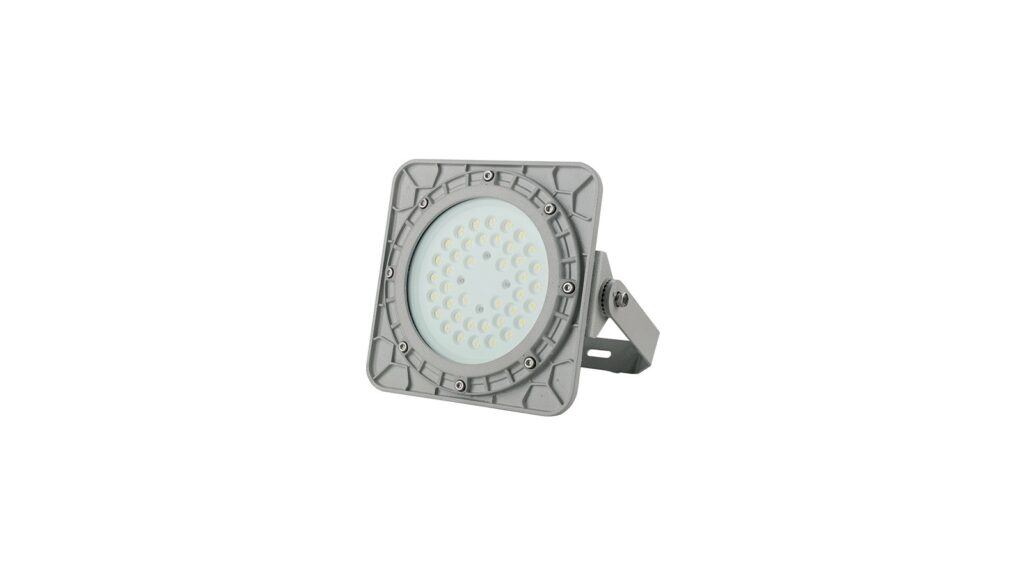
Image note: The representative photograph shows an angled front view of a square gray luminaire with a circular LED and lens array and an adjustable bracket. It is not a photometric measurement or completed lighting design and establishes no lumen output, intensity distribution or illuminance. Verify exact model marking, certificate scope and current documentation.
Lumens vs candela vs lux: three different questions
A purchasing description such as "light output" can conceal different meanings. One attachment may describe the source, another a particular beam direction, and another the result at a surface. Those statements can all be useful, but they cannot occupy the same comparison field without explanation.
The following table is an editorial reading aid, not a performance specification.
| Quantity and unit | Question it answers | Spatial information to retain |
|---|---|---|
| Luminous flux, lumen (lm) | How much photometric output is being described? | The identified source and extent of the reported output |
| Luminous intensity, candela (cd) | How is output concentrated in a specified direction? | Direction and distribution reference |
| Illuminance, lux (lx) | What light is incident at a surface location? | Surface, position and stated arrangement |
| Unqualified light-output claim | Which quantity does the supplier mean? | The missing definition before any ranking |
The listed industrial luminaires and floodlights provide catalogue references for an enquiry. A product card or visible LED array is not a measurement of any of these quantities. Start with the exact offered option, rather than attaching an assumed result to the whole listed family.
Lumens describe flux, not a beam shape
CIE's luminous-flux entry identifies the photometric quantity and its unit, the lumen. Photometric quantities account for the standard observer's response to optical radiation; they are not simply electrical watts.
In a quotation, identify whether a lumen statement concerns the complete luminaire or another stated source. Also retain whether the figure describes total output or a specified portion. The word "lumens" supplies the unit, not the missing subject or coverage.
Once those points match, equal lumen totals still leave an important purchasing question open: how is the output distributed? A total does not identify the directions relevant to the project. Asking for a distribution is therefore not asking for the same quantity again under a different name.
Candela keeps the direction in the comparison
CIE defines luminous intensity through luminous flux per solid angle in a specified direction, expressed in candela. The directional qualification matters. A peak value or a value on one axis is not a complete distribution.
Consider a hypothetical pair of luminaires with the same stated total flux but different optical arrangements. One supplier provides a directional distribution; the other supplies only a single peak intensity. The second reply does not yet establish comparable coverage away from that peak. It would be premature to select a winner from the highest displayed number.
The useful comparison concerns the directions relevant to the intended task. This guide does not prescribe aiming angles or decide which distribution suits the site. It explains why a maximum alone cannot answer a question about the rest of a distribution.
Lux belongs to a receiving surface
CIE's illuminance entry concerns incident luminous flux per area at a point on a surface. Its unit is lux, equivalent to lumen per square metre. That unit identity does not mean all light leaving a luminaire reaches a chosen floor or working plane.
Consequently, a lux claim needs its location and arrangement. Ask whether the reported value concerns a particular point, an average over a stated area or another clearly defined result. Keep the supplier's qualification intact. A single point should not silently become an area-wide promise.
For example, a hypothetical result on a horizontal floor plane and one on a vertical inspection surface are not interchangeable answers merely because both use lux. The task and reference surface must be identified before their relevance can be assessed. The responsible lighting designer determines the project's actual criteria.
Why there is no universal conversion for a purchase
The units are related, but a lone catalogue number does not supply the missing spatial information. A request to "convert these lumens into the lux we will get" leaves the distribution and installation context unspecified. A fixed conversion factor would conceal those omissions.
Likewise, dividing a quoted lumen total by a room's floor area is not an established lighting result for that room. It assumes a relationship between emitted and received light that the quotation has not demonstrated. Treat the unanswered project question as unanswered, rather than presenting convenient arithmetic as a design conclusion.
A supplier's beam-angle label can help identify an optical option, but it does not replace the complete data needed for the actual comparison. Preserve the exact label and let the designer establish what further information is necessary. This article supplies no calculation method, fixture quantity or spacing recommendation.
Turn the quantity distinction into a clear handoff
Separate a source-level claim from the project result it is intended to support. A buyer can accurately record that a supplier stated total output while still leaving workplace illuminance unresolved. That does not accuse the supplier of a false statement; it identifies a different question.
For the file and configuration relationship, use the photometric-data buyer FAQ. It addresses which data belongs to the offered product. Today's guide addresses what the quantities mean once that identity is clear. Correct file identity and correct interpretation are both needed, but they are not the same check.
The power-factor versus efficacy guide separately explains electrical input and lumens per watt. An efficacy ratio is not a substitute for a distribution or a surface result. Keep an energy comparison from silently becoming an answer to where the light is needed.
Source scope and current certification status
The linked CIE e-ILV entries identify the second edition of CIE S 017:2020 and were reviewed on October 31, 2026. They support the short definitions above, not a particular product's measured performance or an industrial illuminance requirement. The hypothetical examples are original interpretation aids.
The MMAIATEX About page describes ATEX, IECEx and CCC certification as in progress. This is an attributed company statement, not independent certificate verification. MMAIATEX Explosion-proof Technology (Zhejiang) Co., Ltd. makes no model-specific optical-performance or approval claim through this guide.
Safety and legal disclaimer
This is purchasing interpretation, not lighting design, optical testing or hazardous-area approval. Competent parties must establish the actual task requirements and assess the equipment and installation. No target lux, safe viewing condition, mounting arrangement or permission to operate equipment is provided.
Contact MMAIATEX
Include the listed luminaire reference, the optical option being discussed and the exact quantity needing clarification. If the question concerns lux, identify the intended task and the surface described in the supplied information.