
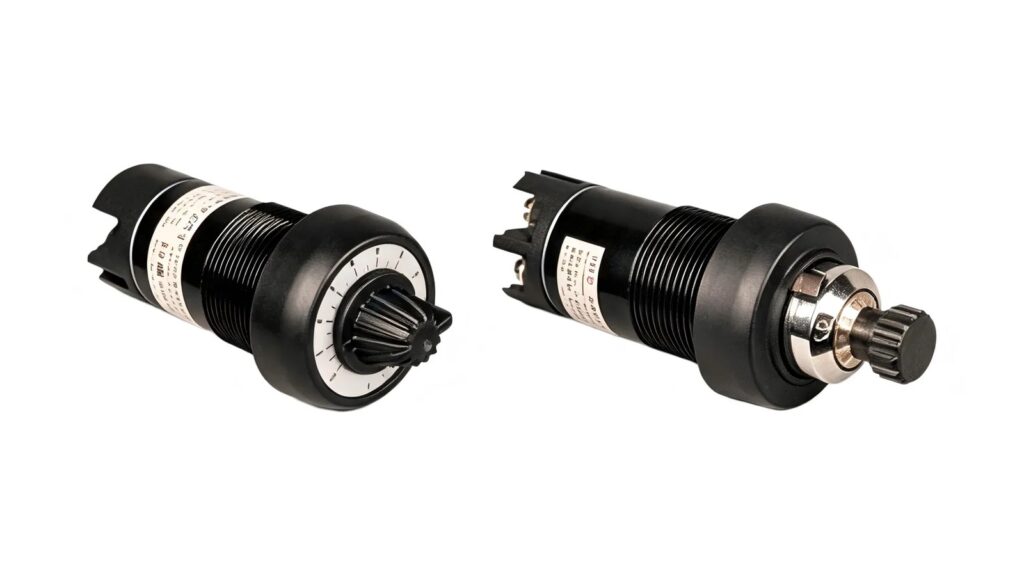
The term explosion-proof is common buyer language, but it is not a complete protection marking. Start with the project's area classification and required Equipment Protection Level, then identify the exact certified construction and conformity route. The Ex-marking guide and certificate-verification guide explain those separate evidence checks.
Potentiometer selection evidence at a glance
| Evidence layer | Buyer decision | Unsafe shortcut |
|---|---|---|
| Control function | Required setpoint behavior and circuit response | Choosing from knob appearance |
| Resistive element | Resistance, tolerance, taper, turns and rated dissipation | Assuming one value fits every input |
| Interface | Shaft, operator, terminals, panel and complete assembly | Treating a loose part as complete Ex Equipment |
| Ex evidence | Exact marking, certificate status, schedule and instructions | Relying on a product name or Ex logo |
| Installation | Wiring, ambient limits, enclosure integrity and inspection | Treating IP66 as explosion protection |
IEC 60393-1:2008 is the current generic IEC specification for resistive potentiometers used in electronic equipment. Its public scope covers single-turn, multi-turn and other resistive types and establishes terms and test methods. Current sectional documents include IEC 60393-3:2023 for rotary precision potentiometers, IEC 60393-4:2023 for single-turn rotary wirewound power potentiometers normally above 10 W, and IEC 60393-5:2015 for single-turn low-power types below 10 W. Those scope boundaries are not ratings for an offered product and do not establish Ex suitability.
IEC 60947-5-1:2024 covers electromechanical control circuit devices and switching elements within its public scope. It matters only when the exact potentiometer assembly includes a function covered by that standard. It is not universal evidence for a passive resistive element.
1. What is an explosion-proof potentiometer?
An explosion-proof potentiometer is buyer shorthand for an adjustable resistive control intended to be used within a hazardous-area equipment design. The phrase does not prove the protection concept or certification. Confirm whether the quoted item is certified complete Ex Equipment, an Ex Component, or an internal part covered only by the certificate and controlled construction of a complete assembly.
2. Is a potentiometer the same as a selector switch?
No. A potentiometer typically varies resistance through a wiper, while a selector switch changes discrete contacts or positions. Some operator assemblies can combine functions, so knob shape is not enough. Confirm the circuit symbol, terminal diagram, resistance characteristic, detents or stops, mechanical travel and complete part number before treating either device as an equivalent.
3. Which resistance value should a buyer specify?
Use the value required by the control-circuit designer and the connected input, not a familiar catalogue value. State nominal total resistance, tolerance and the permitted wiper or load conditions. Also confirm the required adjustment range and failure response. Too high or too low a value can change signal behavior, current, heating and compatibility with the receiving circuit.
4. What do linear and logarithmic taper mean?
Taper describes how the resistance ratio changes as the shaft moves. A linear taper is commonly chosen when proportional adjustment across travel is wanted. A logarithmic or other non-linear taper produces a different response curve. Do not select from the word alone. Obtain the exact characteristic, tolerance, direction of increase and circuit response required by the application.
5. Should I choose a single-turn or multi-turn potentiometer?
Choose according to required adjustment resolution, speed, usable travel and operator ergonomics. A single-turn device supports faster movement across its range, while a multi-turn device can allow finer adjustment. Neither is universally safer or more accurate. Confirm turn count, mechanical stops, scale, shaft interface, repeatability and how the complete operator behaves in service.
6. What is the difference between two-wire and three-wire connection?
A three-terminal resistive potentiometer is commonly used as a voltage divider, with the wiper providing an adjustable fraction of the applied voltage. Using the wiper and one end terminal can create a two-wire variable resistance function. The exact drawing controls. Do not bridge an unused terminal, assign polarity or predict an open-wiper response without documented circuit instructions.
7. Does a potentiometer provide a 4-20 mA or 0-10 V output?
Not by itself as a universal feature. A passive resistive potentiometer changes resistance or a voltage ratio when used in a suitable circuit. Excitation, load and any signal conditioner determine the actual output. Some assemblies may include electronics, but a buyer must verify the exact output range, supply, isolation, fault behavior and terminal diagram rather than infer them from the knob.
8. Which electrical ratings must be checked?
Check nominal resistance, tolerance, rated dissipation, permitted working voltage, wiper limits, load type and environmental derating in the exact datasheet. Also check the connected circuit and protective measures. Do not apply the IEC 60393-5 scope ceiling of 10 W as a product rating, and do not transfer a value from a visually similar potentiometer.
9. Can any potentiometer be mounted through an Ex enclosure?
No. A new panel opening, operator, seal, shaft, retaining method, internal wiring or component substitution can affect the certified construction. Use only the exact parts, mounting dimensions, panel conditions and assembly method permitted by controlled drawings, the certificate schedule and manufacturer instructions. A loose internal potentiometer does not become complete Ex Equipment merely because it is installed behind a certified enclosure wall.
10. Does an IP66 rating prove explosion protection?
No. IEC 60529 classifies enclosure protection against access, solids and water under defined tests. It does not establish an Ex protection concept, EPL, gas or dust group, temperature performance or certificate status. The finished assembly may require both ingress and explosion protection, but the evidence is separate. The MMAIATEX IP66 comparison explains this boundary.
11. Can a potentiometer be used in an intrinsically safe circuit?
Only after the exact circuit has been assessed under the applicable intrinsic-safety requirements. Do not label an unidentified potentiometer as simple apparatus or assume low resistance means safe. The designer must evaluate the certified apparatus, associated apparatus, entity or system parameters, cables, stored energy, temperature effects, faults and installation documentation under the current project basis.
12. Which documents are needed before ordering and energisation?
Request the exact model datasheet, resistance and taper data, terminal diagram, turn count, mechanical drawing, ratings, ambient limits and installation instructions. For hazardous-area use, also obtain the complete marking, current certificate and schedule, specific conditions, controlled bill of materials and assembly evidence. Compare the delivered identity with the approved dossier and complete the required initial inspection before energisation.
Related MMAIATEX guidance
Use the panel-mount push-button FAQ to review operator and panel-interface evidence. The control-station buyer FAQ covers the complete assembled control function. Before changing a certified panel, review the guide on drilling or modifying an Ex enclosure.
Current MMAIATEX certification status
The public MMAIATEX About page states that ATEX, IECEx and CCC certification work is in progress. MMAIATEX Explosion-proof Technology (Zhejiang) Co., Ltd. does not present this FAQ, a representative photograph, a product category, a resistance value or an IP rating as proof that a particular potentiometer or completed assembly is certified.
Verify the exact legal manufacturer, model, marking, current certificate status and scope, schedules, approved assembly, instructions and project requirements before selection or use.
Safety and legal disclaimer
This FAQ is buyer education, not a circuit design, intrinsic-safety assessment, area classification, certificate decision, assembly authorisation, installation instruction or legal opinion. Competent project parties must apply licensed standards, current product evidence, manufacturer instructions and applicable law. Do not select, modify, install or energise a potentiometer from this FAQ alone.
Request a potentiometer evidence review
Send the destination, area classification, required EPL, resistance, tolerance, taper, turn count, circuit diagram, ratings, panel interface, complete offered marking and required documents. MMAIATEX can identify available product records for review by the responsible engineering and compliance team.