
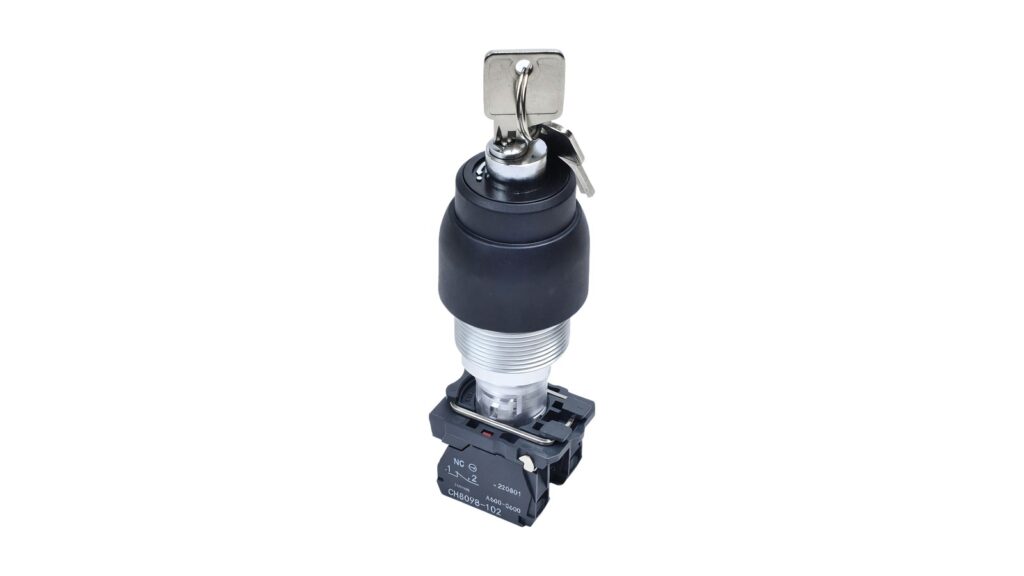
How this FAQ fits the buyer workflow
This FAQ focuses on selector-switch procurement, not general operator terminology. Use the MMAIATEX 13-14 versus 21-22 guide for contact numbering, the panel-mount push-button FAQ for push-button selection and the emergency-stop FAQ for that separate safety function. The control-station buyer FAQ covers the wider assembled station.
1. What is an explosion-proof selector switch?
An explosion-proof selector switch is buyer shorthand for a rotary manual control device intended to select a defined circuit state within a hazardous-area equipment design. The words do not prove a protection concept or certification. Confirm whether the quoted item is complete Ex Equipment, an Ex Component, or an internal part permitted only within the controlled construction of a certified assembly.
2. Is a selector switch the same as an isolator or emergency stop?
No. A selector switch normally commands or selects a control state. A disconnector performs a defined isolation duty, and an emergency-stop device performs a separate emergency function within a validated control system. Similar handles or colours do not make the functions equivalent. Specify the required circuit role first, then apply the product standard, safety assessment and hazardous-area evidence relevant to that role.
3. Should the operator be maintained or spring-return?
Choose the action from the control logic and risk assessment. A maintained operator stays in its selected position after release. A spring-return operator returns to a defined position when released. Some devices combine maintained and return actions in different directions. Record the action required from every position and do not infer it from a photograph, arrow or familiar handle style.
4. How many positions and which operating sequence are required?
State every selectable position, its legend and the permitted direction of travel. A two-position ON and OFF operator, a three-position HAND, OFF and AUTO operator, and a centre-return command device create different requirements. Confirm mechanical stops, rotation angle, centre behavior, key-removal positions where applicable and whether movement can pass through an intermediate contact state.
5. How should the contact arrangement and switching sequence be documented?
Provide a position-to-contact table for the exact assembled switch. It should show which terminal pairs are open or closed at every stable position and, when relevant, during transition. Identify whether contacts make before break, break before make or change simultaneously according to the controlled product data. Terminal numbers are a reading aid, but the exact contact diagram and approved assembly control the wiring decision.
6. Which electrical ratings must be stated?
State the actual control voltage, AC or DC, frequency where relevant, load type, current and required utilization category. Also verify switching capacity, short-circuit protective arrangement, terminal capacity and environmental derating in the exact documentation. The scope ceilings published for IEC 60947-5-1 are not product ratings. Do not transfer a headline value from a visually similar contact block or operator.
7. Which panel and mounting details belong in the RFQ?
Specify the approved panel opening, wall thickness range, anti-rotation feature, operator projection, internal depth, retaining method, orientation, legend and required access. Confirm the actuator, contact block, adapter, seals and enclosure are an approved combination. A matching cutout diameter does not prove that parts from different series can be assembled without affecting mechanical performance or explosion protection.
8. What must be matched for gas or dust hazardous areas?
Match the approved area classification to the full equipment evidence. Check EPL or required category, gas or dust group, protection concept, temperature class or maximum surface temperature, ambient range and environmental duty. Gas suitability does not prove dust suitability, and a Zone label does not replace complete marking. The exact certificate, schedule, model suffix and special conditions must support the delivered configuration.
9. Does an IP rating prove explosion protection?
No. IEC 60529 classifies enclosure protection against access, solid foreign objects and water under defined tests. An IP code does not establish an Ex protection concept, EPL, gas or dust group, temperature performance or certificate status. The MMAIATEX IP66 versus explosion-proof guide explains this evidence boundary. A completed selector-switch assembly may need both ingress protection and explosion protection, but the tests, markings and evidence are separate and must be checked separately.
10. Can an operator and contact block from different assemblies be combined?
Only when the controlled design, certificate schedule and manufacturer instructions permit the exact combination. Visual fit, thread engagement or successful continuity testing is not enough. The actuator travel, contact-block position, adapter, seal, panel interface, internal spacing and temperature contribution can all matter. An unapproved substitution or added panel hole can change the assessed construction and invalidate the intended evidence chain.
11. Which markings and documents must be verified?
Verify the legal manufacturer, complete model and suffix, full Ex marking, certificate number and current issue, schedule or annexes, special conditions, declaration where applicable, installation instructions, dimensional drawing, contact diagram and ratings. Compare the delivered item with those records. A certificate for a similar operator, an online image or a logo without exact-model scope is not sufficient approval evidence.
12. What should the RFQ and handover dossier include?
The RFQ should state destination, area classification, required EPL or category, gas or dust group, temperature and ambient limits, positions, legends, maintained or return action, contact sequence, electrical duty, panel details, entries and document list. Handover should retain approved drawings, certificates, declarations where applicable, instructions, delivered identity, wiring checks and the required initial-inspection record before energisation.
Quick buyer checklist
- Exact control function and required positions
- Maintained or spring-return action for each direction
- Position-to-contact sequence and terminal diagram
- Voltage, current, load and utilization category
- Panel cutout, wall thickness, orientation and legend
- Approved actuator, adapter, contact block and enclosure combination
- Complete Ex marking, EPL, group, temperature and ambient range
- Current certificate status, scope, schedule and special conditions
- Installation instructions and initial-inspection requirements
IEC 60947-5-1:2024 is the current electromechanical control-circuit publication used for the functional layer of this review. IEC 60079-0:2026 and IEC 60079-14:2024 provide separate Ex Equipment and installation context. None of those titles alone proves that a specific switch is suitable for a project.
Current MMAIATEX certification status
The public MMAIATEX About page states that ATEX, IECEx and CCC certification work is in progress. MMAIATEX Explosion-proof Technology (Zhejiang) Co., Ltd. does not present this FAQ, a selector position, a contact diagram, a product category, an IP rating or a representative photograph as proof that a particular model or assembly is certified.
Verify the exact legal manufacturer, model, component combination, complete marking, current certificate status and scope, schedules, instructions and project requirements before selection or use.
Safety and legal disclaimer
This FAQ provides general buyer education. It does not design control logic, validate an emergency or functional-safety function, approve a component combination, classify a hazardous area, interpret a certificate or replace competent work under current standards, applicable law and exact product documentation.
Request a selector-switch configuration review
Send the destination, approved hazardous-area data, required positions and legends, maintained or return action, position-to-contact table, voltage and load, panel details, enclosure configuration and document requirements. MMAIATEX can identify available product information for review by the responsible engineering and compliance team.