
Explosion-proof photocell selection needs two evidence layers
The word photocell is used broadly. First establish whether the device is a photoelectric proximity switch that detects an object's presence. Then establish whether the exact configuration has the required explosion-protection evidence. Neither layer replaces the other.
| Evidence layer | Main question | Records to match |
|---|---|---|
| Sensing function | Does the exact device detect the intended target in the proposed geometry? | Controlled data for sensing principle, range, operating distance, target, background, alignment, output and connection |
| Explosion protection | Is the exact device covered for the intended atmosphere and protection concept? | Complete Ex marking, current certificate and schedule, conditions, applicable IEC 60079 standards and controlled instructions |
| Finished application | Does the installed sensor remain within all assessed limits? | Mounting, wiring, associated equipment, interfaces, ambient conditions, inspection, maintenance and site records |
The public scope of IEC 60947-5-2:2019 includes photoelectric proximity switches that sense the presence of objects. It is Edition 4.0, published October 18, 2019, with a stability date of 2027. Its edition notes discuss sensing range, operating distance and photoelectric Type D with background suppression. These facts define scope, not product ratings.
The current IEC 60079-0:2026 is Edition 8.0, published June 16, 2026, with a stability date of 2029. It gives general Ex requirements. The marking, certificate and controlled documentation must identify the supplementary standards and editions for the offered device.
Why the featured device is not presented as a photocell
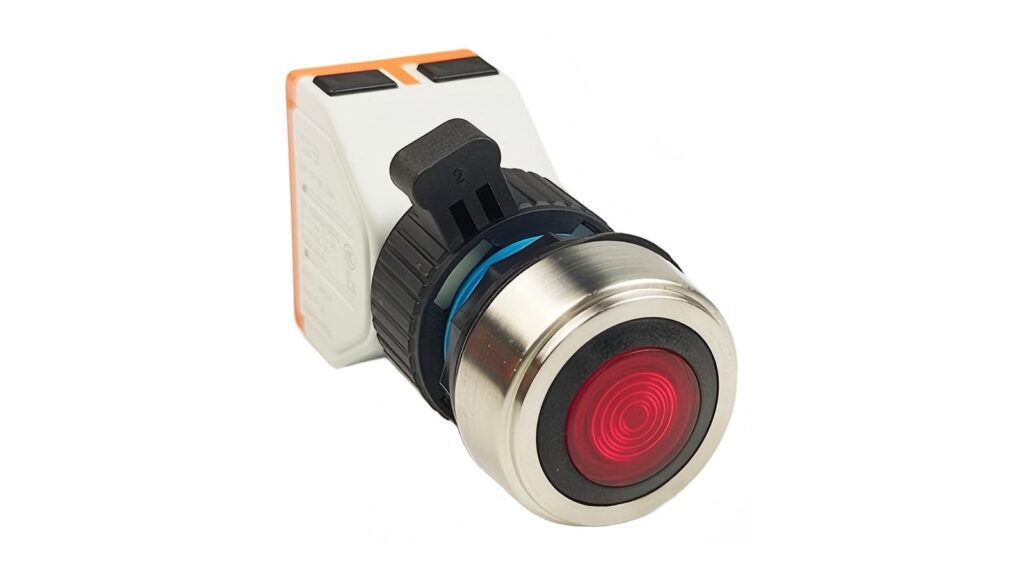
The featured photograph shows a real illuminated panel-mount control head from the MMAIATEX media library, not a verified photocell. It is used transparently to demonstrate why a lens, illuminated face or similar front profile cannot establish a sensing function. The alt text and media caption identify what is actually visible. Selection must begin with the exact model identity and controlled documentation, never with visual resemblance.
1. Is every device called a photocell covered by IEC 60947-5-2?
No. Photocell can describe different light-responsive products. IEC 60947-5-2:2019 includes photoelectric proximity switches that sense object presence. Confirm the function and exact standard in controlled documentation. Do not assume that a lighting control, solar cell or analytical instrument shares this scope.
2. Does IEC 60947-5-2 prove explosion protection?
No. IEC 60947-5-2 addresses the proximity-switch function within its scope. It is not by itself an explosion-protection certificate. Hazardous-area use requires separate evidence for the exact product, including complete Ex marking, a current certificate where the applicable route requires one, schedules, conditions and instructions. A general-function test report cannot replace this evidence.
3. Which sensing data should the buyer request?
Request the sensing principle, range, operating distance, target, background, alignment limits and response characteristics. Define the installation geometry and expected target-present and target-absent states. Do not transfer values from a neighbouring model, distributor page or visually similar sensor.
4. Which electrical and output details must match?
Verify supply, switching output, load, connection, response and diagnostic data for the exact model. Determine whether the output is binary or transmits an analogue or digital value. IEC 60947-5-7:2024 covers specified proximity devices with such outputs, but it does not apply automatically.
5. Does ordinary sensing performance establish a safety function?
No. For a safety-related control function, the designer must identify required fault behaviour and functional-safety evidence. IEC 60947-5-3:2026 adds requirements for proximity devices with defined behaviour under fault conditions within its scope. An ordinary switching claim does not establish that performance.
6. Does IEC 60079-28 apply to every photocell?
No. IEC 60079-28:2025 addresses Ex Equipment, associated equipment or Ex Components containing optical systems that emit optical radiation and are exposed to explosive atmospheres. Its public scope identifies laser equipment, optical-fibre equipment and optical systems that create convergent beams with focal points in the hazardous area. A light-based sensing function alone does not prove that Part 28 applies. Review the exact optical design and certified standard set.
7. Which explosion-protection standard should a buyer use?
Use the standards identified for the exact product by its complete marking, certificate, schedule and controlled instructions. IEC 60079-0 supplies general requirements, while a particular protection concept needs its applicable supplementary standard. Do not assign flameproof enclosure, increased safety, intrinsic safety, optical-radiation protection or another concept from the word photocell, its housing shape or its catalogue category.
8. Which Ex marking details must be checked?
Match the legal manufacturer, full model and suffix, protection concept, equipment group, EPL or category, gas or dust group, temperature information, ambient range and certificate suffix. Read them as one identity. The guide to reading Ex markings can organise the review but cannot validate an application.
9. Why must the exact certificate and schedule match the offer?
A certificate family can contain several variants, options and limitations. Compare the product, nameplate and instructions with the current public certificate record where one exists. Resolve mismatches before purchase. The certificate and document verification guide explains why a number without its scope is incomplete evidence.
10. What installation and environmental details should be controlled?
Confirm mounting, alignment, target path, wiring, cable entries, associated equipment, ambient range, vibration, contamination and moisture. Use controlled instructions for inspection, function testing and maintenance. Compare site conditions with both functional and Ex documentation.
11. Can a photograph, IP rating or product-page title prove suitability?
No. A photograph and the CH8000-BG7 photocell product page can identify an item for further enquiry, but they do not establish IEC 60947-5-2 coverage, sensing performance, Ex protection, certification or site suitability. An IP rating addresses ingress protection within its stated test basis. The IP66 versus explosion-proof guide explains why ingress protection is not Ex certification.
12. Who is responsible for final selection and installation?
Responsible designers, hazardous-area engineers and installers must validate the application under applicable law, standards, certificates and instructions. They must resolve sensing geometry, output, control logic, protection concept, associated equipment, wiring and site conditions. A supplier article cannot perform area classification, certify the product or authorise installation.
Current MMAIATEX certification status
The public MMAIATEX About page states that ATEX, IECEx and CCC certification work is in progress. MMAIATEX Explosion-proof Technology (Zhejiang) Co., Ltd. does not present this FAQ, the linked product page, a photograph, an IP rating, a standard reference or a category name as proof that an identified photocell has completed a certification process. Verify the exact model, marking, current certificate status and scope, schedules, controlled instructions, destination requirements and site conditions before selection.
Safety and legal disclaimer
This FAQ provides general technical and procurement education. It is not product certification, conformity assessment, hazardous-area classification, optical-safety analysis, functional-safety validation, control-system design, installation authorisation or site approval. The exact controlled product documents, current standards, applicable law and actual installation conditions govern. Qualified professionals must approve the final selection and installation.
Official sources
- IEC 60947-5-2:2019, Edition 4.0
- IEC 60079-0:2026, Edition 8.0
- IEC 60079-28:2025, Edition 3.0
- IEC 60947-5-7:2024, Edition 2.0
- IEC 60947-5-3:2026, Edition 3.0
- IEC 60079:2026 Series current-content page
Contact MMAIATEX about a photocell enquiry
Send the exact model and suffix, intended target, sensing distance, output and connection data, complete marking, available certificate and schedule, controlled instructions, installation geometry, ambient conditions and destination market. MMAIATEX can organise its available product information for review by the responsible project parties.