
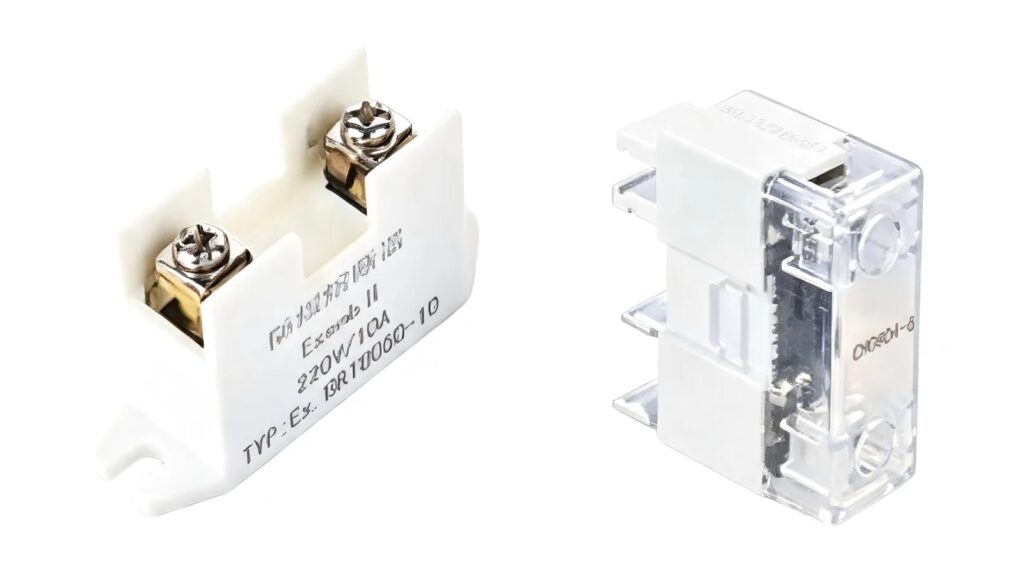
Fuse evidence belongs in two connected files
| Evidence layer | Main question | What does not answer it |
|---|---|---|
| Electrical protection | Can the exact fuse system interrupt the specified fault and protect the intended circuit under its documented conditions? | Physical size or rated current alone |
| Hazardous-area conformity | Is the complete exact-model assembly covered for the required atmosphere, EPL, group, temperature and ambient conditions? | Fuse performance or an IP code alone |
| Installation | Does the installed configuration preserve electrical protection and the applicable type of protection? | A certificate copied from a different model or configuration |
IEC 60269-1:2024 supplies general requirements within its stated scope. IEC 60269-2:2013+AMD1:2016+AMD2:2024 CSV supplies supplementary requirements for specified industrial fuse systems used by authorized persons. Neither publication is an Ex certificate.
1. What is an explosion-proof fuse module?
An explosion-proof fuse module is a market description for a fuse assembly intended to be incorporated into hazardous-area equipment. The phrase does not identify the formal fuse system, utilization category, rating, type of protection, EPL or certificate scope. Start the enquiry with the circuit protection duty, then verify the complete Ex assembly.
2. Are the fuse-link, fuse-holder and fuse module the same item?
No. The fuse-link is the replaceable part that operates when its defined current and time conditions are reached. The holder or base provides the intended electrical and mechanical interface. The module may include the holder, terminals, protective enclosure, indication and other parts. Approval of one part does not automatically approve the combined assembly. Request the exact part numbers and the documented permitted combinations.
3. Which IEC 60269 fuse system applies?
The answer depends on the exact construction and intended users. IEC 60269-2 covers standardized industrial systems A to K for use by authorized persons. A similar-looking cylindrical part may instead fall under another standard or product family. Ask the manufacturer to identify the applicable IEC 60269 part, fuse system and dimensional interface. Do not select the governing standard from a photograph.
4. Why must the fuse class or utilization category be stated?
The class or utilization category describes the protective duty and operating range for which the fuse-link is designed. Different categories can have different time-current behavior and protection purposes even when their dimensions and current markings appear similar. State the load and protection objective, then request the exact category, curve and manufacturer data. Do not substitute examples such as general-purpose or motor-circuit fuses without an engineering review of the real circuit.
5. Which voltage and AC or DC details are required?
State the system voltage, AC or DC, frequency where applicable and all normal and abnormal operating conditions. IEC 60269-1:2024 publicly states a scope for relevant enclosed current-limiting fuse-links in power-frequency AC circuits up to 1,000 V or DC circuits up to 1,500 V. Those scope limits are not ratings for every product. The offered fuse-link, holder and assembly must each be documented for the actual voltage and current type.
6. How should rated current be selected?
Rated current is only one input. Selection must consider the load profile, conductor protection, starting or inrush current, permissible operating temperature, enclosure temperature, ventilation, adjacent heat sources, duty cycle and any documented derating. A higher current can defeat protection, while an unsuitable lower current can operate during acceptable service. Use the manufacturer's time-current and thermal information for the exact fuse system and installed configuration.
7. What breaking capacity must the fuse provide?
The fuse's documented breaking capacity must be suitable for the prospective short-circuit current at its installation point and for the relevant voltage and current type. IEC 60269-1:2024 applies within its scope to enclosed current-limiting fuse-links having rated breaking capacities of at least 6 kA. That threshold is a standard-scope statement, not a universal project value. Obtain the project fault calculation and compare it with the exact product evidence.
8. What coordination information belongs in the enquiry?
Provide upstream and downstream protective devices, load type, conductor data, expected inrush, required selectivity and any back-up protection arrangement. Request time-current curves, let-through or energy data where applicable, and the manufacturer's documented coordination conditions. Coordination is a system result. It cannot be inferred from two current ratings or transferred from a different voltage, fuse class, device family or enclosure temperature.
9. Can a same-size replacement fuse-link be installed?
Not automatically. Matching length, diameter or end contacts does not prove the same class, voltage, current, breaking capacity, curve, power dissipation or permitted holder combination. In hazardous-area equipment, a substitution can also affect temperature, clearances and the certified construction. Use the exact replacement identified in controlled documentation, or obtain formal engineering and conformity review before a change.
10. Which Ex details must match the site?
Provide the gas or dust classification, Zone or other applicable system, required EPL or category, group, temperature class or maximum surface temperature, ambient range and environmental conditions. Compare them with the complete marking and current certificate schedule for the exact assembly. The Ex marking guide explains the marking chain, while IP66 vs explosion proof explains why ingress protection is separate from explosion protection.
11. Why must the complete module and enclosure be reviewed?
Terminals, fuse carriers, covers, seals, internal spacing, heat dissipation, conductors, entries, stopping plugs and operating access interact. A fuse element with suitable electrical performance does not establish Ex conformity of those parts together. Confirm that every item and option belongs to the assessed construction. Never drill, exchange a holder, add an indicator or alter wiring based only on mechanical fit. The enclosure modification FAQ explains the wider change-control risk.
12. Which documents and site checks are required before approval?
Request the legal manufacturer, exact model and suffix, fuse-link and holder part numbers, applicable standard and system, class, voltage, current, breaking capacity, coordination evidence, complete Ex marking, current certificate or declaration, schedules, drawings, wiring diagram, instructions and replacement list. Use the certificate and document verification guide to compare identity and issue. A competent party must then verify installation, conductor termination, bonding, entries and initial inspection before energization.
RFQ checklist for a fuse-module review
- Define the protected circuit, load, conductor and fault level.
- State AC or DC voltage, frequency, current, inrush and environmental conditions.
- Request the exact fuse standard, system, class and permitted holder combination.
- Compare breaking capacity and coordination evidence with the project calculation.
- State the hazardous-area classification, required EPL, group, temperature and ambient range.
- Request complete exact-model Ex evidence, schedules, drawings and instructions.
- Freeze the approved replacement fuse-link and accessory list.
- Require competent installation and initial inspection under the project rules. The IEC 60079-14:2024 buyer checklist provides useful installation-input context.
Current MMAIATEX certification status
The public MMAIATEX About page states that ATEX, IECEx and CCC certification work is in progress. MMAIATEX Explosion-proof Technology (Zhejiang) Co., Ltd. does not present this FAQ, a fuse image, a category name, IEC 60269 performance or an IP rating as proof that a particular fuse module or assembly is certified.
Verify the exact manufacturer, model and suffix, complete marking, current certificate status and scope, schedules, fuse performance, permitted parts, instructions and installation conditions before selection or use.
Safety and legal disclaimer
This FAQ provides general procurement education. It does not calculate fault current, select a fuse, design circuit protection, classify a hazardous area, interpret a certificate, authorize substitution or approve equipment. Opening a fuse does not prove that all hazardous energy is isolated. Competent parties must apply current standards, exact manufacturer instructions, licensed project documents, safe-isolation procedures and applicable law.
Request an exact-model evidence review
Send the circuit voltage, current, load, fault level, required protection duty, hazardous-area classification, destination market and document list. MMAIATEX can identify available exact-model information for review by the responsible engineering, EHS and compliance teams.