
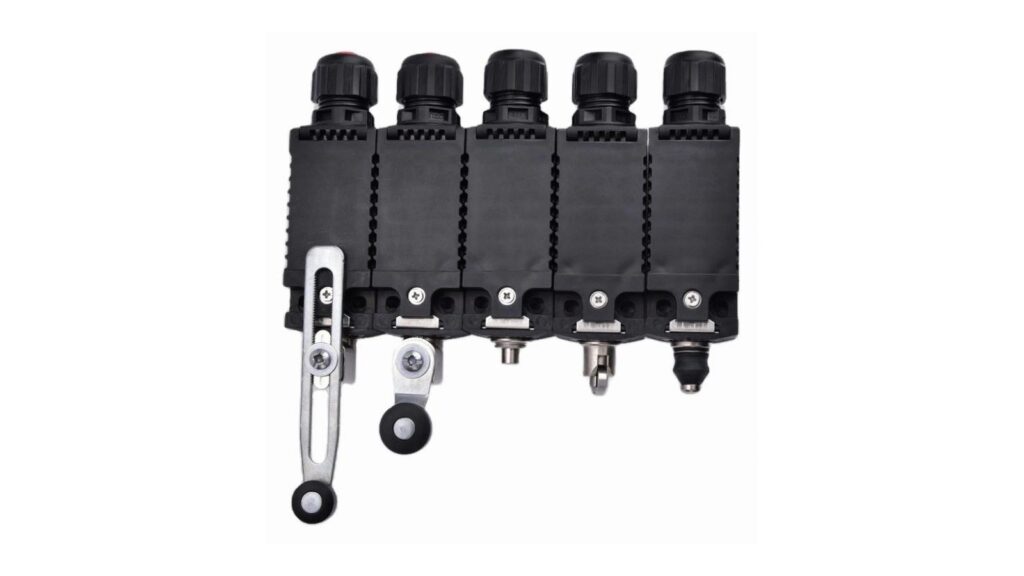
How to specify explosion-proof limit switches
A limit switch is an electromechanical control-circuit device operated by the position or movement of a machine part. It can provide position confirmation, travel-limit information or an interlock signal. The switching function does not establish hazardous-area suitability, and Ex protection does not prove that the actuator geometry or contacts suit the machine.
IEC 60947-5-1:2024 covers electromechanical control-circuit devices and switching elements used for control, signalling and interlocking. The IEC 60079 series addresses explosive-atmosphere protection. A complete selection therefore needs evidence from both layers as applicable.
Before requesting a quote, provide:
- approved Zone or Division, required EPL or category, gas or dust group and temperature requirement;
- minimum and maximum ambient temperature;
- actuator type, direction of approach, operating travel, overtravel and mounting constraints;
- required contact arrangement, control voltage, current, load type and utilization duty;
- cable type, entry thread, gland or conduit system and earthing requirements;
- enclosure material, ingress and environmental conditions;
- exact required certificate, listing, declaration, instructions and inspection records; and
- destination country, authority, owner specification and applicable installation code.
The public CH1250-8 position switch and CH1250-9 position switch pages are catalog starting points, not selection or certification evidence. Confirm the exact current model, actuator, contacts, marking, scope and documentation before specifying either product.
1. What is an explosion-proof limit switch?
It is a position-operated switching device whose exact assembly has been assessed for a defined hazardous-area protection method and scope. The term can be used loosely in catalogs, so the controlled evidence matters more than the label. Verify the full marking, certificate or listing, model code, actuator and instructions. A standard industrial limit switch inside an unverified cover is not automatically an explosion-protected assembly.
2. Which Zone or EPL should I specify?
Use the approved area-classification and engineering documents. For an IEC-based gas project, the required Zone, EPL, gas group, temperature class and ambient range form one selection set. Do not choose Zone 1 only because it is common in a supplier catalog. The EPL guide explains Ga, Gb and Gc, while the responsible project team determines the required level.
3. Is Class I Division 1 the same as Zone 1?
No. Both can involve gas or vapor during normal operation, but the systems divide risk into different classification structures. The Zone system separates continuous or long-duration presence into Zone 0, while the Division system uses Division 1 and Division 2. Read the Class I Division 1 versus Zone 1 guide and verify the exact US approval or international certification route required for the project.
4. Does a gas marking also cover combustible dust?
Not unless the exact marking and certificate scope include the required dust protection. Gas groups and dust groups are different, and a product assessed only for a gas atmosphere must not be assumed suitable for combustible dust. Obtain the complete marking, the official certificate schedule and the dust-area classification. The Zone 20, Zone 21 and Zone 22 guide explains the dust-zone structure.
5. Which actuator style should I choose?
Choose from the actual machine motion, approach direction, available travel, return behavior and mechanical environment. Roller levers, plungers and other actuator forms respond differently to direction and movement. Provide a drawing or clear motion description and verify the permitted actuator options in the exact product documentation. Do not select only by a front-view photograph or assume that two actuator heads are interchangeable.
6. Why do operating travel and overtravel matter?
The mechanism must change state reliably without being struck beyond its permitted movement or left in an uncertain position. Record the operating point, total travel, overtravel, approach angle, speed and repeatability required by the application, then compare them with current manufacturer data. Mechanical stops, guards and mounting tolerances belong to the machine design. The switch should not be used as the machine's physical end stop unless the approved design explicitly provides for that duty.
7. Which contact arrangement and electrical duty should I request?
State the required normally open and normally closed contacts, control voltage, current, AC or DC duty, load type, switching frequency and required isolation behavior. IEC 60947-5-1 applies to control-circuit devices, but the exact product ratings and utilization categories must come from its current documentation. A contact rating for one duty cannot be transferred to another load solely because the voltage number looks similar.
8. Can the limit switch directly control a motor or high-current load?
Only when the exact contact ratings, utilization duty, control design and product instructions permit it. Many position switches are used as control inputs to a relay, contactor, safety controller or other interface rather than as the main load-switching device. The responsible electrical designer must verify fault protection, isolation, contact life and the complete control architecture. Never infer main-circuit capacity from enclosure size.
9. What temperature information must be checked?
Compare the site's minimum and maximum ambient temperature with the exact marked and certified range. Then verify the applicable gas temperature class or dust maximum surface temperature, plus any load or installation conditions. Ambient range and temperature class answer different questions. The temperature class and ambient temperature guide explains why both must appear in the approval record.
10. Are IP rating and cable entries part of the Ex review?
Yes, but an IP rating is not Ex certification. Verify the required ingress protection, entry thread, cable diameter, gland or conduit system, stopping plugs, seals, earthing and permitted assembly arrangement. Use only entry devices and installation methods allowed by the exact certificate and instructions. Review IP66 versus explosion proof and the cable gland selection FAQ for the two separate evidence layers.
11. Can I replace the actuator, drill the housing or change an entry?
Do not make a change unless the exact product documentation and responsible approval route permit it. An actuator can be part of the certified model configuration, and machining or changing an entry can affect enclosure integrity, flame paths, ingress protection, temperature performance and the certificate schedule. The enclosure modification FAQ provides a conservative decision path for changes.
12. Which documents and inspection records should be approved?
Approve the current certificate or listing record, declaration where required, model schedule, complete marking, product data, actuator and contact information, installation instructions, approved entry details and maintenance guidance. Record the received model and nameplate at delivery. IEC 60079-14:2024 covers installation design, selection and initial inspection, while IEC 60079-17:2023 addresses inspection and maintenance of hazardous-area electrical installations.
Current MMAIATEX certification status
The public MMAIATEX About page states that ATEX, IECEx and CCC certification work is in progress. MMAIATEX Explosion-proof Technology (Zhejiang) Co., Ltd. does not present these answers, catalog pages or the representative image as proof that a particular limit-switch model is certified for a stated Zone, Division, EPL, gas group or dust group.
Request the current exact-model marking, certificate or listing, issue, scope, conditions, actuator and contact data, instructions and approved entry details. Verify them through the applicable official source before selection.
Safety and legal disclaimer
These answers provide general procurement guidance, not a machine-safety design, hazardous-area classification, certificate interpretation, legal opinion, control-system validation or installation approval. Competent persons must assess the process hazard, machine motion, electrical duty, failure behavior, installation, inspection and maintenance using current site and product evidence.
Request an exact limit-switch review
Send MMAIATEX the approved area classification, destination market, actuator and motion requirement, contact duty, ambient range, cable-entry system and required documents. The team can identify potentially relevant product information for the responsible engineer or buyer to assess.