
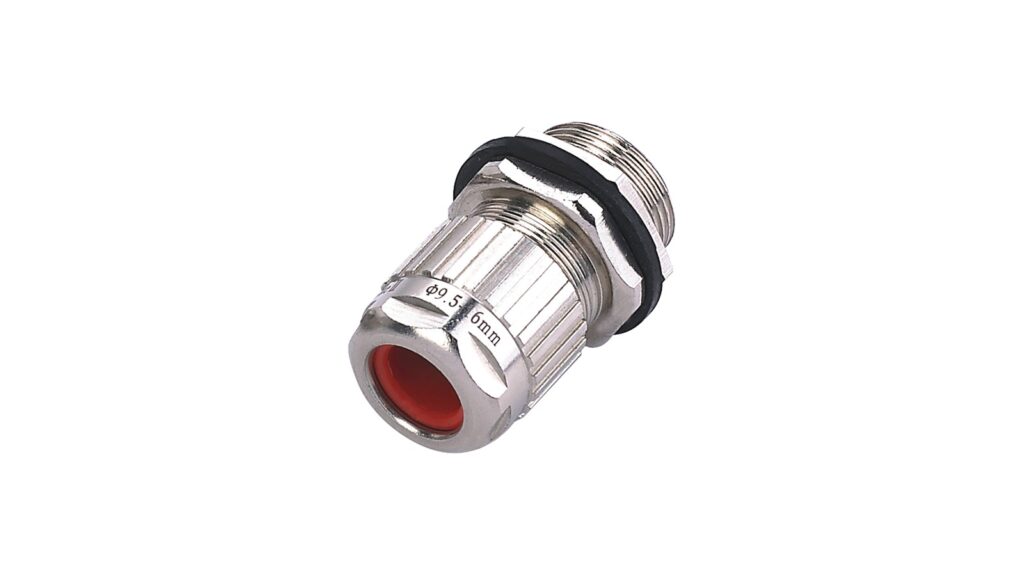
This guide excludes cable diameter, armour, barrier and material selection; use the cable gland buyer FAQ for those decisions.
What Ex cable entry thread compatibility actually requires
Thread compatibility is a chain of matching evidence. Start with the certified enclosure entry, then compare the proposed gland or accessory, and finally review the installed arrangement.
| Interface check | Evidence to compare | Why a nominal label is insufficient |
|---|---|---|
| Thread system and designation | Enclosure drawing, gland drawing, certificate schedule and instructions | Similar diameters can belong to different thread systems |
| Nominal size and pitch | Controlled dimensions and manufacturer data | A part can start to turn even when pitch is wrong |
| Form, fit and tolerance | Applicable drawing and certified construction | Clearance or interference can differ despite a similar name |
| Usable thread length and engagement | Entry depth, gland thread length, chamfer, undercut and accessory stack | The visible thread length is not always the usable engagement |
| Permitted quantity and location | Certified enclosure drawing and schedule | A suitable thread type may still be outside the assessed entry pattern |
| Sealing and retention arrangement | Both sets of instructions and exact accessory documents | A washer, O-ring or seal cannot correct a mismatched thread |
IECEx OD 017 Edition 7 provides unusually clear public support for this evidence approach. For Ex d documentation, it identifies threaded joints and entries by range of sizes, maximum number, pitch, class of fit and thread length, with chamfers and undercuts taken into account. It also requires the allowed area for cable entries and other fittings to be shown. For Ex t documentation, it calls for drawings showing enclosure holes, threaded entries and thread length.
A six-step document matching workflow
1. Identify the exact enclosure entry
Record the enclosure model, certificate issue, schedule, Ex marking and instructions. Find the controlled entry designation and confirm the permitted location, range, quantity and accessory arrangement. Do not assume every machined opening is interchangeable.
2. Identify the exact gland thread
Use the gland's current drawing, marking, certificate and instructions. Record the full thread designation and suffixes. Cable sealing range is separate, so a gland can fit the cable but not the enclosure entry. IEC 62444:2010 covers complete cable glands and IEC 60423 metric entry threads, but compliance with it alone does not prove Ex suitability.
3. Compare more than nominal size
Compare thread system, form, nominal size, pitch, fit or tolerance and usable lengths. If any field is ambiguous, stop and obtain controlled information. Measuring tools support inspection but do not establish certificate scope.
4. Check engagement in the real stack
Usable engagement is affected by entry depth, gland shoulder, chamfer, undercut and the accessory stack. Do not use total visible thread length or a universal number of turns. The protection concept, certificate and construction control acceptance.
5. Treat adapters and reducers as certified interfaces
An adapter or reducer creates two interfaces. Both sides must match, and the exact accessory must be permitted for the protection concept. A generic plumbing fitting is not an Ex accessory. Do not approve stacked parts merely because each thread appears to fit.
6. Verify the installed result without changing the design
IEC 60079-14:2024 addresses installation and initial inspection. Confirm the identified parts, locations and instructions. Do not force, tape, re-tap, machine or add unapproved sealant to correct a mismatch. Stop and assess any proposed alteration before work.
Common shortcuts that do not prove compatibility
| Shortcut | Safe interpretation |
|---|---|
Both are the same nominal size |
Confirm the complete thread designation, pitch, form and tolerance |
It turns by hand |
A trial fit can still be partial, crossed or based on incompatible profiles |
The gland is IEC 62444 compliant |
That standard covers cable-gland construction and performance, not Ex certification by itself |
The assembly reaches an IP target |
Environmental ingress protection does not prove the explosion-protection interface |
An adapter connects them |
Verify both interfaces and the adapter's exact certified scope and permitted arrangement |
The photograph looks identical |
A photograph cannot establish thread dimensions, issue status or certificate coverage |
Use the IP66 versus explosion-proof guide to separate ingress protection from Ex protection. Check the enclosure modification FAQ before any proposed machining, and use the IECEx and ATEX document verification guide to confirm certificate identity, issue and scope.
Protection concept and edition boundaries
The interface must be reviewed within the actual protection concept. IEC 60079-1 addresses flameproof enclosure Ex d construction and testing. IEC 60079-31:2022 addresses dust ignition protection by enclosure Ex t and specifically added requirements for entry devices. IEC 60079-0:2026 supplies current general requirements for Ex Equipment and Ex Components. IEC 60079-14:2024 addresses installation design, selection, installation and initial inspection.
As of this review date, the IEC 60079:2026 Series page still lists IEC 60079-1:2014 as the published Part 1 while IEC 60079-1:2026 remains a pre-release item through September 4, 2026. Never infer the controlling edition from today's catalogue alone. The exact equipment certificate, local adoption and project specification determine which edition applies.
The IEC SC 31J background paper distinguishes the cable-to-gland seal, paths through a cable and the gland-to-enclosure thread. It is explanatory background, not a replacement for standards or product documents.
Pre-order interface record
Before approving the entry hardware, record:
- Exact enclosure type, certificate issue, schedule and entry drawing
- Approved entry location, range and maximum quantity
- Complete female thread designation and controlled dimensions
- Exact gland or accessory type and complete male thread designation
- Pitch, fit or tolerance and usable engagement evidence
- Every adapter, reducer, washer, O-ring, locknut or closing element
- Protection concept, group, EPL or category, ambient range and environmental requirement
- Current instructions for each connected item
- Competent design and installation acceptance required by the project
Current MMAIATEX certification status
The public MMAIATEX About page states that ATEX, IECEx and CCC certification work is in progress. MMAIATEX Explosion-proof Technology (Zhejiang) Co., Ltd. does not present this guide, a product-category name, an IP rating or a representative photograph as evidence that a particular gland, enclosure or assembled entry has completed certification. Buyers must request current exact-model documents and independently verify their status and scope.
Safety and legal disclaimer
This article provides general technical information, not installation instructions, conformity assessment or legal advice. Ex cable entry selection, installation, inspection and any proposed alteration must be completed or approved by competent persons using the full current standards, local rules, exact certificates, schedules, drawings and manufacturer instructions. Never work on energized equipment or open an enclosure where an explosive atmosphere may be present.
Request a cable entry document check
For a document review before ordering, send the destination country, enclosure marking and certificate, controlled entry designation, cable data, proposed gland or accessory reference and required approval route. Request current exact-model evidence before adding the combination to a specification.