
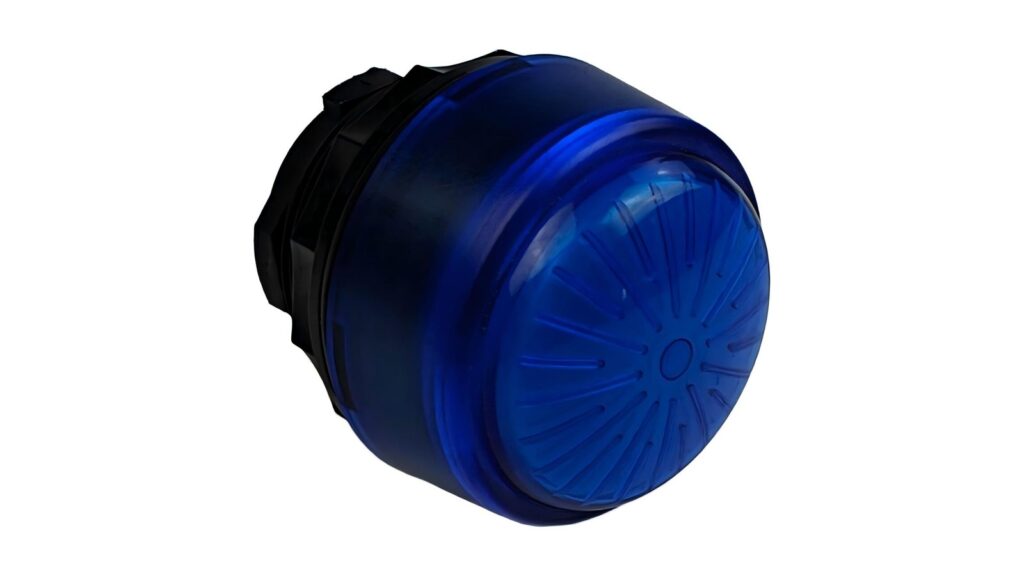
How to select an explosion-proof signal lamp
Prepare these inputs before comparing products:
- destination country and required certification or approval route;
- Zone or Division, gas or dust group, EPL or category and temperature requirements;
- the process state the lamp must communicate and the site's colour convention;
- supply voltage, AC or DC, frequency where relevant and circuit supervision needs;
- panel or enclosure material, mounting hole, wall thickness and available depth;
- ambient temperature, sunlight, washdown, corrosion, vibration and impact exposure;
- cable entry, terminal, earthing and enclosure protection concept; and
- certificate, drawing, data sheet, instructions and inspection records required at handover.
The existing MMAIATEX control-station FAQ can help when the lamp is one part of a complete operator assembly. Use the Ex marking guide to organize the nameplate review.
1. What is an explosion-proof signal lamp?
It is an indicator intended to communicate a machine or process condition while installed in equipment selected for a hazardous area. Depending on the certified design, the protection may belong to the indicator itself, the enclosure assembly or a combination of components and installation conditions. The phrase explosion-proof signal lamp is a buyer search term, not a complete approval description. The exact marking and certificate decide the recognized protection concept.
2. Which Zone, Division or EPL should I specify?
Use the facility's approved area-classification document. State the applicable system rather than converting Zone and Division terms by name. For an IEC-based project, include gas or dust classification, required EPL, group, temperature information and ambient range. For a North American project, provide the Class, Division or Zone, group and the certification route required by the authority. The Division versus Zone guide explains why the systems are not interchangeable.
3. Does the lens colour prove what the signal means?
No. Lens colour helps users interpret an indication, but the assigned meaning comes from the machine, process and site design. IEC 60073:2002 establishes general coding principles for indicators and actuators. Buyers should document the intended state, colour, label and any audible or text confirmation. A blue, green, amber, red or clear lens does not prove an Ex rating, voltage or safe operating condition.
4. How do I choose the voltage and circuit type?
Specify the actual control supply, including nominal voltage, AC or DC, frequency where relevant, allowable tolerance, circuit current, duty and any monitoring or test function. Confirm whether the light source, resistor, driver or transformer is integral to the exact model. IEC 60947-5-1:2024 applies to control circuit devices and associated equipment used for signalling, but ordinary control-device compliance alone does not establish hazardous-area certification.
5. Does the lamp need its own Ex certificate?
That depends on how it is assessed and installed. It may be certified equipment, an Ex Component with a U suffix that needs further assessment, or a component covered only within a certified enclosure or control-station assembly. Ask for the exact certificate and schedule that cover the offered configuration. The guide to IECEx X and U suffixes explains why a component certificate is not permission to use an item alone.
6. How do Ex db and Ex eb change the selection?
They are different protection concepts with different construction and installation controls. An Ex db arrangement may depend on flameproof enclosure details and certified entries. An Ex eb arrangement controls ignition risks through increased-safety measures and approved components within its scope. Do not move an operator head, lamp module or terminal arrangement from one assembly to another based only on panel-cutout fit. Review the Ex db versus Ex eb guide for the concept boundary.
7. Which ambient and temperature details matter?
Provide the minimum and maximum ambient temperature at the installed location, including solar heating, nearby process heat and enclosure temperature rise. Check the exact product's marked ambient range and temperature information under its assessed configuration. Do not infer a T-class from LED efficiency or low touch temperature. The temperature class and ambient guide explains why maximum surface temperature and ambient limits are separate checks.
8. Is an IP rating enough for hazardous-area use?
No. IEC 60529 classifies specified protection against access, solids and water. It does not certify an explosion-protection concept. The installed lamp assembly may need to preserve an enclosure's IP rating through its seals, mounting and entries, but that environmental check is separate from Ex conformity. Read the MMAIATEX guide on IP66 versus explosion proof before treating the two claims as equivalent.
9. How are panel cutout and mounting details checked?
Use the controlled outline drawing for the exact indicator and certified assembly. Confirm the cutout size and shape, panel thickness, anti-rotation feature, sealing arrangement, mounting torque, spacing, rear clearance and orientation. A lamp that fits the hole can still be outside the certificate scope or compromise the enclosure. Do not enlarge a certified panel opening or substitute a fixing method without the responsible manufacturer's documented approval.
10. What wiring and cable-entry information is needed?
Specify conductor type and size, terminal method, protective conductor requirements, cable entry thread, cable gland or conduit system, sealing and strain relief. Confirm how the indicator connects inside the enclosure and whether polarity matters. The installation must follow the exact instructions and certificate conditions. The cable gland selection FAQ helps organize entry data, but it cannot approve the complete signal-lamp assembly.
11. Can the lens or light module be replaced in service?
Only with a part and method allowed by the manufacturer and the controlled product documentation. Lens material, colour, gasket, light source, driver and retaining parts can affect indication, environmental protection, temperature and certification. Isolate the equipment and follow the site's competent-person procedure. If the approved part is unavailable or identity is uncertain, stop and obtain a product-specific decision instead of fitting a visually similar module.
12. What should be checked before energizing?
Verify the exact model, marking, certificate status, lens function, supply rating, mounting, seals, terminals, conductor security, entries, earthing, enclosure closure and applicable specific conditions. Confirm that the indicator shows the intended state and that its colour and label match the site logic. Preserve inspection results and document revisions. Do not energize equipment with an unresolved identity, damaged lens, loose mounting, open entry or uncertain certificate scope.
Current MMAIATEX certification status
The public MMAIATEX About page states that ATEX, IECEx and CCC certification work is in progress. MMAIATEX Explosion-proof Technology (Zhejiang) Co., Ltd. does not present this FAQ, a coloured lens, an IP rating, a product category or a representative photograph as evidence that a particular signal lamp or panel assembly has completed certification.
Buyers should obtain current exact-model evidence and verify the certificate holder, issue, online status, covered configuration, marking, standards, conditions, mounting details and instructions through the applicable official source.
Safety and legal disclaimer
This FAQ is general educational information. Signal-lamp selection, panel modification, wiring and maintenance can affect electrical safety, process communication, ingress protection and explosion protection. Work must be performed by competent parties under the applicable site, manufacturer, certificate, standard and regulatory requirements. Do not install or energize an indicator when its function, rating, assembly evidence or protection status is unresolved.
Request an exact signal-lamp review
Send the destination market, approved area classification, required indication and lens colour, supply details, panel drawing, environment, cable entry and document list. MMAIATEX can identify available product information for assessment by the responsible buyer and panel designer.
Primary sources
- IEC 60947-5-1:2024 control circuit devices and signalling equipment
- IEC 60073:2002 coding principles for indicators and actuators
- IEC 60079-0:2026 general requirements
- IEC 60079-1:2014 flameproof enclosures
- IEC 60079-7:2015 increased safety
- IEC 60079-14:2024 installation design and initial inspection
- IEC 60529 consolidated IP Code